
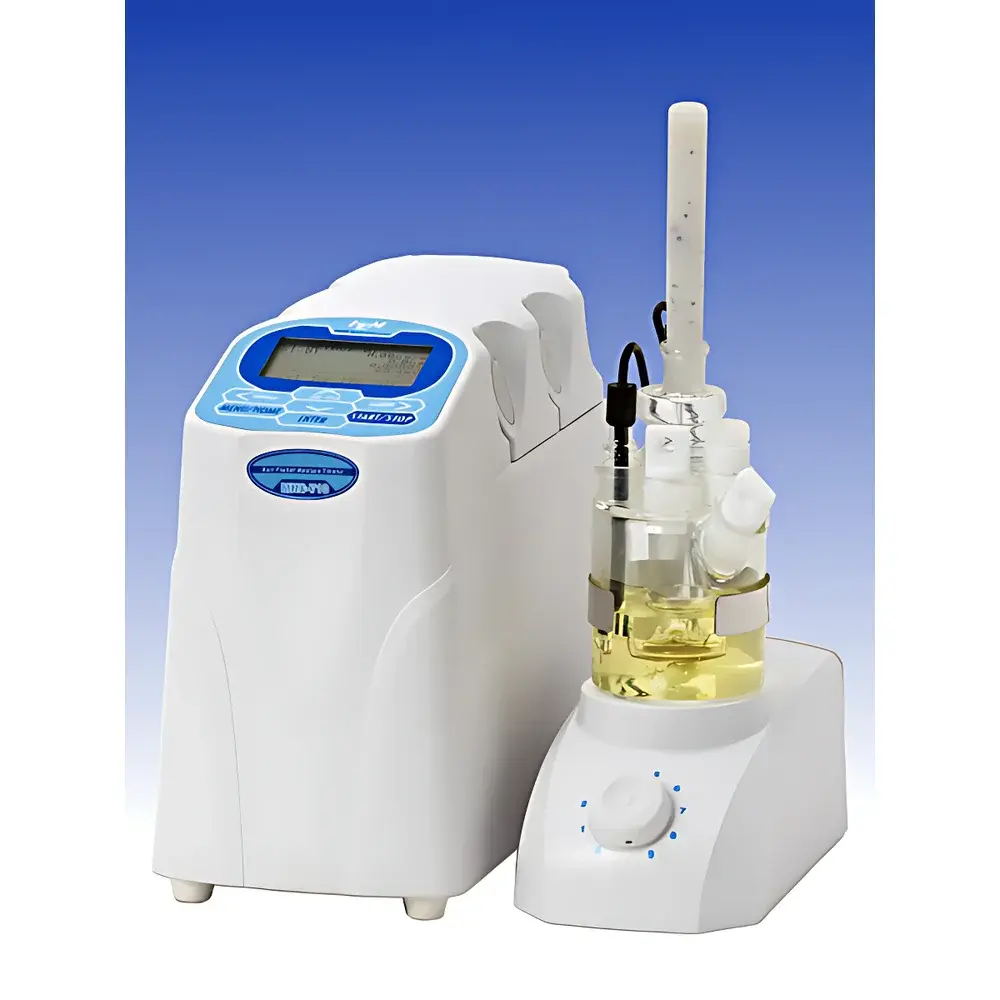
KEM JFH21 Karl Fischer Coulometric Moisture Analyzer
| Origin | Japan |
|---|---|
| Instrument Type | Coulometric Karl Fischer Moisture Analyzer |
| Titration Method | Coulometric (Electrolytic) KF Titration |
| Endpoint Detection | Constant-Current Polarity Detection |
| Maximum Electrolysis Current | 400 mA |
| Maximum Titration Rate | 2.1 mg H₂O/min |
| Background Correction | Automatic Drift Compensation (µg/s) |
| Measurement Range | 10 µg – 100 mg H₂O |
| Repeatability | ±5 µg (for 10–1000 µg), RSD ≤ 0.5% (≥1 mg H₂O) |
| Sensitivity | 0.1 µg H₂O |
| Display | 2-line × 20-character LCD |
| Environmental Operating Conditions | 5–40 °C, ≤80% RH (non-condensing) |
| Power Supply | AC 230–240 V, 50/60 Hz, 30 VA |
| Dimensions (W×D×H) | 280 × 180 × 200 mm |
| Net Weight | 4.5 kg (main unit), 6.3 kg (unit + power supply) |
| Interface Options | RS-232 for printer, PC, or analytical balance |
| Calculation Modes | %, ppm, mg/g (M/W), auto-unit switching (>1000 ppm → %) |
| Delayed Titration | Programmable start time |
| End Signal | On-screen message + audible alert |
Overview
The KEM JFH21 Karl Fischer Coulometric Moisture Analyzer is a precision benchtop instrument engineered for trace-level water quantification in low-moisture samples—particularly those containing less than 1% (10,000 ppm) water by mass. Unlike volumetric KF systems, the JFH21 employs coulometric titration: water is consumed electrochemically at the anode via iodine generation from iodide ions, with stoichiometric equivalence governed by Faraday’s law (1 mole I₂ ≡ 1 mole H₂O). This principle enables direct, absolute measurement of water mass without reliance on standardized titrant concentration—eliminating calibration drift and delivering inherent accuracy for microgram-level determinations. Designed for laboratories requiring high reproducibility in pharmaceutical excipients, lithium battery electrolytes, polymer resins, solvents, and electronic-grade chemicals, the JFH21 operates within a validated measurement span of 10 µg to 100 mg H₂O per analysis, with sensitivity down to 0.1 µg and repeatability meeting ISO 8533 and ASTM E203 criteria for coulometric KF methods.
Key Features
- Coulometric electrolysis cell with pulse-controlled current delivery, supporting stable 400 mA maximum current for rapid, controlled iodine generation.
- Constant-current polarity endpoint detection ensures unambiguous termination, minimizing over-titration risk in volatile or reactive matrices.
- Real-time background drift compensation (reported in µg/s) automatically corrects for ambient moisture ingress and reagent aging—critical for long-duration analyses or low-water samples.
- Dual-line alphanumeric LCD display shows concurrent parameters: water content (ppm/%), titrant concentration (mg/mL), titration rate (µg/s), background drift, elapsed time, and system status—enabling immediate method verification.
- Programmable delayed titration allows pre-set initiation after sample introduction, accommodating equilibration in hygroscopic or viscous materials.
- Integrated calculation engine supports automatic unit conversion (ppm ↔ %) above 1000 ppm, mass-normalized reporting (mg H₂O/g sample), and customizable M/W (molar/weight) expressions per user-defined sample weight input.
Sample Compatibility & Compliance
The JFH21 accommodates a broad range of solid, liquid, and gaseous samples when paired with appropriate KF oven adapters or gas extraction modules (sold separately). It is routinely deployed for USP , EP 2.5.12, and JP 2.07-compliant moisture testing in GMP-regulated environments. While the base unit does not include 21 CFR Part 11 audit trail functionality, its RS-232 interface supports connection to compliant LIMS or ELN platforms for electronic record retention. All measurements adhere to ISO 760 (KF titration fundamentals) and ISO 15512 (plastics moisture determination), with repeatability data satisfying internal QC protocols for raw material release and stability-indicating assays.
Software & Data Management
The JFH21 operates as a standalone analyzer with embedded firmware—no proprietary PC software is required for routine operation. RS-232 serial output enables direct data logging to external devices: thermal printers (for GLP-compliant hardcopy reports), laboratory balances (auto-importing sample mass), or validated third-party data acquisition systems. Output includes timestamp, sample ID (user-entered), water mass (µg), calculated concentration (% or ppm), titration duration, and drift-corrected net result. For regulated environments, integration with 21 CFR Part 11-compliant software (e.g., LabWare LIMS or Thermo Fisher SampleManager) permits full electronic signature support, version-controlled method storage, and audit-ready export of raw titration curves and metadata.
Applications
- Pharmaceuticals: Quantification of residual moisture in lyophilized APIs, excipients (e.g., mannitol, lactose), and sterile packaging headspace.
- Electronics: Moisture assessment in Li-ion battery cathode/anode slurries, separator films, and electrolyte solvents where <10 ppm H₂O is critical for cell longevity.
- Chemicals: Purity verification of acetonitrile, THF, DMF, and other KF-compatible solvents used in synthesis and chromatography.
- Polymers: Determination of hydrolyzable water in PET, polyamide, and polycarbonate prior to extrusion or molding.
- Food & Cosmetics: Low-level water activity correlation studies in preservative-free formulations and anhydrous ointments.
FAQ
What is the difference between coulometric and volumetric Karl Fischer titration?
Coulometric KF (used in the JFH21) generates titrant electrochemically during analysis, offering superior precision for samples containing 1000 ppm).
Can the JFH21 analyze solid samples directly?
No—solid or viscous samples require dissolution in KF-compatible solvents (e.g., chloroform/methanol mixtures) or coupling with a KF oven (e.g., MKC-710 series) for thermally driven water extraction.
Is method validation support available for the JFH21?
Yes—KEM provides application notes aligned with ICH Q2(R2) guidelines, including specificity, linearity (10–1000 µg), accuracy (spike recovery), and robustness (reagent batch, temperature, electrode cleaning frequency).
Does the JFH21 meet GLP requirements?
As a standalone instrument, it supports GLP through manual recordkeeping and printed reports. Full GLP compliance requires integration with validated data management software enabling electronic signatures and audit trails.
What maintenance is required for consistent performance?
Daily: Electrode cleaning with dry tissue; weekly: Cell rinsing with methanol; quarterly: Replacement of molecular sieve drying tube and electrolyte solution (Hydranal-Coulomat AG).





