
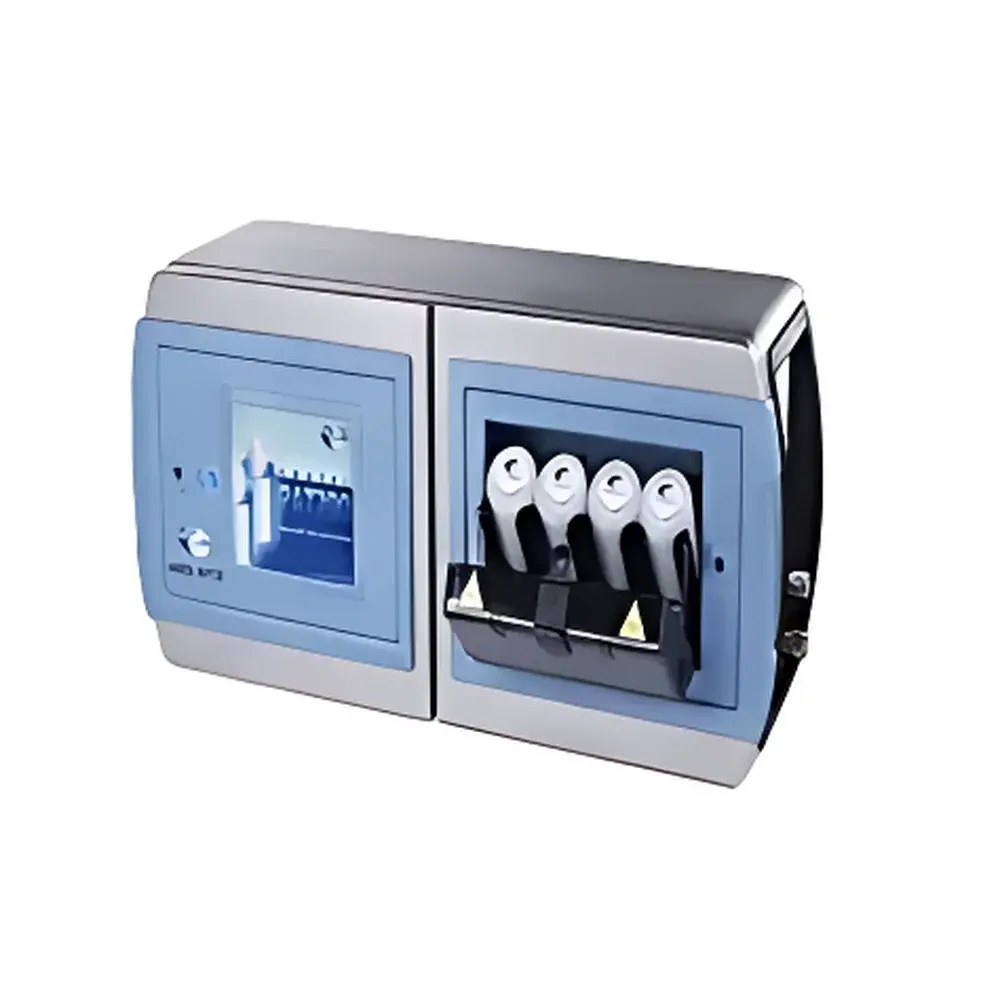
HACH Anatel PAT700 Online/Portable TOC Analyzer
| Brand | HACH |
|---|---|
| Origin | Imported |
| Manufacturer Status | Manufacturer |
| Model | Anatel PAT700 |
| Measurement Range | 0.5–2,000 ppb C TOC |
| Repeatability | ±0.3 ppb or ±1% (whichever is greater) |
| Accuracy | ±1 ppb or ±5% (whichever is greater) |
| TOC Resolution | 0.1 ppb |
| Conductivity/Resistivity Resolution | 0.01 µS/cm or MΩ·cm |
| Temperature Resolution | 0.1 °C |
| Conductivity Compensation | Temperature-compensated and non-temperature-compensated modes |
| Inlet Pressure | 10–100 psig (69–690 kPa) |
| Flow Rate | 60–300 mL/min |
| Analog Outputs | Three 4–20 mA |
| Digital I/O | Two digital inputs, four digital outputs |
| Communication Interfaces | RS232, USB, Ethernet, Serial printer port |
Overview
The HACH Anatel PAT700 Online/Portable TOC Analyzer is a purpose-engineered total organic carbon measurement system designed for continuous, real-time monitoring of purified water (PW) and water for injection (WFI) in pharmaceutical manufacturing environments. It employs high-intensity dual ultraviolet (UV) oxidation at 185 nm and 254 nm wavelengths, followed by highly sensitive conductivity detection—eliminating the need for catalysts or persulfate reagents. This UV-persulfate-free oxidation method ensures robust, low-maintenance operation while maintaining full compliance with pharmacopoeial requirements for oxidizable carbon quantification. The PAT700 operates on the principle that organic carbon compounds are photochemically oxidized to CO₂, which dissolves in water to form carbonic acid, resulting in a measurable increase in solution conductivity proportional to TOC concentration. Its architecture supports both permanent online installation and portable deployment for verification, commissioning, and troubleshooting—enabling seamless integration into process analytical technology (PAT) frameworks and supporting Quality-by-Design (QbD) initiatives.
Key Features
- Dual-wavelength UV oxidation (185 nm + 254 nm) for complete, catalyst-free oxidation of recalcitrant organics—including chloramines, alcohols, and low-molecular-weight acids—without chemical reagents or consumables.
- On-board Automated Standards Introduction System (OASISTM): Fully integrated, programmable standard delivery module enabling unattended calibration verification, system suitability testing, and performance qualification per USP and FDA guidance.
- Color touchscreen interface with intuitive navigation, multilingual support (English, German, Japanese, Chinese), and context-sensitive help—designed for GMP-compliant operation with audit-ready event logging.
- Real-time deviation detection: Monitors flow, pressure, temperature, and baseline conductivity trends to identify anomalies upstream in the water distribution system before TOC excursions occur.
- Modular I/O architecture: Three isolated 4–20 mA analog outputs (TOC, conductivity, temperature), two digital inputs (e.g., for sample valve control or alarm acknowledgment), and four relay outputs (for alarm staging, pump interlock, or data acquisition triggers).
- Rugged, IP65-rated enclosure suitable for cleanroom environments (Grade C/D) and utility corridors; operates continuously at ambient temperatures from 10–40 °C and relative humidity up to 80% non-condensing.
Sample Compatibility & Compliance
The PAT700 is validated for direct analysis of PW, WFI, and clean steam condensate per global regulatory expectations. It meets all technical and procedural requirements outlined in United States Pharmacopeia “Total Organic Carbon”, “Water for Pharmaceutical Purposes”, European Pharmacopoeia 2.2.44, and Japanese Pharmacopoeia XV . Its firmware and data handling architecture support ALCOA+ data integrity principles and are configurable for compliance with 21 CFR Part 11 (electronic records/signatures), Annex 11 (computerized systems), and EU GMP Annex 15 (qualification). All calibration, maintenance, and diagnostic events are time-stamped, user-attributed, and stored with immutable audit trails—facilitating inspection readiness during FDA, EMA, or PMDA audits.
Software & Data Management
The analyzer runs embedded firmware with secure, role-based access control (operator, supervisor, administrator). Data export is supported via USB mass storage, RS232 serial dump, or Ethernet TCP/IP to SCADA, DCS, or LIMS platforms using Modbus TCP or custom ASCII protocols. Optional Anatel Data Manager (ADM) software provides centralized configuration management, historical trending, automated report generation (PDF/CSV), and electronic signature workflows for SOP-driven validation documentation. All raw sensor data—including UV lamp intensity logs, oxidation chamber temperature profiles, and conductivity drift metrics—are retained onboard for ≥30 days and available for forensic review.
Applications
- Continuous TOC monitoring at PW/WFI loop return points to support parametric release strategies under ICH Q5C and Q9.
- Verification of sanitization efficacy (e.g., after ozone or steam-in-place cycles) by detecting residual organics post-treatment.
- Commissioning and periodic requalification of water purification systems per ASTM D1129 and ISO 22196.
- Root-cause investigation of microbial excursion events through correlation of TOC spikes with bioburden trends.
- Supporting change control assessments for filter replacement, resin regeneration, or piping modifications.
- Portable use for point-of-use (POU) testing, leak investigation, and cross-contamination studies across multi-facility networks.
FAQ
Does the PAT700 require routine reagent replacement or catalyst cartridges?
No. The dual-UV oxidation method eliminates the need for sodium persulfate, catalysts, or consumable oxidation modules—reducing operational cost and downtime.
Can the PAT700 be integrated into an existing MES or automation platform?
Yes. Native Modbus TCP and ASCII over Ethernet enable direct communication with Siemens PCS7, Rockwell FactoryTalk, Honeywell Experion, and most DCS/SCADA systems without middleware.
How is instrument performance verified between scheduled calibrations?
OASISTM performs automated system suitability tests (SST) using certified KHP standards at user-defined intervals—generating IQ/OQ-relevant reports traceable to NIST-certified reference materials.
Is the PAT700 compliant with current GMP Annex 1 requirements for water quality monitoring?
Yes. Its design, validation documentation package, and data integrity controls align with EMA Annex 1 (2022) Section 6.4 on continuous monitoring of critical quality attributes in water systems.
What is the minimum detectable TOC level under typical PW operating conditions?
The specified lower detection limit is 0.5 ppb C TOC at 95% confidence, with demonstrated stability and reproducibility across >1,000 hours of continuous operation in validated PW loops.







