
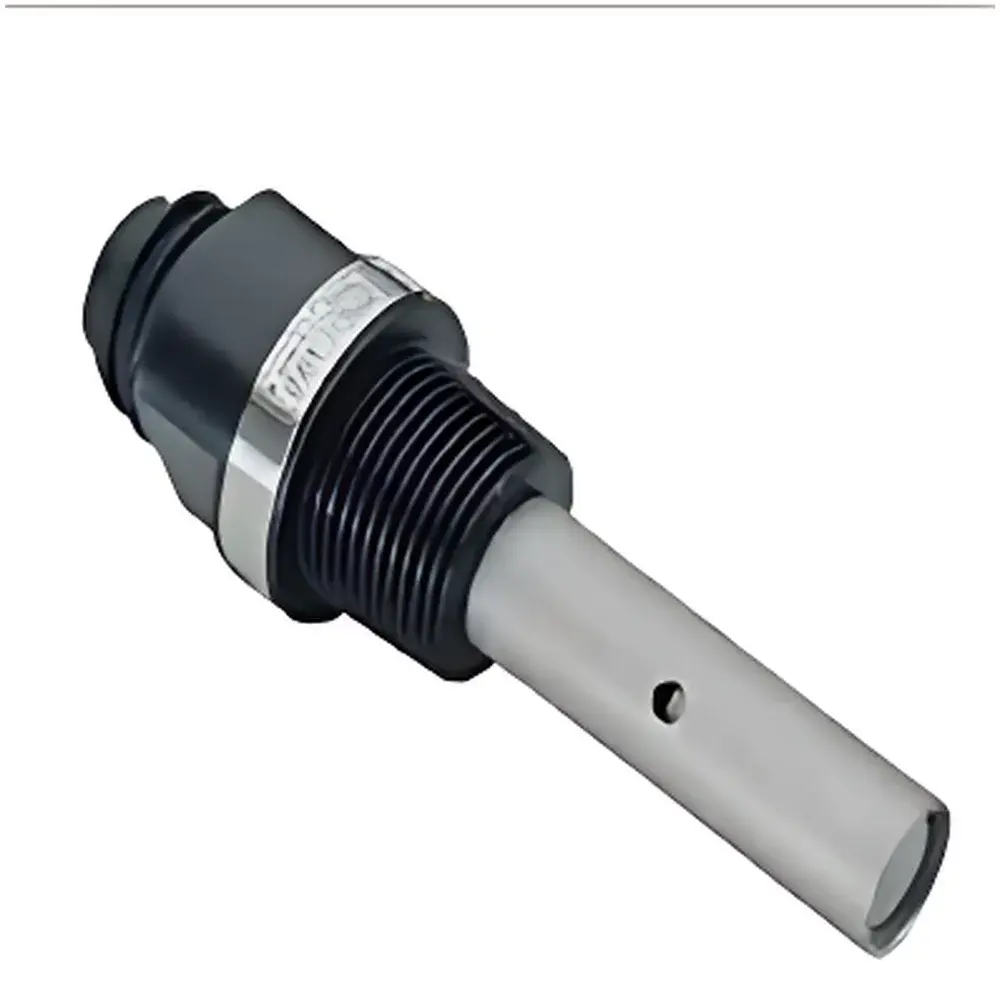
HACH Polymentron Contact Conductivity Sensor Series 8310, 8311, and 8312
| Brand | HACH |
|---|---|
| Origin | USA |
| Manufacturer Type | Original Equipment Manufacturer (OEM) |
| Import Status | Imported |
| Models | 8310, 8311, 8312 |
| Pricing | Available Upon Request |
Overview
The HACH Polymentron Contact Conductivity Sensor Series (Models 8310, 8311, and 8312) is a family of robust, industrial-grade contact-type conductivity sensors engineered for continuous, high-reliability measurement in demanding water quality monitoring applications—particularly within power generation, boiler feedwater, condensate, and ultrapure water (UPW) systems. These sensors operate on the principle of two-electrode or four-electrode conductance measurement, where an alternating current is applied across platinum or stainless-steel electrodes immersed in the sample, and the resulting current flow is used to calculate specific conductance (µS/cm or mS/cm) based on cell geometry and temperature compensation. Designed for integration into HACH’s SC1000, CL17, or other compatible controller platforms, the Polymentron series delivers stable performance across a broad dynamic range—from ultra-low conductivity (0.057 µS/cm) in high-purity steam-cycle waters up to 20,000 µS/cm in cooling tower or wastewater influent streams. Its operational integrity is maintained under high-pressure, high-temperature, and chemically aggressive conditions typical of utility and industrial process environments.
Key Features
- Multi-model platform architecture: 8310 (standard two-electrode), 8311 (four-electrode for high-ionic-strength or fouling-prone samples), and 8312 (high-temperature variant rated up to 150°C / 302°F)
- Electrode construction: 316 stainless steel body with inert, corrosion-resistant electrode surfaces; optional platinum black plating for enhanced stability in low-conductivity applications
- Integrated Pt1000 or Pt100 RTD for real-time, high-accuracy temperature compensation per IEC 60751
- IP68-rated housing with NPT or DIN 11851 process connections; pressure rating up to 10 bar (145 psi) at 20°C
- Field-replaceable sensor elements and standardized mounting interfaces reduce downtime during maintenance
- Compliant with ISO 7888:2019 (Water quality — Determination of electrical conductivity) and ASTM D1125-22 (Standard Test Methods for Electrical Conductivity and Resistivity of Water)
Sample Compatibility & Compliance
The Polymentron sensors are validated for use across diverse aqueous matrices including deionized water, reverse osmosis permeate, turbine condensate, boiler blowdown, cooling water, and municipal secondary effluent. Each model is calibrated traceably to NIST-certified KCl standards and supports automatic temperature compensation using either linear (0.02%/°C) or non-linear (EN 27888) algorithms. The sensor design meets requirements for GLP-compliant data acquisition when paired with HACH controllers supporting audit-trail functionality per FDA 21 CFR Part 11. All units undergo factory verification per ISO/IEC 17025-accredited procedures, with calibration certificates available upon request.
Software & Data Management
When connected to HACH SC1000 or similar programmable controllers, the Polymentron sensors interface via 4–20 mA analog output or Modbus RTU/ASCII protocols. Configuration, diagnostics, and calibration history are accessible through HACH’s Instrument Manager software or web-based controller UI. Real-time conductivity, temperature, and sensor status (e.g., electrode fouling detection, cable integrity check) are logged with timestamped metadata. Data export supports CSV and XML formats, enabling seamless integration into LIMS, SCADA, or enterprise asset management (EAM) systems. Firmware updates maintain alignment with evolving regulatory reporting needs—including EPA Method 120.1 and EU Directive 2000/60/EC Annex V compliance workflows.
Applications
- Power plant cycle chemistry monitoring: feedwater, condensate polishing, and steam purity assurance
- Pharmaceutical water systems (PW, WFI, Pure Steam) per USP and EU GMP Annex 1
- Microelectronics UPW distribution networks requiring sub-0.1 µS/cm resolution
- Municipal drinking water treatment: source water characterization and disinfection by-product precursor tracking
- Industrial wastewater pre-treatment and discharge compliance verification (e.g., NPDES permit limits)
FAQ
What is the difference between Model 8310, 8311, and 8312?
The 8310 is a standard two-electrode sensor optimized for clean, low-to-moderate conductivity water. The 8311 uses a four-electrode configuration to eliminate polarization errors and handle higher conductivity or scaling-prone samples. The 8312 adds high-temperature capability (up to 150°C) and reinforced thermal shielding for direct insertion into hot steam condensate lines.
Can these sensors be used in seawater or brine applications?
While rated up to 20,000 µS/cm, prolonged exposure to seawater (>50,000 µS/cm) or saturated brine may accelerate electrode passivation; the 8311 is recommended for such cases, but routine cleaning and recalibration are essential.
Is temperature compensation automatic and configurable?
Yes—each sensor includes a built-in Pt1000 RTD, and compensation algorithm (linear or non-linear) is selectable via controller firmware to match application-specific water matrix behavior.
How often does calibration verification require field intervention?
Under stable operating conditions, quarterly verification against a certified reference solution is recommended; annual full recalibration is advised for critical GMP or regulatory applications.
Are replacement electrodes and calibration kits available separately?
Yes—HACH offers OEM-certified electrode assemblies, NIST-traceable KCl calibration standards (0.01, 1.413, 12.88 mS/cm), and cleaning solutions formulated for inorganic scale removal without damaging sensor surfaces.
Related Products







