
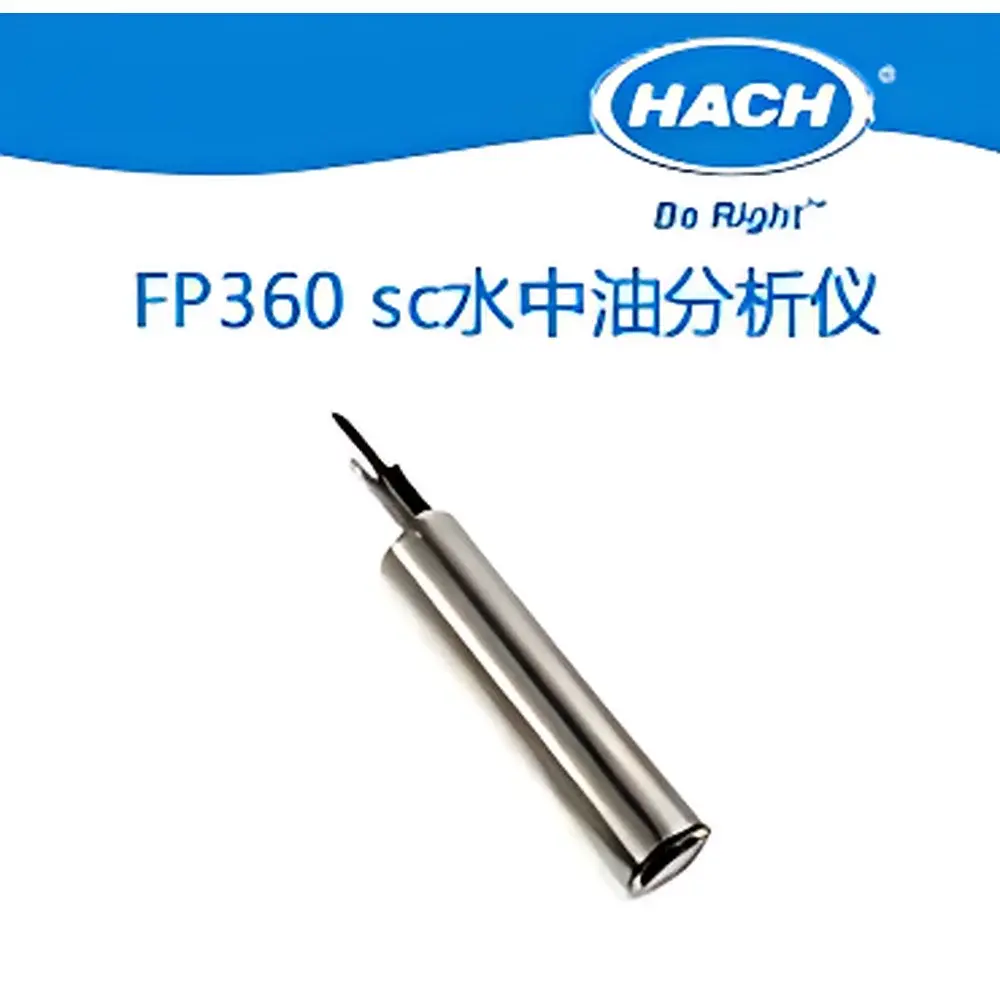
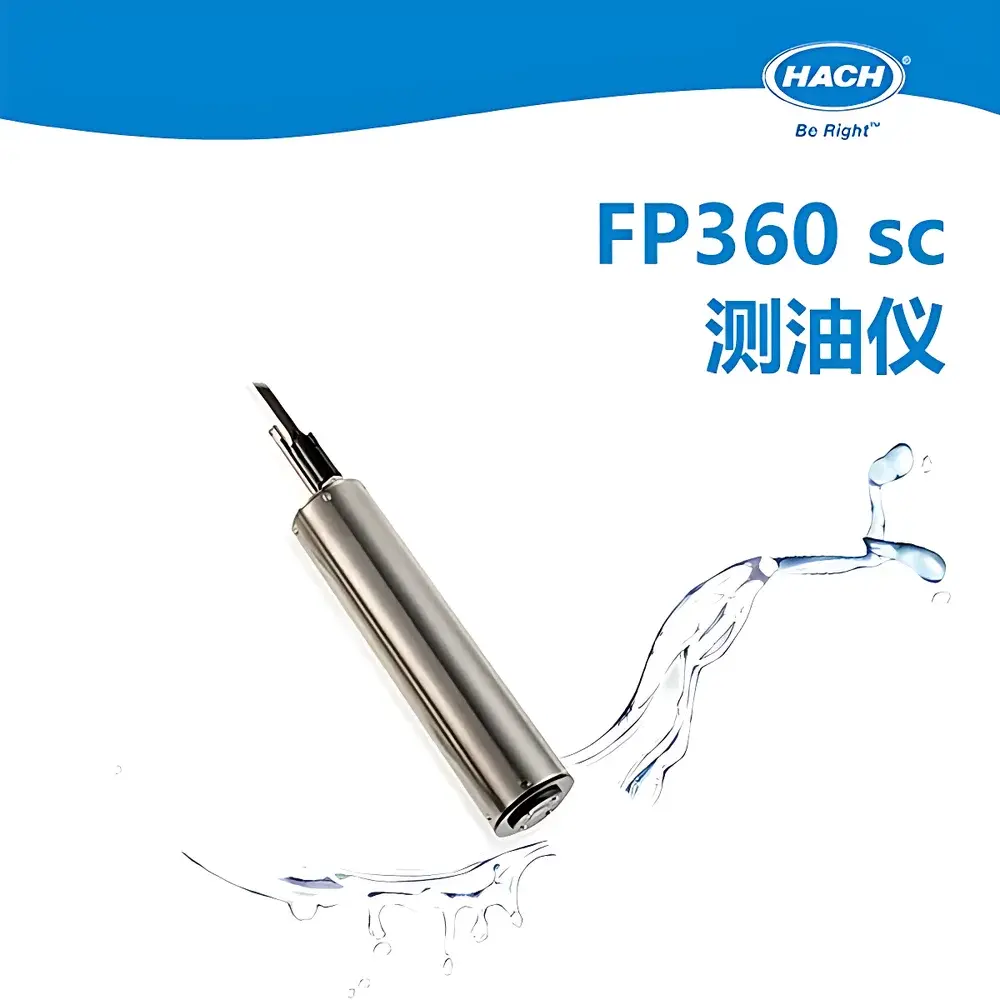
HACH FP360 sc Oil-in-Water Analyzer
| Brand | HACH |
|---|---|
| Origin | USA |
| Manufacturer | HACH Company (a Danaher subsidiary) |
| Product Type | Imported Industrial Online Analyzer |
| Model | FP360 sc |
| Pricing | Available upon Request |
Overview
The HACH FP360 sc Oil-in-Water Analyzer is a robust, field-deployable ultraviolet (UV) fluorescence spectrophotometer engineered for continuous, real-time quantification of hydrocarbon contaminants—including dissolved, emulsified, and aromatic fractions—in aqueous matrices. It operates on the principle of UV-induced fluorescence: polycyclic aromatic hydrocarbons (PAHs), which are intrinsic constituents of most petroleum-based oils, absorb UV light at 254 nm and re-emit characteristic fluorescence centered at 360 nm. This spectral signature enables selective detection without interference from turbidity, suspended solids, or colored dissolved organic matter—critical advantages over optical absorption or infrared methods in complex industrial effluents and natural waters. Designed for unattended operation in demanding environments, the FP360 sc delivers stable baseline performance over extended intervals, with minimal drift and no routine optical alignment required.
Key Features
- UV fluorescence detection optimized for PAH-rich hydrocarbons, delivering high specificity for oil contamination across diverse water types
- Three mounting configurations: submersible (for open channels or tanks), flow-through (for pressurized sample lines), and insertion-style (for pipe or conduit integration)
- Titanium alloy probe option (Grade 2) certified for long-term deployment in seawater, brackish water, and high-salinity process streams
- Integrated solar radiation compensation via built-in photodiode array, eliminating diurnal signal drift in outdoor installations
- Micro-pulsed xenon flash lamp (254 nm peak, 25 nm FWHM) with closed-loop intensity control using an internal UV reference diode—ensuring consistent excitation energy over time and temperature
- High-stability 360 nm bandpass-filtered silicon photodiode detector with low-noise transimpedance amplification
- IP68-rated stainless steel or titanium housing; compliant with NEMA 4X and IEC 60529 environmental protection standards
Sample Compatibility & Compliance
The FP360 sc is validated for use in cooling tower make-up water, boiler feedwater, condensate return systems, municipal and industrial wastewater influent/effluent, and surface water monitoring stations. It exhibits negligible sensitivity to common interferents including humic substances, iron oxides, and silica colloids—enabling reliable measurement in turbid or colored samples where conventional UV-Vis absorbance analyzers fail. The instrument meets requirements for continuous emission monitoring (CEM) under EPA Method 1664B (oil and grease) by proxy correlation to PAH fluorescence, and supports compliance reporting per ISO 9377-2 (water quality — determination of hydrocarbons — part 2: method using fluorescence). Its firmware architecture supports audit trails, user access levels, and data integrity controls aligned with GLP and 21 CFR Part 11 principles when integrated with HACH sc200/sc1000 controllers.
Software & Data Management
The FP360 sc communicates digitally via Modbus RTU/ASCII or HART 7 protocols, enabling seamless integration into SCADA, DCS, or HACH’s own IntelliCAL™ ecosystem. When paired with an sc-series controller, it supports automated calibration verification, scheduled zero/span checks, and diagnostic logging—including lamp output history, detector response stability, and temperature-compensated signal validation. All measurement data—including raw fluorescence intensity, calculated oil concentration (mg/L), PAH-equivalent concentration (µg/L), and status flags—are timestamped and stored locally with configurable retention. Export formats include CSV and Modbus register maps compatible with third-party historian platforms (e.g., OSIsoft PI, Inductive Automation Ignition).
Applications
- Early leak detection in steam condensate systems to prevent turbine fouling and corrosion
- Monitoring hydrocarbon breakthrough in activated carbon or granular media filters
- Regulatory compliance tracking for oil & grease discharge limits in industrial pretreatment programs
- Real-time assessment of oil separation efficiency in API separators and dissolved air flotation (DAF) units
- Long-term trend analysis of background PAH loading in watershed monitoring networks
- Verification of membrane integrity in ultrafiltration/nanofiltration pilot systems handling oily feedwater
FAQ
What is the detection limit for mineral oil under typical operating conditions?
The practical lower detection limit is 0.04 mg/L (40 µg/L) for mineral oil equivalents in clean matrix water, based on signal-to-noise ratio ≥3:1 over 10-second integration.
Does the analyzer require reagents or consumables during operation?
No—FP360 sc is a reagent-free, non-contact optical sensor; only periodic mechanical cleaning of the optical window is recommended in high-fouling applications.
Can it distinguish between diesel, lubricating oil, and crude oil?
It does not speciate individual hydrocarbon classes but provides total aromatic hydrocarbon response correlated to standard oil calibrants; multi-point calibration with site-specific oils improves quantitative accuracy.
Is the probe suitable for high-pressure pipeline installation?
Yes—the flow-through variant supports up to 10 bar (145 psi) working pressure and is rated for ASME B31.4/B31.8 service when installed with appropriate flanged adapters.
How often must the instrument be calibrated?
Field calibration is recommended every 3–6 months depending on matrix severity; factory calibration traceability is maintained to NIST-traceable PAH standards (e.g., phenanthrene, pyrene).







