
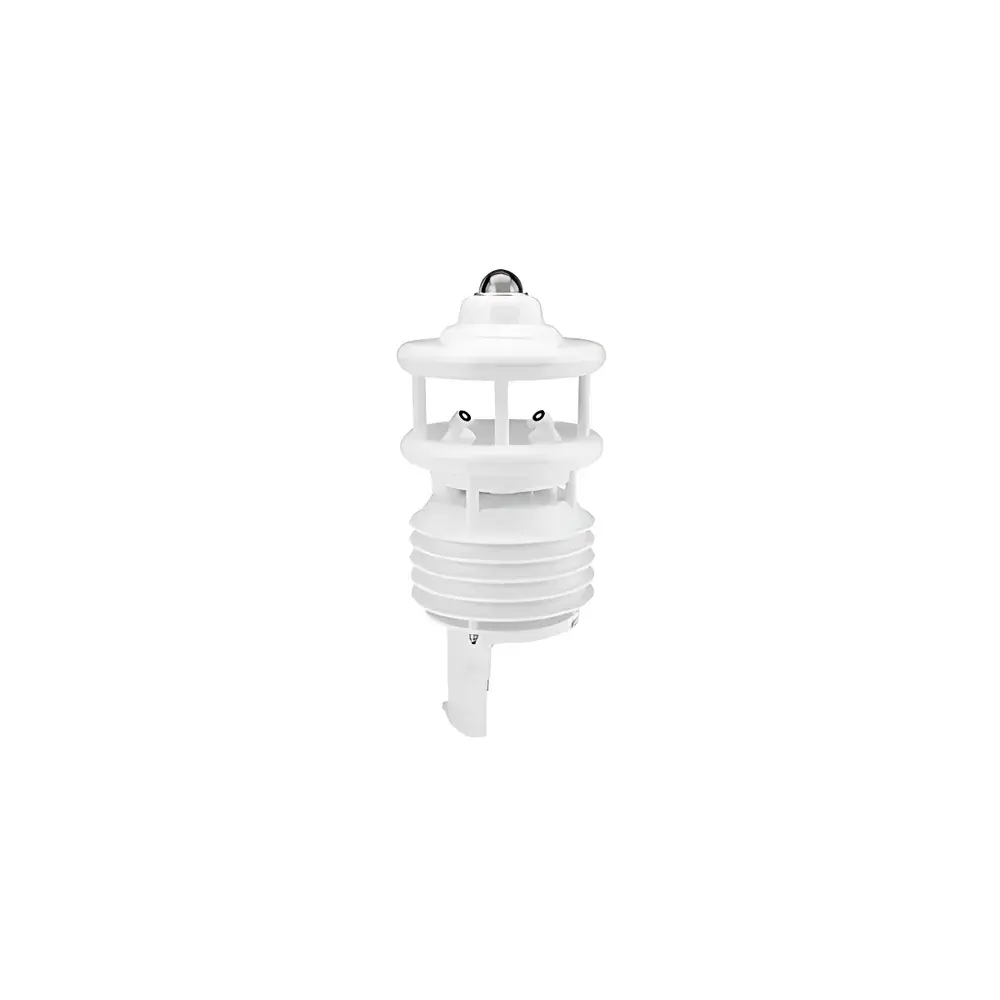
Lufft WS501-UMB Ultrasonic Weather Station
| Brand | Lufft |
|---|---|
| Model | WS501-UMB |
| Measurement Principle | Ultrasonic time-of-flight (wind speed & direction), NTC thermistor (temperature), capacitive humidity sensor (relative humidity), MEMS capacitive barometer (atmospheric pressure), thermopile pyranometer (global solar radiation) |
| Power Supply | DC 12–30 V, solar-compatible |
| Communication Protocols | SDI-12, Modbus RTU (RS-485), CAN bus, UMB-ASCII (native), optional MQTT/HTTP via gateway |
| Wind Measurement Range | 0–60 m/s (±0.1 m/s @ <5 m/s), 0–360° (±2°) |
| Temperature Range | –40 to +70 °C (±0.2 °C) |
| Relative Humidity Range | 0–100 %RH (±2 %RH) |
| Pressure Range | 500–1100 hPa (±0.5 hPa) |
| Radiation Range | 0–2000 W/m² (±5 %) |
| Operating Temperature | –40 to +70 °C |
| IP Rating | IP66 |
| Heating | Integrated ultrasonic transducer heating (–40 to +5 °C activation) |
| Fan-Assisted Aspiration | Yes, continuous low-power fan for radiation and humidity sensor thermal stabilization |
| Sensor Mounting | Integrated, single-mast mounting |
| Data Output | Real-time analog/digital, quality flags per parameter |
| Compliance | CE, RoHS, EN 61326-1 (EMC), EN 61000-6-2/-4, WMO Guide to Instruments and Methods of Observation (CIMO) Class II recommended |
Overview
The Lufft WS501-UMB is a fully integrated, ultrasonic weather station engineered for long-term, unattended environmental monitoring in demanding outdoor applications. Unlike traditional mechanical anemometers and cup-based wind sensors, the WS501-UMB employs ultrasonic time-of-flight (TOF) technology to measure both wind speed and wind direction with no moving parts—eliminating mechanical wear, icing-induced failure, and periodic recalibration requirements. Temperature is measured using a precision NTC thermistor housed within a fan-aspirated radiation shield; relative humidity relies on a polymer capacitive sensor stabilized by active airflow; atmospheric pressure is acquired via a temperature-compensated MEMS capacitive barometer; and global solar radiation is captured using a thermopile-based pyranometer compliant with ISO 9060:2018 Class C specifications. All sensing elements are co-located on a single compact housing, minimizing spatial separation errors and ensuring synchronized, time-aligned measurements at 1 Hz default output rate.
Key Features
- Ultrasonic wind measurement with built-in heating: Transducers feature automatic anti-icing activation below +5 °C, enabling reliable operation in freezing fog, rime, or light snow conditions.
- Fan-aspirated dual-sensor assembly: A low-power, brushless DC fan ensures consistent airflow over temperature and humidity elements—critical for reducing solar radiation error and improving diurnal stability.
- UMB-ASCII native protocol support: Enables plug-and-play integration with Lufft’s UMB data loggers and third-party systems supporting the standardized Universal Measurement Bus interface.
- Multi-protocol flexibility: Simultaneous SDI-12, Modbus RTU (RS-485), and CAN bus outputs allow seamless integration into legacy SCADA, ITS (Intelligent Transport Systems), and industrial IoT architectures.
- Low-power design optimized for solar operation: Typical average current draw is <15 mA at 12 V DC, supporting battery-buffered solar deployments exceeding 12 months autonomy in mid-latitude regions.
- Integrated electronic compass: Provides true north-referenced wind direction output, compensated for local magnetic declination via configurable firmware parameters.
- Quality-assured data output: Each wind vector includes real-time confidence indicators (e.g., signal-to-noise ratio, transducer health flag, freeze detection status) for automated QA/QC filtering.
Sample Compatibility & Compliance
The WS501-UMB is designed for deployment across heterogeneous environmental regimes—from alpine road corridors to coastal photovoltaic farms—and meets foundational requirements for operational meteorology under WMO CIMO Guide (2022) recommendations for Class II stations. Its enclosure complies with IP66 ingress protection, ensuring resistance to high-pressure water jets and dust accumulation. Electromagnetic compatibility adheres to EN 61326-1 (industrial environments) and EN 61000-6-2 (immunity) / -6-4 (emissions). The radiation sensor satisfies spectral responsivity and cosine response tolerances defined in ISO 9060:2018 (Class C), while pressure and humidity modules are factory-calibrated traceable to national metrology institutes (NMI). No user calibration is required; however, optional annual verification services—including on-site drift assessment against reference standards—are available through authorized Lufft service partners.
Software & Data Management
Raw sensor outputs are delivered in ASCII-formatted UMB-ASCII frames, enabling direct parsing without proprietary drivers. Configuration, firmware updates, and diagnostic logging are performed via Lufft’s free UMB ConfigTool (Windows/macOS) or command-line UMB CLI utilities. For enterprise-scale deployments, the station integrates natively with Lufft’s meteoIO middleware and supports MQTT publishing via optional UMB-Edge gateway modules—enabling TLS-secured transmission to cloud platforms (e.g., AWS IoT Core, Azure IoT Hub). Data integrity is maintained through cyclic redundancy checks (CRC16) in all serial protocols and optional timestamped audit logs compliant with GLP-aligned field data governance practices. While the device itself does not store historical data, its deterministic 1 Hz output stream is optimized for ingestion into time-series databases (e.g., InfluxDB, TimescaleDB) with sub-second latency.
Applications
- Road weather information systems (RWIS): Real-time input for black ice prediction models, pavement temperature forecasting, and dynamic message sign (DMS) triggering.
- Photovoltaic performance monitoring: Correlation of irradiance, temperature, and wind-cooling effects on panel efficiency and soiling rate estimation.
- Hydrological modeling: Input for evapotranspiration (ET₀) calculation (FAO-56 Penman-Monteith), snowmelt forecasting, and reservoir inflow estimation.
- Air quality network augmentation: Co-location with gas analyzers to contextualize pollutant dispersion using wind vector statistics and boundary layer stability indices.
- Aviation meteorological terminals (AWOS/ASOS): Supplemental surface observation at general aviation airports where full ASOS infrastructure is cost-prohibitive.
- Coastal and port operations: Wind gust detection for crane safety interlocks, wave height proxy via wind stress estimation, and visibility trend analysis.
FAQ
Does the WS501-UMB require routine mechanical maintenance?
No—its ultrasonic wind sensor contains no bearings, cups, or vanes. Only periodic visual inspection of the radiation shield and cleaning of the pyranometer dome (every 3–6 months depending on dust/pollen load) is recommended.
Can the station operate reliably in high-humidity or salt-laden coastal environments?
Yes—the housing uses marine-grade stainless-steel fasteners and conformally coated PCBs; the ultrasonic transducers are sealed with hydrophobic membranes rated to IP66, and the barometer features internal gel encapsulation to inhibit moisture diffusion.
Is third-party sensor integration supported beyond rain gauges and external temperature probes?
Yes—via the open 4–20 mA or RS-485 expansion port, users may connect calibrated sensors for precipitation type (e.g., Parsivel disdrometer), soil moisture, or CO₂ concentration, with linear scaling and offset configurable in UMB ConfigTool.
What level of data traceability does the device provide for regulatory reporting?
Each measurement packet includes embedded UTC timestamps (synchronized via optional GPS module), sensor-specific quality flags, and firmware revision identifiers—enabling full chain-of-custody documentation aligned with ISO/IEC 17025 and EPA 40 CFR Part 58 requirements for ambient air monitoring networks.







