
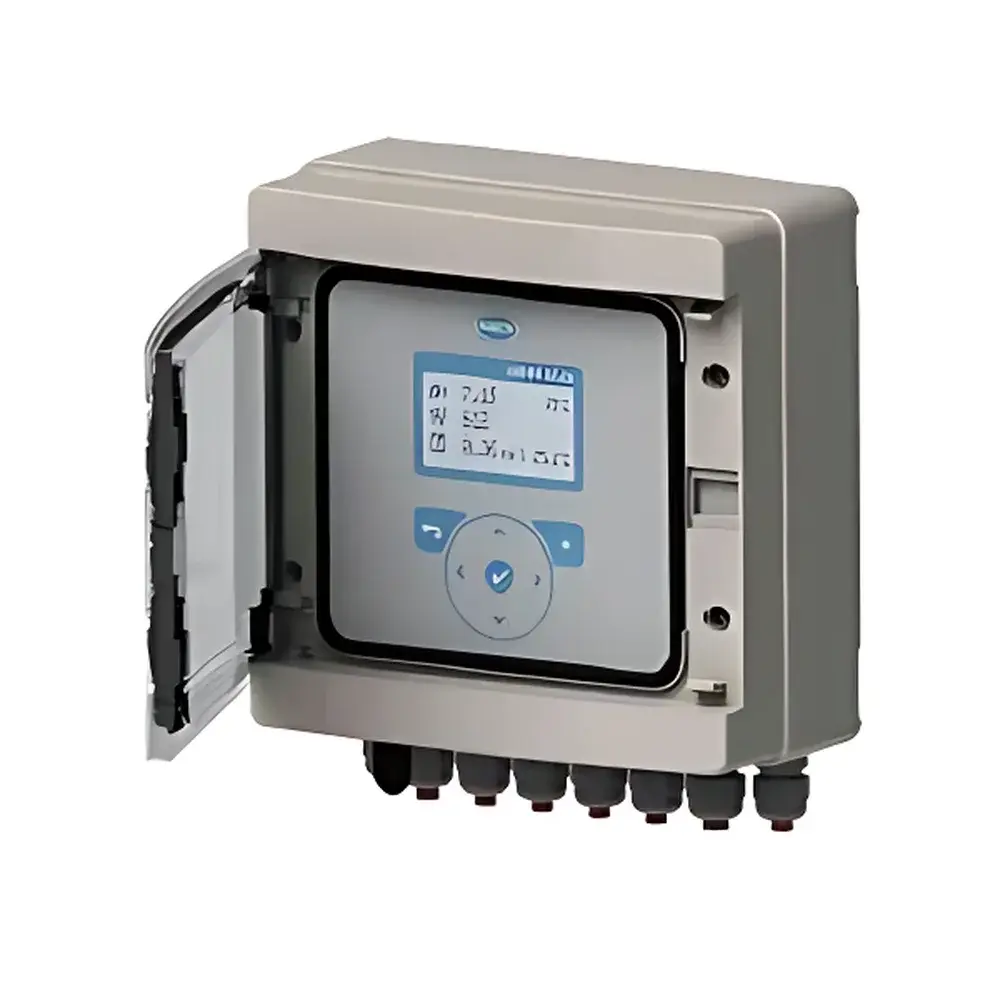
HACH SI6xx Series Controller
| Brand | HACH |
|---|---|
| Origin | Imported |
| Manufacturer Type | Manufacturer |
| Model | SI6xx |
| Pricing | Upon Request |
Overview
The HACH SI6xx Series Controller is a microprocessor-based, multi-parameter water quality monitoring and control system engineered for continuous, reliable operation in demanding industrial and municipal water treatment environments. Designed around a robust analog and digital signal processing architecture, the SI6xx performs real-time acquisition, conditioning, and interpretation of electrochemical sensor inputs—including pH, ORP (oxidation-reduction potential), conductivity, chlorine (free/total), dissolved oxygen, and turbidity—depending on configured sensor modules. Its core measurement principle relies on precision analog-to-digital conversion (ADC) of millivolt or current signals from standardized 2- or 4-electrode sensors, coupled with temperature-compensated algorithms compliant with ISO 7888 (conductivity), ISO 5667-22 (pH/ORP), and ASTM D1293 (pH of water). The controller operates as a standalone local control unit or integrates seamlessly into larger SCADA or DCS frameworks via its isolated 4–20 mA analog outputs and optional Modbus RTU/ASCII communication interface.
Key Features
- Simultaneous dual-line LCD display showing primary measured parameter (e.g., pH, mV, µS/cm) and real-time temperature reading—enabling immediate assessment of thermal drift effects.
- Intelligent electrode diagnostics: automatic detection of open-circuit, short-circuit, and aging conditions; status-driven guidance for calibration readiness verification per ISO 17025-aligned procedures.
- Secure access hierarchy: configurable user passwords restrict access to calibration routines, setpoint adjustments, and configuration menus—supporting role-based operational integrity in GLP/GMP-regulated facilities.
- Hardware-enforced calibration lockout: instrument enters protected mode during calibration or parameter programming, preventing concurrent process interference or erroneous data entry.
- Dual mounting flexibility: field-installable wall-mount bracket and panel-cutout kit included—compatible with NEMA 4X/IP66-rated enclosures for indoor/outdoor deployment.
- Isolated 4–20 mA current loop output with scalable range assignment (e.g., 0–14 pH → 4–20 mA), supporting direct connection to PLCs, recorders, or centralized alarm systems without external signal conditioners.
Sample Compatibility & Compliance
The SI6xx Series interfaces exclusively with HACH-certified analog sensors utilizing industry-standard BNC, DIN, or M12 connectors. It supports both two-wire (passive) and four-wire (active) sensor configurations, accommodating glass pH electrodes, platinum ORP probes, toroidal or graphite conductivity cells, amperometric chlorine sensors, and optical DO sensors. All firmware and calibration logic conform to EPA Method 150.1 (pH), Standard Methods 4500-Cl G (chlorine), and ISO 5814 (dissolved oxygen). Device construction meets IEC 61000-6-2 (EMC immunity) and IEC 61000-6-4 (EMC emissions) standards. For regulated utilities, audit trails and calibration logs may be exported manually for FDA 21 CFR Part 11 compliance when paired with HACH’s LogPro software (optional add-on).
Software & Data Management
While the SI6xx operates autonomously without PC dependency, it supports configuration and historical data review via HACH’s free Connect Desktop utility (Windows-compatible). This application enables firmware updates, sensor profile import/export, calibration certificate generation (PDF), and time-stamped event log extraction—including alarms, calibration events, and sensor fault codes. All calibration data includes operator ID (if entered), date/time stamp, buffer values used, slope/mV offset, and temperature at calibration—facilitating traceability per ISO/IEC 17025 Clause 7.7. No onboard memory is provided for long-term trending; however, the 4–20 mA output enables integration with third-party historian systems (e.g., Ignition SCADA, Siemens Desigo CC) for archival and analytics.
Applications
- Desalination pre-treatment and post-treatment monitoring (e.g., pH stabilization prior to RO membranes; residual chlorine verification after chlorination).
- Recreational water management in swimming pools and spas—continuous control of pH, ORP, and free chlorine to meet CDC Model Aquatic Health Code (MAHC) thresholds.
- Electroplating bath chemistry control—real-time monitoring of acid concentration (via pH), metal ion activity (via ORP), and bath conductivity for process consistency.
- Neutralization and detoxification systems handling acidic/alkaline industrial effluents—closed-loop dosing control based on pH setpoints with programmable hysteresis.
- Small-scale municipal wastewater treatment—sludge digestion pH oversight, disinfection contact chamber monitoring, and final effluent compliance verification.
- Community drinking water systems serving populations under 10,000—source water pH/ORP screening, coagulation pH optimization, and distribution system chlorine residual tracking.
FAQ
Does the SI6xx support digital sensor protocols such as HART or Profibus?
No—the SI6xx accepts only analog sensor inputs (mV or 4–20 mA). Digital smart sensors require the HACH SC200 or SC1000 platform.
Can multiple parameters be measured simultaneously on a single SI6xx unit?
No—each SI6xx controller is dedicated to one primary parameter. Multi-parameter monitoring requires separate units or migration to the HACH HQ40d or CL17 platforms.
Is temperature compensation automatic and configurable?
Yes—NTC or PT1000 temperature input is mandatory for all measurements; compensation curves follow NIST-traceable algorithms and are adjustable per sensor manufacturer specifications.
What is the operating temperature range for outdoor installation?
–20 °C to +60 °C ambient, provided the unit is installed in a NEMA 4X-compliant enclosure with adequate solar shielding and ventilation.
How often does the SI6xx require recalibration?
Calibration frequency follows sensor-specific recommendations and application criticality—typically daily for chlorine in high-variability streams, weekly for pH in stable potable water, and monthly for conductivity in cooling towers—per ASTM D1129 guidelines.







