
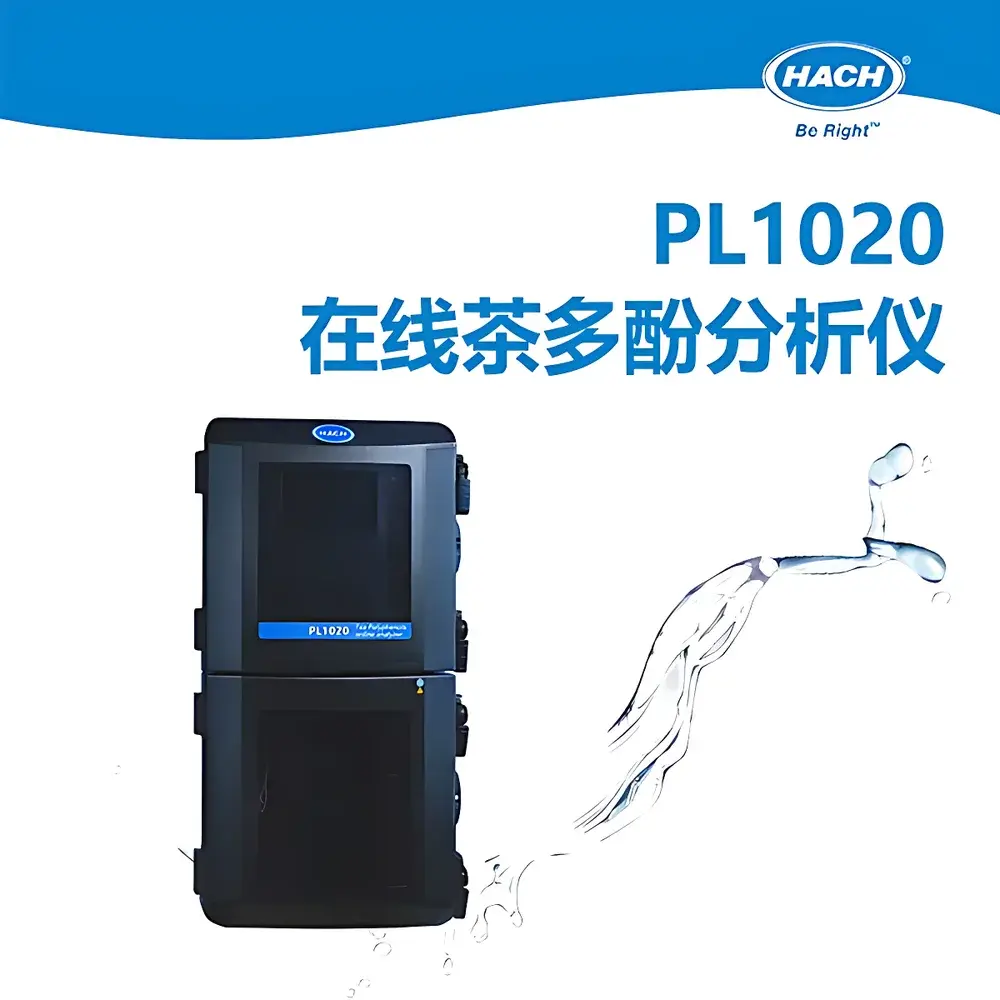
HACH PL1020 Online Tea Polyphenol Analyzer
| Brand | HACH |
|---|---|
| Origin | Imported |
| Manufacturer Type | Manufacturer |
| Model | PL1020 |
| Instrument Category | Online Beverage Analyzer |
| Application Type | Online |
| Measurement Time | ~5 min per cycle |
| Dimensions (L × W × H) | 455 mm × 365 mm × 805 mm |
| Analytical Principle | Ferric Tartrate Spectrophotometry per GB/T 21733–2008 Annex A |
Overview
The HACH PL1020 Online Tea Polyphenol Analyzer is an industrial-grade, fully automated photometric analyzer engineered for continuous, real-time quantification of total tea polyphenols in liquid food and beverage streams—primarily concentrated tea extracts, ready-to-drink (RTD) tea beverages, iced teas, and functional tea-based formulations. It implements the standardized ferric tartrate spectrophotometric method specified in Annex A of GB/T 21733–2008, “Tea Beverages”, which relies on the formation of a stable blue-violet complex between tea polyphenols and ferric ions in the presence of potassium sodium tartrate under controlled pH and temperature conditions. Absorbance is measured at 540 nm using a high-stability tungsten-halogen light source and precision optical path design, ensuring traceable compliance with Chinese national methodology. Unlike laboratory-based manual assays, the PL1020 integrates sample aspiration, reagent dosing, mixing, reaction incubation, photometric detection, and waste disposal into a single compact module—enabling unattended operation in production environments where rapid process feedback is critical for quality consistency and formulation control.
Key Features
- Regulatory-aligned methodology: Direct implementation of GB/T 21733–2008 Annex A, facilitating direct comparability with QC lab reference data and supporting internal method validation protocols.
- Short-cycle analysis: Delivers quantitative results in approximately 5 minutes per measurement, compatible with high-speed bottling and blending line monitoring requirements.
- Low reagent consumption: Optimized fluidics design limits reagent usage to ≤2.2 mL per analysis cycle, reducing operational cost and chemical waste generation.
- Intuitive touchscreen interface: Graphical HMI supports programmable scheduling of calibration, blanking, cleaning, and maintenance routines without requiring external software or PC connectivity.
- Comprehensive self-diagnostic architecture: Monitors critical system parameters—including sample flow integrity, reagent level, photometer baseline stability, cuvette cleanliness, and reaction temperature—and generates actionable alerts for “no sample”, “no reagent”, “high/low concentration out-of-range”, and consumables expiration.
- Robust industrial enclosure: IP65-rated cabinet with corrosion-resistant internal wetted components (e.g., PTFE tubing, ceramic valves), designed for deployment in humid, temperature-variable food processing environments.
Sample Compatibility & Compliance
The PL1020 is validated for use with clarified, low-turbidity aqueous tea matrices—including black tea, green tea, oolong, and herbal infusions—within a typical polyphenol concentration range of 100–2000 mg/L (as gallic acid equivalents). Samples must be pre-filtered (≤5 µm) and maintained at ambient temperature (15–30 °C) prior to inlet. The analyzer complies with general electrical safety standards IEC 61010-1 and electromagnetic compatibility (EMC) requirements per IEC 61326-1. While GB/T 21733–2008 is a national standard, its analytical principle aligns conceptually with ISO 14502-1 (determination of total phenolic compounds by Folin–Ciocalteu method) and AOAC Official Method 982.21; however, method equivalence must be verified per site-specific validation protocols. For regulated facilities operating under GMP or HACCP frameworks, the PL1020 supports audit-ready documentation through timestamped event logs and configurable report exports.
Software & Data Management
The embedded firmware provides local data storage for up to 10,000 measurement records, including absorbance values, calculated concentrations, timestamps, diagnostic flags, and operator-initiated events. Data export is supported via USB flash drive in CSV format for integration into LIMS or MES systems. Optional analog 4–20 mA output and Modbus RTU (RS-485) communication enable direct interfacing with PLCs and SCADA platforms for real-time process control loop integration. Although the device does not include FDA 21 CFR Part 11-compliant electronic signature or audit trail features as standard, its deterministic measurement sequence, non-volatile memory retention, and tamper-evident log structure support GLP-aligned data integrity practices when deployed within validated infrastructure.
Applications
- Real-time monitoring of tea extract concentration during evaporation and standardization stages in concentrate manufacturing.
- In-line verification of polyphenol dosage consistency in RTD tea blending tanks prior to hot-fill or aseptic packaging.
- Batch release testing for shelf-life studies correlating polyphenol stability with storage time and temperature.
- Supplier qualification support—comparing incoming tea ingredient lots against specification limits defined in technical agreements.
- Troubleshooting flavor drift or browning reactions linked to oxidative degradation of catechins and flavonols.
FAQ
Does the PL1020 require daily calibration?
No—calibration frequency is determined by process stability and regulatory requirements; typical intervals range from once per shift to once per 24 hours. Factory-prepared calibration standards are recommended for traceability.
Can it analyze turbid or particulate-containing tea samples?
No—samples must be filtered to ≤5 µm prior to analysis. Unfiltered samples risk clogging the microfluidic manifold and compromising photometric accuracy.
Is the ferric tartrate method specific to tea polyphenols?
It measures total reducing phenolics capable of forming the colored complex; while highly correlated with tea catechins and flavonoids, cross-reactivity with non-tea phenolics (e.g., chlorogenic acid in coffee blends) may occur and should be assessed during method transfer.
What maintenance is required beyond reagent replacement?
Routine tasks include weekly cleaning of the sample probe and reaction cuvette with dilute citric acid solution, monthly inspection of peristaltic pump tubing wear, and annual verification of photometer lamp intensity and wavelength accuracy.
Is remote diagnostics or cloud connectivity available?
Not natively—the PL1020 operates as a standalone edge device. Remote access requires integration via third-party industrial gateways supporting Modbus TCP or OPC UA bridging.





