
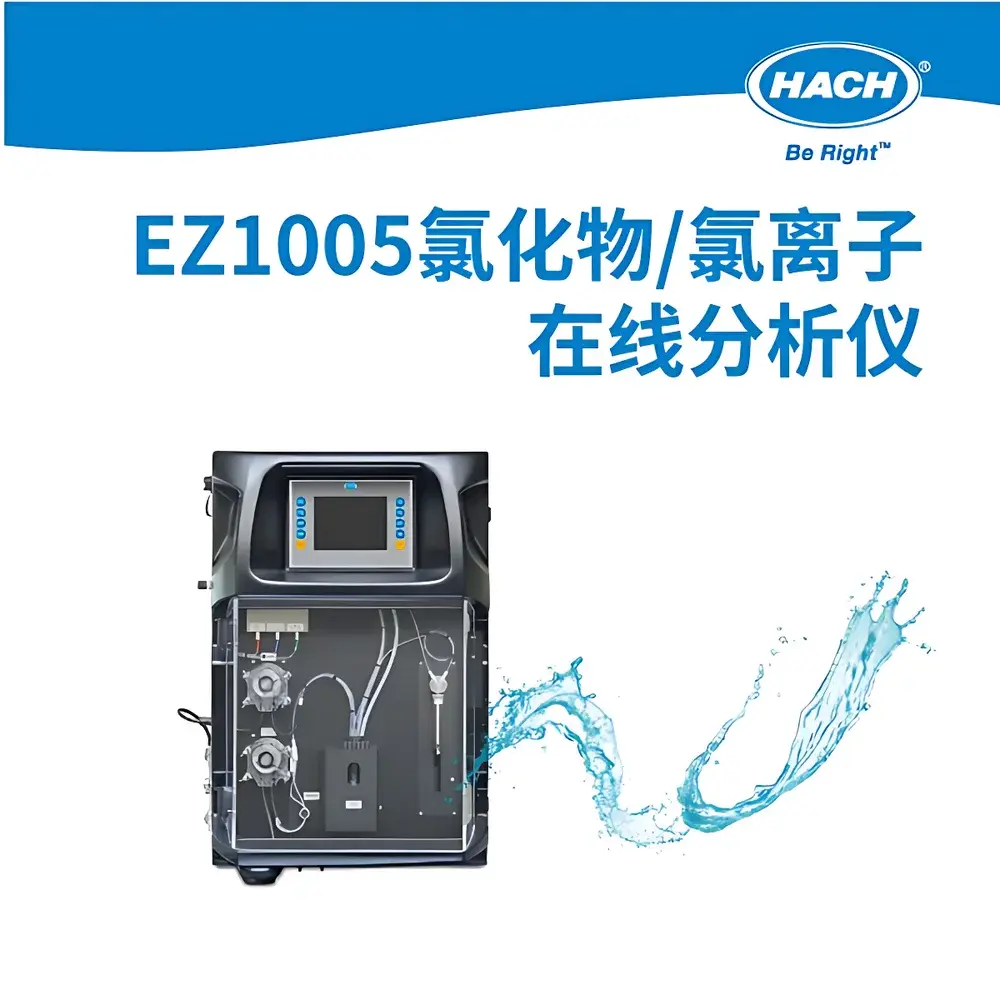
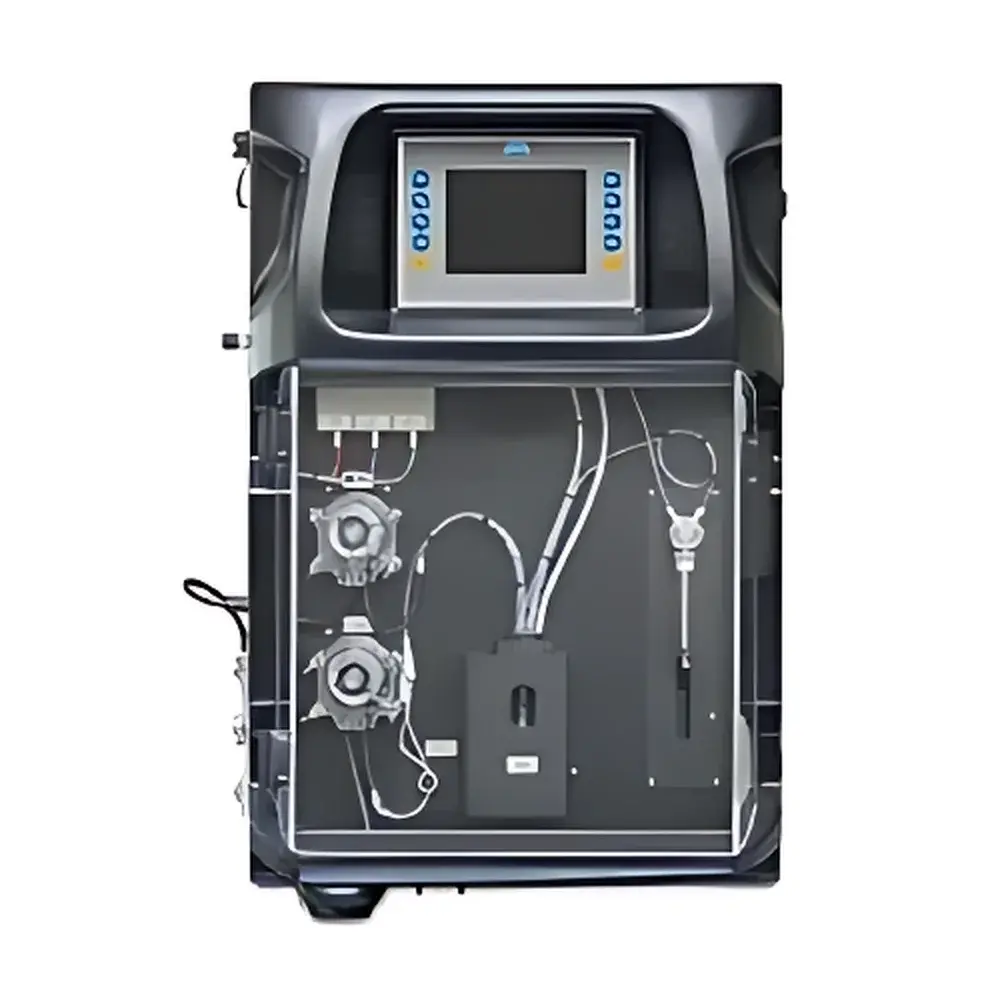
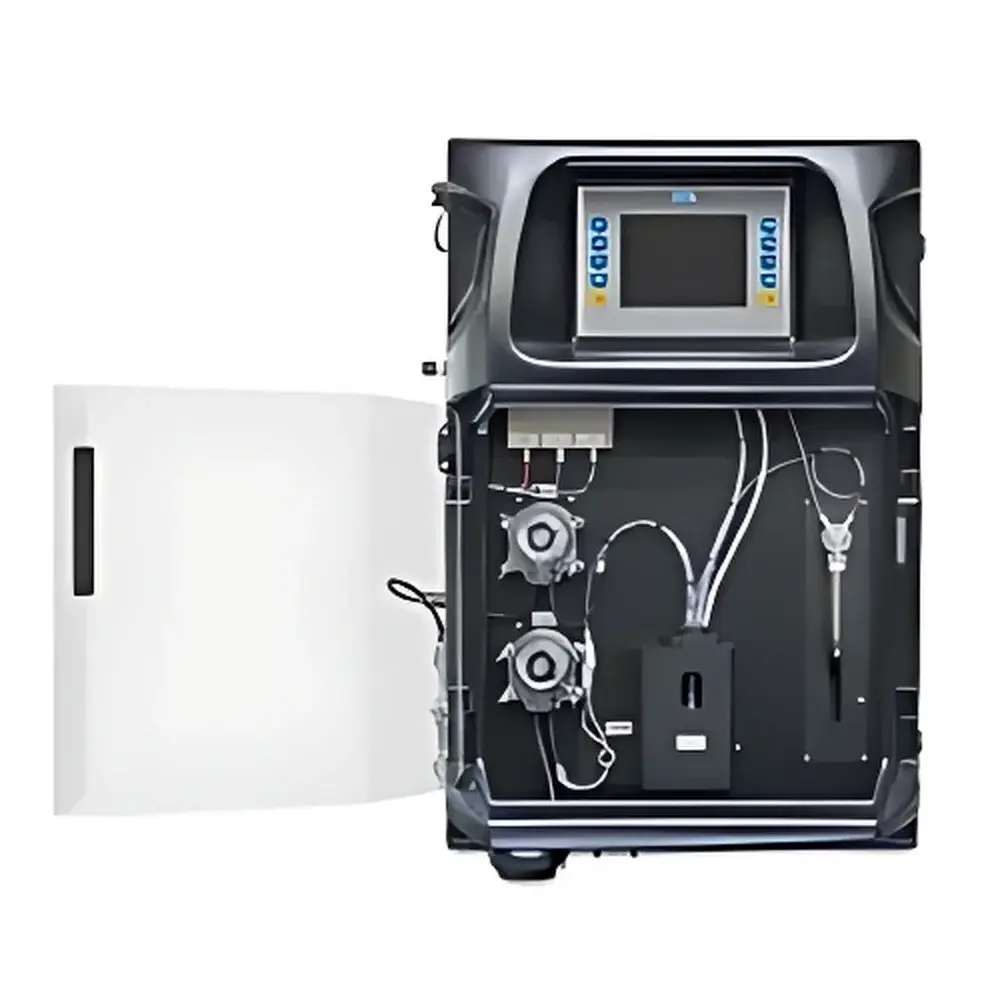
HACH EZ1005 Online Chloride Analyzer
| Brand | HACH |
|---|---|
| Origin | Imported |
| Manufacturer Type | Manufacturer |
| Model | EZ1005.99001102, EZ1005.99001E02 |
| Instrument Type | Online Analyzer |
| Measuring Range | 1–10 mg/L Cl⁻ |
| Detection Limit | ≤1 mg/L Cl⁻ |
| Response Time | 10 min (including dilution + 5 min measurement) |
| Accuracy | ≤2% F.S. (with certified standard solutions) |
| Operating Temperature | 10–30°C |
| Sample Flow Rate | 100–300 mL/min |
| Sample Turbidity Limit | <50 NTU |
| Max Particle Size | 100 µm |
| Sample Solids Content | <0.1 g/L |
| Power Supply | 110–240 VAC, 4 A, 50/60 Hz, Max 150 VA |
| Analog Output | 4–20 mA (standard 1 channel, up to 8 optional) |
| Digital Communication | RS232, Modbus TCP/IP, Modbus RTU (RS485) |
| Enclosure Rating | IP55 (analyzer), IP65 (panel PC) |
| Dimensions | 690 × 465 × 330 mm |
| Weight | 25 kg |
Overview
The HACH EZ1005 Online Chloride Analyzer is a fully automated, laboratory-grade photometric system engineered for continuous, real-time monitoring of chloride ion (Cl⁻) concentration in aqueous streams. It operates on the principle of silver nitrate titration followed by spectrophotometric quantification of insoluble silver chloride (AgCl) precipitate at 480 nm — a method rigorously aligned with APHA Standard Method 4500-Cl(B). This gravimetric-spectroscopic hybrid approach ensures high selectivity for chloride in complex matrices, minimizing interferences from bromide, iodide, and common anions under controlled reagent stoichiometry and pH conditions. Designed for unattended operation in demanding industrial and municipal environments, the EZ1005 delivers stable baseline performance across fluctuating sample temperatures (10–30°C) and flow rates (100–300 mL/min), with built-in thermal management to maintain optical path integrity. Its architecture supports long-term deployment without manual intervention, making it suitable for regulatory compliance monitoring where data continuity and traceability are critical.
Key Features
- Photometric detection at 480 nm using AgCl precipitation chemistry per APHA 4500-Cl(B), ensuring method-defensible results
- Low-volume reaction cell design reduces reagent consumption by up to 40% versus conventional online analyzers
- Extended optical path length enhances sensitivity and lowers effective detection limit to ≤1 mg/L Cl⁻
- Configurable internal dilution module enables extended range flexibility (e.g., 0.5–50 mg/L Cl⁻ via programmable 1:2 or 1:5 dilution)
- Integrated industrial panel PC with intuitive HMI interface for local configuration, diagnostics, and alarm management
- Modular I/O architecture: standard 4–20 mA analog output (1 channel), expandable to 8 isolated channels; optional digital protocols including Modbus TCP/IP and RS485 for SCADA integration
- Ruggedized enclosure rated IP55 (analyzer cabinet) and IP65 (touchscreen panel), certified to CE and UL standards for hazardous-area-adjacent installation
Sample Compatibility & Compliance
The EZ1005 accepts raw or filtered water samples meeting defined physical constraints: turbidity <50 NTU, suspended solids <0.1 g/L, and particulate size ≤100 µm. It is validated for use in drinking water distribution systems, wastewater treatment plant effluents, cooling tower make-up water, power plant boiler feedwater, and surface water monitoring stations. All calibration and verification procedures comply with ISO/IEC 17025 requirements for testing laboratories, and the analyzer’s audit trail functionality supports GLP and GMP data integrity frameworks. Automatic two-point calibration (zero and span) and scheduled validation cycles meet EPA Method 300.0 and ISO 9963-1 traceability expectations. Reagents are stored at 10–30°C and monitored via onboard temperature logging to ensure chemical stability throughout shelf life.
Software & Data Management
Firmware includes embedded data logging with timestamped records of measurements, calibrations, alarms, and maintenance events — all stored internally for ≥90 days. The system supports secure remote access via Ethernet for firmware updates and historical data export in CSV format. Audit trails are immutable and include user ID, action type, timestamp, and pre/post values — compliant with FDA 21 CFR Part 11 requirements when deployed with appropriate IT controls. Configuration parameters (e.g., measurement interval, dilution factor, alarm thresholds) are password-protected and version-controlled. Optional HACH DataSuite™ integration enables centralized fleet monitoring, predictive maintenance alerts, and automated report generation aligned with ISO 14001 environmental management reporting.
Applications
- Drinking water utilities: Continuous verification of chloride levels post-disinfection to prevent corrosion and meet WHO guidelines (<250 mg/L)
- Wastewater treatment plants: Monitoring chloride ingress from industrial discharges to protect biological nutrient removal (BNR) processes
- Power generation: Feedwater purity control in steam cycle systems where chloride >10 µg/L can initiate stress corrosion cracking in austenitic alloys
- Municipal surface water networks: Early detection of saline intrusion or road de-icing runoff contamination
- Industrial process water loops: Closed-loop monitoring in semiconductor rinse water or pharmaceutical purified water (PW) systems where chloride must remain below pharmacopeial limits (e.g., USP )
FAQ
What analytical method does the EZ1005 employ, and how is it standardized?
It implements APHA Standard Method 4500-Cl(B), based on stoichiometric AgNO₃ addition and photometric quantification of AgCl precipitate at 480 nm.
Can the EZ1005 operate without external dilution pumps or sample conditioning units?
Yes — its integrated peristaltic dilution module and self-cleaning sample line enable direct connection to representative process streams meeting specified turbidity and particle criteria.
Is the system compatible with existing plant DCS or SCADA platforms?
Fully compatible via Modbus TCP/IP or RS485; 4–20 mA outputs support legacy analog interfaces with configurable scaling and fault signaling.
How frequently must calibration be performed, and is it traceable to NIST standards?
Calibration frequency is user-defined (typically daily or per shift); certified reference materials traceable to NIST SRM 3194 (chloride in water) are recommended for span verification.
Does the analyzer require annual certification or third-party validation for regulatory reporting?
While not mandated annually, periodic verification against accredited reference standards and documented instrument performance qualification (IPQ) are required under ISO 17025 and EPA-approved monitoring programs.







