
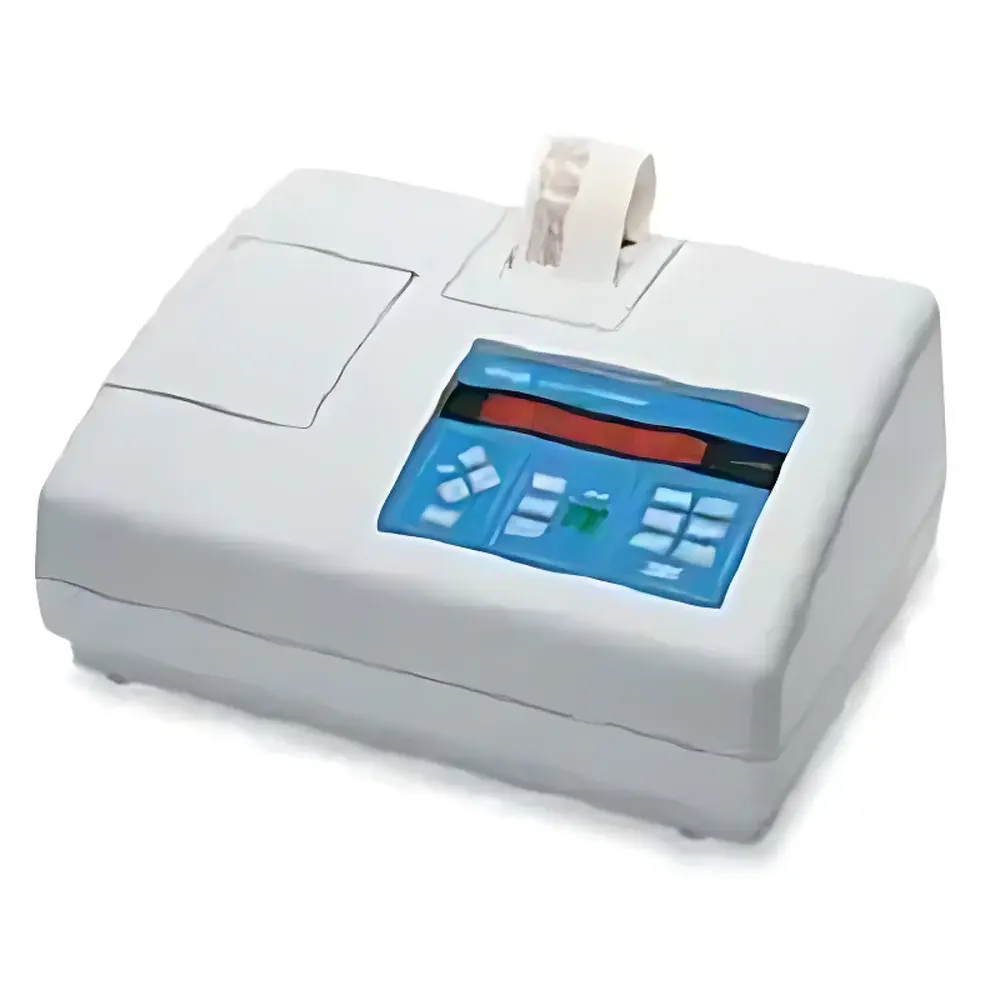
Hach 2100AN Laboratory Turbidimeter
| Brand | Hach |
|---|---|
| Origin | Imported |
| Manufacturer | Hach Company |
| Type | Benchtop/Laboratory |
| Measurement Range | Turbidity: 0–10,000 NTU |
| Color | 0–500 CU |
| Resolution | Turbidity: 0.001 NTU |
| Color | 1 CU |
| Operating Environment | 10–40 °C, ≤90% RH (non-condensing at 25 °C) |
| Accuracy | Turbidity: (1) 0–1,000 NTU: ±0.01 NTU or ±2% of reading |
| (2) 1,000–4,000 NTU | ±5% of reading |
| (3) 4,000–10,000 NTU | ±10% of reading. Color: (1) 0–30 CU: ±2 CU |
| (2) 0–500 CU | ±5 CU |
| Compliance | EPA Method 180.1 |
| Sample Volume | ≥20 mL |
| Measurement Units | NTU, NEP, EBC, ABS, T%, CU, and user-defined units |
| Repeatability | ±1% of reading or ±0.01 NTU |
| Power Supply | 230 V, 50/60 Hz |
| Weight | 3.43 kg |
Overview
The Hach 2100AN Laboratory Turbidimeter is a precision optical instrument engineered for high-accuracy turbidity and color measurement in regulated laboratory environments. Based on the nephelometric principle—measuring scattered light intensity at a 90° angle relative to the incident beam—the 2100AN employs Hach’s proprietary ratio measurement technology to minimize interference from sample color, suspended solids, and lamp aging. This dual-parameter capability enables simultaneous, traceable quantification of turbidity (in NTU and other internationally recognized units) and true color (in CU), supporting method-compliant analysis across drinking water, wastewater, surface and groundwater, as well as industrial process streams and academic research. Designed to meet U.S. Environmental Protection Agency (EPA) Method 180.1 requirements, the instrument delivers metrological integrity essential for regulatory reporting, quality assurance, and method validation under GLP and ISO/IEC 17025 frameworks.
Key Features
- Extended turbidity range up to 10,000 NTU with 0.001 NTU resolution—enabling precise low-level detection and high-concentration analysis without dilution.
- Ratiometric dual-detector optics that actively compensate for chromatic interference, ensuring accurate turbidity values even in highly colored samples such as humic-rich surface waters or dyed industrial effluents.
- Integrated thermal management and programmable air purge system to prevent condensation-induced scattering in cold or hot sample measurements—critical for reproducible results across variable temperature conditions.
- Onboard automatic calibration verification and self-diagnostic routines—including lamp intensity monitoring, detector signal validation, and optical path integrity checks—to maintain measurement confidence between scheduled maintenance intervals.
- Built-in thermal printer supporting direct output of measurement data, calibration records, date/time stamps, and operator ID—facilitating audit-ready documentation per FDA 21 CFR Part 11 and ISO 17025 record-keeping requirements.
- Programmable signal averaging (1–100 cycles) to suppress transient noise and improve statistical robustness for low-turbidity or unstable suspensions.
Sample Compatibility & Compliance
The 2100AN accommodates standard 20–50 mL glass or disposable cuvettes and is validated for use with aqueous matrices including potable water, clarified wastewater, raw influent, groundwater, and process rinse solutions. Its optical design conforms to ISO 7027 (nephelometric principle) and meets EPA Method 180.1 performance criteria for precision, linearity, and inter-laboratory reproducibility. The instrument supports traceability through NIST-traceable calibration standards (e.g., Formazin, AMCO AEPA-1, StablCal®), and its firmware includes configurable audit trails for calibration events, user logins, and result modifications—aligning with GLP and GMP data integrity expectations.
Software & Data Management
Data export and remote control are enabled via HachLink™ Software (Windows-compatible), which provides secure, time-stamped transfer of measurement logs, calibration history, and instrument configuration settings to local or networked storage. All exported files retain embedded metadata—including operator ID, sample ID, timestamp, unit selection, and environmental conditions—ensuring full data lineage. The software supports CSV and PDF report generation, customizable templates for lab-specific SOPs, and integration with LIMS platforms via ODBC-compliant drivers. Instrument firmware supports password-protected user roles (Operator, Supervisor, Administrator) to enforce procedural controls and prevent unauthorized parameter changes.
Applications
- Drinking water treatment: Monitoring coagulation efficiency, filter performance, and final disinfection clarity per WHO and EPA guidelines.
- Wastewater compliance: Quantifying effluent turbidity against NPDES permit limits and evaluating tertiary treatment efficacy.
- Environmental monitoring: Field-deployable lab verification of in-situ sensor data from rivers, lakes, and reservoirs.
- Pharmaceutical manufacturing: Assessing clarity of purified water (PW) and water-for-injection (WFI) per USP and EP 2.2.1.
- Academic research: Studying particle aggregation kinetics, flocculant dosing optimization, and colloidal stability under controlled hydrodynamic conditions.
- Food & beverage QA: Verifying suspension stability in juices, dairy products, and brewing wort prior to filtration or pasteurization.
FAQ
Does the 2100AN comply with EPA Method 180.1 for regulatory reporting?
Yes—the instrument is designed and factory-validated to meet all performance specifications outlined in EPA Method 180.1, including precision, accuracy, and linearity requirements across its full 0–10,000 NTU range.
Can the 2100AN measure both turbidity and color simultaneously in a single sample run?
No—it performs sequential turbidity and color measurements using the same optical path but requires separate instrument mode selections and cuvette rinsing between readings to avoid cross-contamination and spectral interference.
Is the built-in printer compliant with 21 CFR Part 11 for electronic records?
While the thermal printer generates permanent, human-readable records suitable for audits, full Part 11 compliance requires integration with HachLink™ Software configured for electronic signatures, audit trails, and secure user authentication—features supported in version 4.2 and later.
What is the minimum recommended sample volume, and does it vary by measurement mode?
A minimum of 20 mL is required for all modes; however, optimal repeatability is achieved with 40–50 mL to ensure consistent meniscus height and eliminate air bubble artifacts in the light path.
How frequently should calibration verification be performed in routine operation?
Hach recommends daily verification using primary standards (e.g., 20 NTU and 1,000 NTU StablCal®) when used in regulated environments; weekly full calibration is advised if instrument usage exceeds five samples per day or if environmental conditions fluctuate significantly.





