
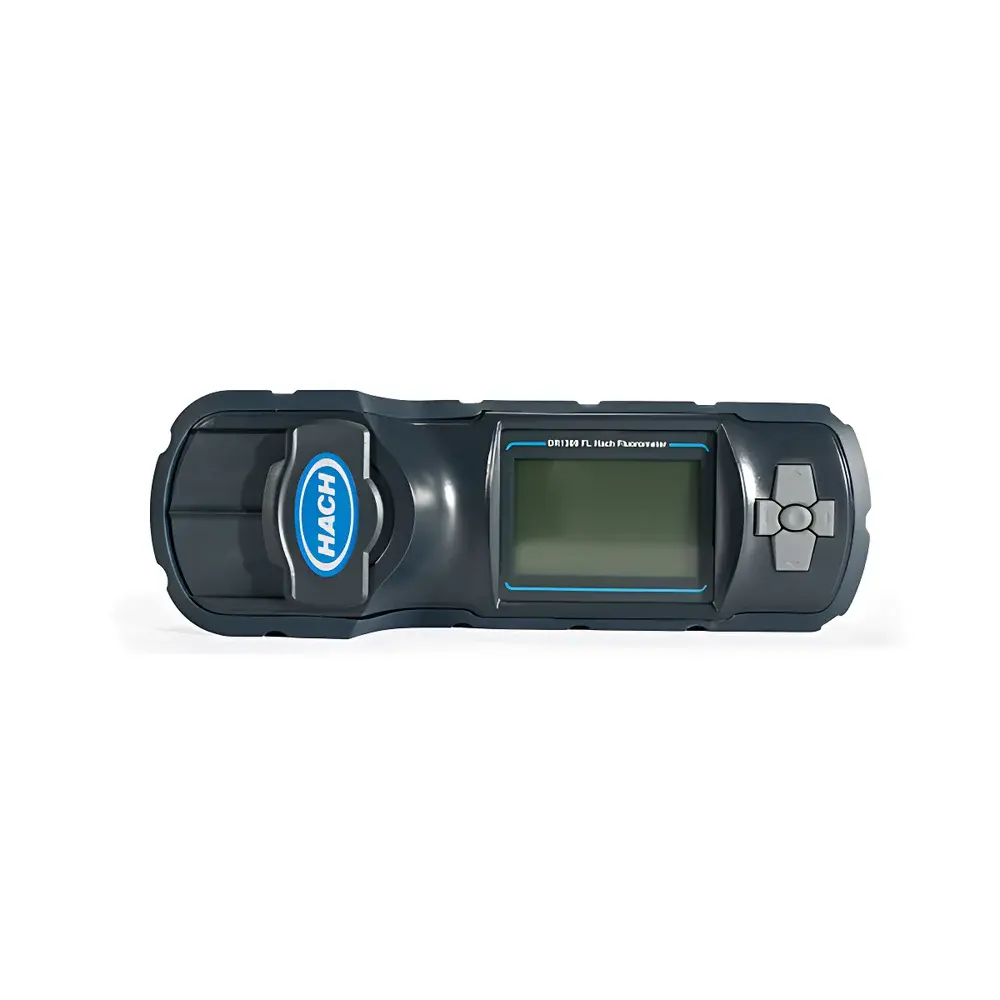
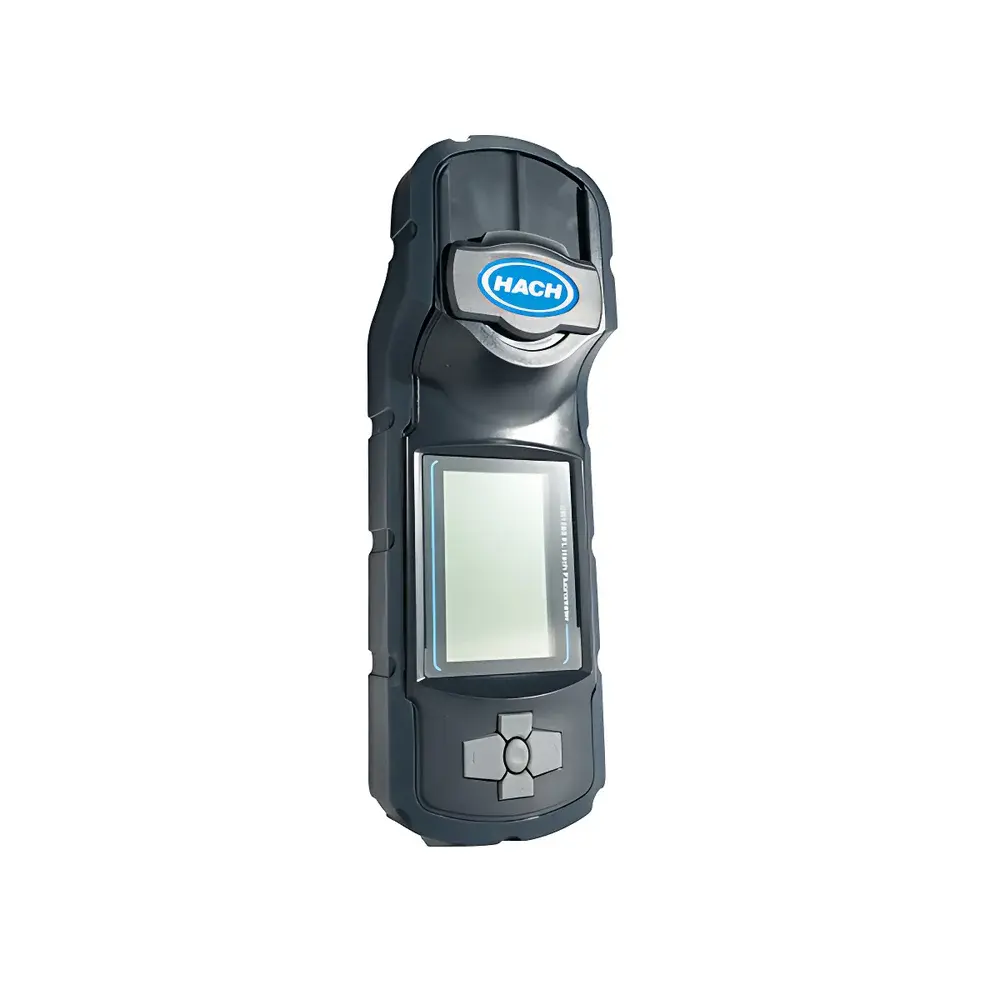
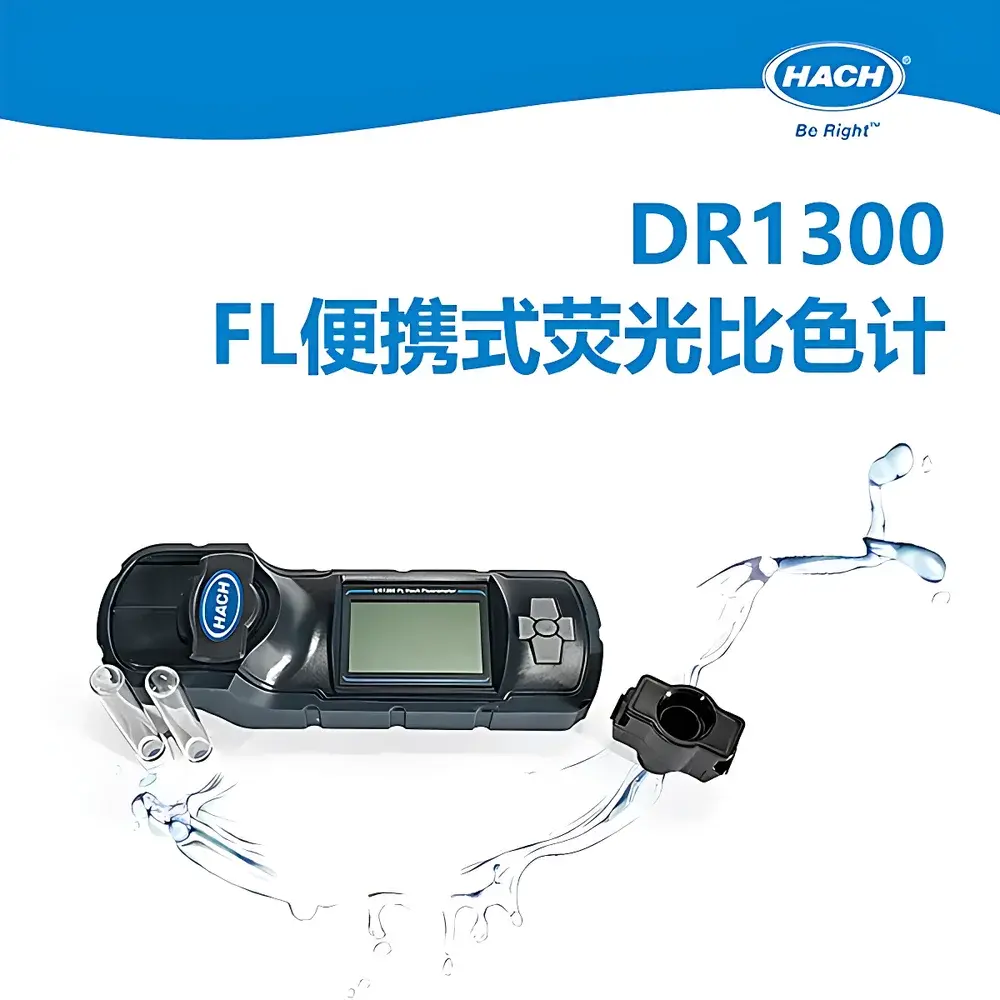
Hach DR1300 FL Portable Fluorometric Chlorine & Sulfite Analyzer
| Brand | Hach |
|---|---|
| Origin | Imported |
| Manufacturer Status | Manufacturer |
| Model | DR1300 FL |
| Price | Upon Request |
Overview
The Hach DR1300 FL is a portable, field-deployable fluorometric analyzer engineered for ultra-low-range quantification of free chlorine, total chlorine, and sulfite (as SO₃²⁻) in critical water treatment streams. Unlike conventional colorimetric or amperometric methods, the DR1300 FL employs Hach’s proprietary fluorescence-based detection principle: specific reagents react selectively with chlorine species or sulfite to form stable, highly fluorescent adducts. The instrument measures emitted fluorescence intensity at defined excitation/emission wavelengths—enabling direct, interference-resistant quantification without sample dilution or complex matrix correction. This optical methodology delivers high specificity in complex matrices such as boiler feedwater, RO permeate, ultrapure water (UPW), and pharmaceutical process water—where trace-level oxidant or reductant control is essential for membrane integrity, microbial control, and regulatory compliance.
Key Features
- Ultra-low detection capability: 2 ppb (0.002 mg/L) for free and total chlorine; 6 ppb (0.006 mg/L) for sulfite—validated per Hach Method 10194 (chlorine) and Method 10205 (sulfite)
- Fluorescence-specific chemistry eliminates common interferences from turbidity, colored organics, transition metals (e.g., Fe³⁺, Cu²⁺), and residual bromide or iodide
- Integrated, pre-calibrated reagent cartridges with barcoded lot tracking ensure method consistency and reduce operator error
- Rugged, IP67-rated housing with shock-absorbing rubber overmold designed for industrial plant floor and outdoor field use
- Onboard data logging with time-stamped results, user ID tagging, and audit-ready export via USB-C or Bluetooth 5.0
- Battery life exceeding 1,000 measurements per full charge (Li-ion, replaceable)
Sample Compatibility & Compliance
The DR1300 FL is validated for use with deionized water, reverse osmosis permeate, condensate, boiler feedwater, clean steam condensate, and purified water per USP and EP 2.2.42. It meets functional requirements outlined in ASTM D5117 (Standard Practice for Monitoring Residual Chlorine in High-Purity Water Systems) and supports GLP/GMP-aligned workflows through configurable user access levels, electronic signature support, and 21 CFR Part 11–compliant data integrity features (including immutable audit trails, password-protected method changes, and tamper-evident result archives). No external calibration standards are required during routine operation—factory calibration is traceable to NIST-certified reference materials.
Software & Data Management
Instrument firmware supports seamless integration with Hach’s Insight™ Mobile App (iOS/Android) and enterprise-level Hach WQX Cloud platform. Field measurements sync automatically with timestamp, GPS coordinates (optional), operator ID, and method version metadata. Data exports comply with ASTM E2500-13 and ISO/IEC 17025:2017 documentation requirements—including full uncertainty budgeting per measurement. Custom report templates can be generated for internal QA reviews or third-party audits. All raw fluorescence intensity values, blank-subtracted signals, and calibration curve parameters are retained in native format for retrospective analysis.
Applications
- RO system protection: Continuous monitoring of post-carbon bed chlorine breakthrough to prevent irreversible polyamide membrane oxidation
- Pharmaceutical water systems: Real-time verification of sulfite dosing efficacy prior to WFI generation, ensuring absence of residual oxidants that compromise sterilization validation
- Power generation: Feedwater chlorination control in combined-cycle plants to suppress biofilm formation without risking turbine blade pitting corrosion
- Microelectronics UPW loops: Detection of sub-ppb chlorine carryover after ion exchange polishing, safeguarding photolithography tool performance
- Food & beverage CIP rinse validation: Confirming complete removal of chlorine-based sanitizers prior to product contact surfaces
- Chemical process water: Sulfite residual monitoring in reducing-agent-controlled cooling towers to inhibit sulfate-reducing bacteria (SRB) proliferation
FAQ
What is the measurement principle used by the DR1300 FL?
It uses selective fluorogenic reaction chemistry followed by quantitative fluorescence intensity measurement at optimized excitation (λex = 365 nm) and emission (λem = 450 nm) wavelengths.
Does the instrument require daily calibration?
No—factory-installed calibration remains stable for ≥90 days under normal operating conditions; verification checks using certified reference standards are recommended weekly per ISO/IEC 17025.
Can it measure both chlorine and sulfite in the same sample without reagent change?
No—separate, dedicated reagent cartridges are required for chlorine and sulfite assays due to chemically distinct reaction pathways.
Is the DR1300 FL compliant with FDA 21 CFR Part 11?
Yes—when configured with multi-level user authentication, electronic signatures, and audit-trail-enabled firmware v3.2 or higher.
What sample volume is required per test?
10 mL of unfiltered, ambient-temperature sample is sufficient for all standard assays.







