
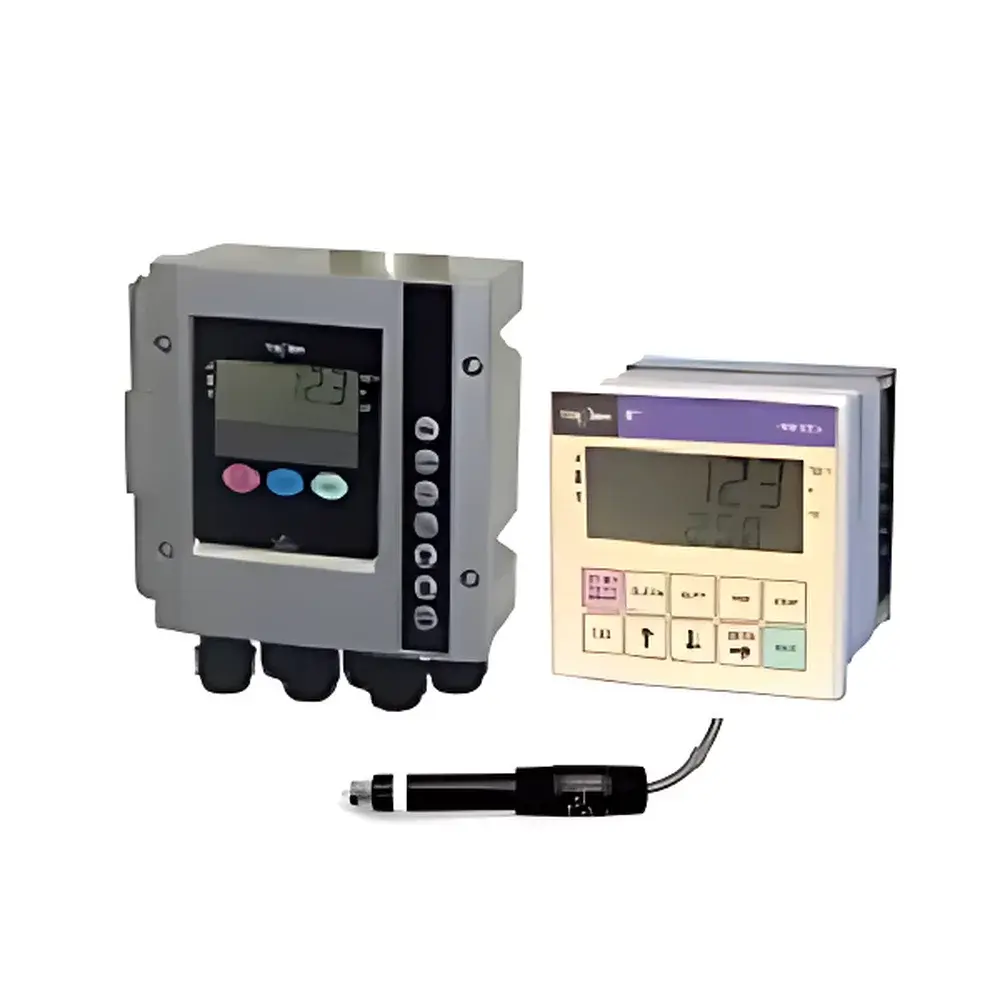
Hach DKK FBM-160 / FBM-100A Fluoride Ion Concentration Analyzer
| Brand | Hach |
|---|---|
| Origin | Imported |
| Manufacturer Type | Manufacturer |
| Model | FBM-160 / FBM-100A |
| Measurement Range | 0–99.9 mg/L, 0–999 mg/L, 0–9990 mg/L |
| Temperature Output (FBM-160 only) | 0.0–50.0 °C |
| Linearity | ±8% FS (controller) |
| Repeatability | ±5% FS (controller) |
| 90% Response Time | ≤60 s |
| Analog Output | DC 4–20 mA (650 Ω, isolated) |
| Digital Output | RS-232C (optional) |
| Alarm Outputs | 4 configurable |
| Power Supply | AC 90–264 V, 50/60 Hz |
| Environmental Rating | IP65 (FBM-160), IP30 (FBM-100A) |
| Operating Ambient | −20 to +55 °C, ≤95% RH |
| Sample pH Range | 4–9 |
| Sample Temperature | 0–40 °C (non-freezing) |
| Minimum Conductivity | 50 mS/m (500 µS/cm) |
| Flow Rate | 0.01–0.2 m/s |
| Interference Constraints | Avoid high concentrations of Ca²⁺, Al³⁺, Fe³⁺ |
Overview
The Hach DKK FBM-160 and FBM-100A Fluoride Ion Concentration Analyzers are industrial-grade online analyzers engineered for continuous, real-time monitoring of fluoride ion (F⁻) concentration in process water and wastewater streams. These instruments operate on the potentiometric principle using a solid-state, ion-selective electrode (ISE) specifically optimized for fluoride detection. The measurement relies on the Nernstian response of a lanthanum fluoride (LaF₃) crystal membrane, which generates a stable, logarithmic voltage potential proportional to the activity of free fluoride ions in solution. Unlike colorimetric or titrimetric methods, this approach requires no reagents, eliminates consumables, and delivers rapid, maintenance-light operation suitable for unattended 24/7 deployment. Designed for compliance-critical environments—including municipal water treatment, semiconductor rinse water monitoring, aluminum anodizing effluent control, and phosphate fertilizer production—the FBM series provides trace-level sensitivity and robust performance under variable hydraulic and chemical conditions.
Key Features
- Fluoride-specific ISE sensor with replaceable LaF₃ crystal membrane, ensuring long-term selectivity and calibration stability
- Non-refillable, double-junction reference electrode incorporating a porous fluorocarbon resin salt bridge—resistant to sulfide, heavy metal, and organic fouling
- Integrated temperature sensor (FBM-160 only) for automatic temperature compensation across 0.0–50.0 °C, critical for accurate activity-to-concentration conversion
- Field-installable controller with IP65-rated enclosure (FBM-160) for direct outdoor mounting on pipes, walls, or support brackets; FBM-100A features DIN 92 panel-mount design (IP30) for indoor control rooms
- Self-diagnostic routines continuously monitor electrode offset, slope, and response time—flagging drift or contamination before measurement integrity is compromised
- Four user-configurable relay outputs supporting high/low alarms, maintenance alerts, or interlock signaling per regulatory or operational protocols
- Isolated 4–20 mA analog output with programmable span (≥10% of full scale), enabling seamless integration into DCS, SCADA, or PLC systems
Sample Compatibility & Compliance
The FBM analyzers are validated for use in aqueous matrices meeting defined physicochemical constraints: sample pH must remain between 4.0 and 9.0 to prevent LaF₃ membrane hydrolysis or hydrogen ion interference; temperature must stay within 0–40 °C (non-freezing); and minimum conductivity of 50 mS/m (500 µS/cm) ensures adequate ionic strength for stable junction potential. Samples containing elevated concentrations of calcium, aluminum, or iron—common in hard water or metal-finishing effluents—may form insoluble fluorides (e.g., CaF₂), reducing free F⁻ availability and biasing results low. For such applications, inline acidification or chelation pretreatment is recommended. While not certified to ISO 10523 or ASTM D3869 as a standalone method, the instrument supports GLP/GMP data integrity requirements when paired with compliant data logging systems. Its analog and optional RS-232C interfaces facilitate audit-ready recordkeeping aligned with FDA 21 CFR Part 11 principles when deployed with validated software platforms.
Software & Data Management
The FBM series operates via embedded firmware with local configuration through a backlit LCD keypad interface—no PC required for basic setup. Calibration is performed using two-point standardization (e.g., 1.0 mg/L and 10.0 mg/L NaF solutions), with slope and offset values stored in non-volatile memory. All calibration history, alarm logs, and diagnostic events are timestamped and retained onboard. Optional RS-232C serial communication enables remote parameter adjustment, real-time data streaming, and automated report generation via third-party SCADA middleware or custom LabVIEW/Python scripts. Output data includes measured F⁻ concentration (mg/L), temperature (°C, FBM-160 only), electrode millivolt reading, and system status flags. No proprietary cloud platform or vendor-hosted software is required—ensuring full data sovereignty and compatibility with existing IT security policies.
Applications
- Continuous monitoring of fluoride discharge compliance at wastewater treatment plants subject to EPA 40 CFR Part 426 or local discharge permits
- In-line control of fluoridation dosing systems in drinking water distribution networks
- Effluent verification in aluminum smelting and etching operations where HF-based chemistry is employed
- Process water quality assurance in pharmaceutical clean steam condensate loops and biotech facility utility systems
- Environmental surveillance of groundwater near landfill leachate collection points or fluoride-mining sites
FAQ
What is the recommended calibration frequency?
Calibration should be performed at least once per week in stable applications; daily calibration is advised for high-variability or high-regulation environments (e.g., potable water fluoridation). Automatic slope validation during each calibration confirms electrode health.
Can the FBM measure fluoride in seawater or brine?
No. High chloride concentrations (>10,000 mg/L) and ionic strength beyond 1 mol/kg interfere with LaF₃ membrane selectivity and junction potential stability. Use is restricted to freshwater and low-salinity industrial effluents.
Does the analyzer require pH adjustment of the sample stream?
Not routinely—but if sample pH falls outside 4–9, an inline pH sensor and acid/base dosing module must be integrated upstream to maintain electrochemical validity.
How does the fluorocarbon salt bridge improve reliability over traditional ceramic junctions?
The hydrophobic, chemically inert fluorocarbon matrix resists clogging by colloids, oils, and precipitated metal hydroxides—extending service intervals in wastewater and cooling tower applications by up to 3× versus conventional designs.
Is the 4–20 mA output intrinsically safe for hazardous area installation?
No. The FBM-160’s analog output is not IS-certified. For Zone 1/2 or Class I Div 2 locations, a separately certified signal isolator or barrier must be installed in series per IEC 60079-11 or UL 913 requirements.
Related Products







