
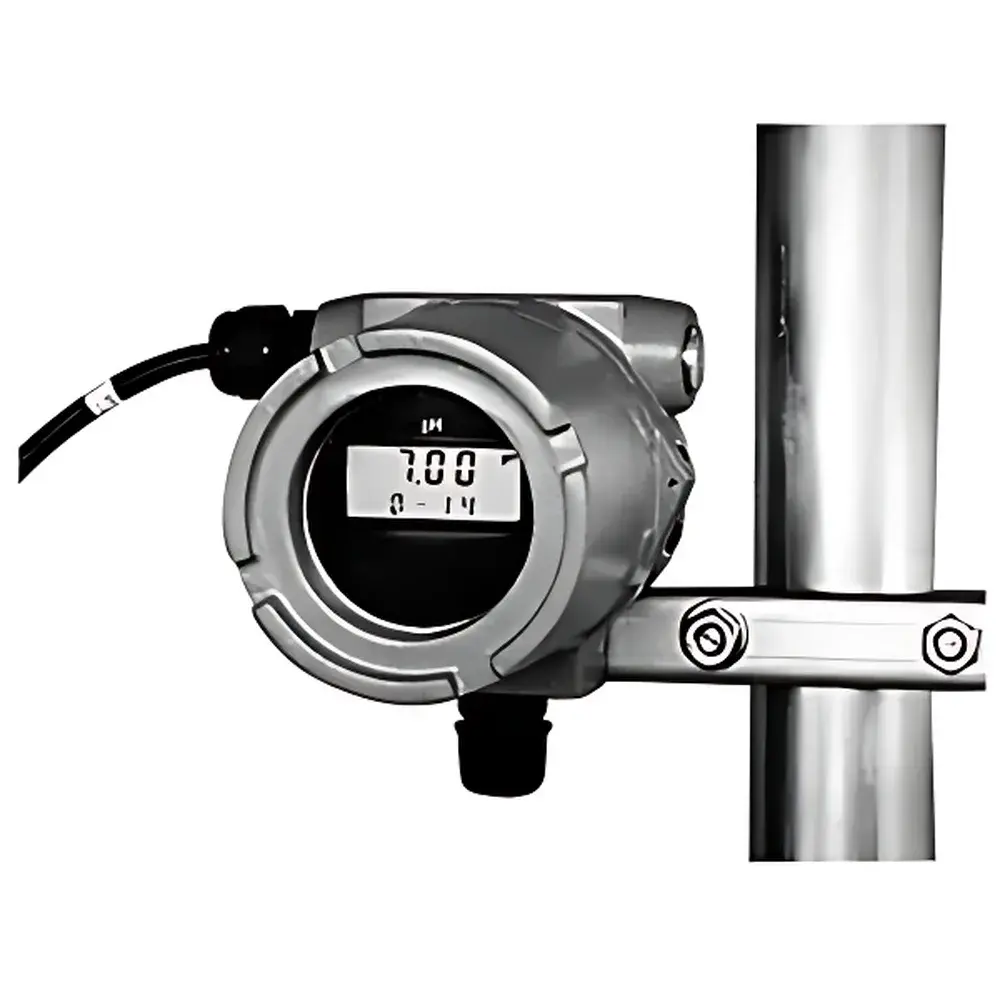
HACH DKK SRCP-20 Intrinsically Safe ORP Transmitter
| Brand | HACH |
|---|---|
| Origin | Imported |
| Manufacturer Type | Manufacturer |
| Model | SRCP-20 |
| Certification | IECEx/ATEX Ex ia IICT4 (Cert. No. TC15214) |
| Measurement Range | −2000 to +2000 mV |
| Temperature Display Range | 0–100 °C |
| Output | 2-wire 4–20 mA DC, isolated |
| Power Supply | 17.2–27 V DC |
| Accuracy (Output Linearity) | ±0.6% FS |
| Repeatability | < ±3 mV |
| Environmental Rating | IP65 |
| Operating Temperature | −20 to +55 °C |
| Relative Humidity | < 99% RH |
| Enclosure Material | Die-cast aluminum |
| Weight | 2 kg |
| Mounting | 2″ pipe (60.5 mm O.D.) or wall-mount |
| Cable Entry | 3×NPT |
Overview
The HACH DKK SRCP-20 is an intrinsically safe, two-wire ORP (Oxidation-Reduction Potential) transmitter engineered for continuous, high-reliability monitoring of redox activity in aqueous process streams and environmental water systems. Based on potentiometric measurement using a noble metal reference electrode (typically platinum or gold), the SRCP-20 detects the thermodynamic tendency of a solution to gain or lose electrons—expressed as millivolt (mV) potential relative to the Standard Hydrogen Electrode (SHE). Unlike pH, which measures hydrogen ion activity, ORP provides a holistic indicator of oxidative stress, disinfection efficacy (e.g., chlorine, ozone, chlorine dioxide), and biological stability in wastewater, drinking water, cooling towers, aquaculture, and industrial effluent treatment. Its Ex ia IICT4 certification (TC15214) enables deployment in Zone 0/1 hazardous areas where flammable vapors may be present—including chlorination rooms, chemical dosing stations, and biogas-handling facilities—without requiring explosion-proof enclosures.
Key Features
- Intrinsically safe design compliant with IEC 60079-0 and IEC 60079-11, certified for Zone 0 use (TC15214); suitable for Class I, Division 1 environments per NEC/CEC.
- Robust die-cast aluminum housing rated IP65, resistant to corrosion, UV degradation, and mechanical impact; blue finish for rapid field identification.
- Adjustable mounting bracket supports 2″ pipe (60.5 mm O.D.) or direct wall installation; integrated NPT ×3 cable entries ensure secure, drip-tight conduit connections.
- Embedded microprocessor enables full self-diagnostic capability: automatic detection of hardware faults, sensor disconnection, signal saturation, and data integrity errors.
- Configurable alarm behavior: upon fault detection, output can be forced to user-defined high-limit (22 mA), low-limit (3.6 mA), or hold-last-valid-value mode—critical for fail-safe process control integration.
- Electrode health verification via standard buffer check: displays measured mV vs. theoretical value (e.g., +420 mV in 2.5 mM K₃Fe(CN)₆/2.5 mM K₄Fe(CN)₆), enabling predictive maintenance and traceable calibration records.
- Measurement/maintenance mode toggle: during servicing, live ORP values remain visible while analog output freezes at pre-set hold value (last reading, user-defined setpoint, or configured offset)—preserving DCS/PLC continuity.
Sample Compatibility & Compliance
The SRCP-20 is validated for use in clean to moderately fouling aqueous matrices including potable water, secondary effluent, membrane filtrate, and low-conductivity industrial rinse water. It is not recommended for highly viscous, abrasive, or strongly reducing media containing sulfides or heavy metals without protective flow cells or periodic cleaning protocols. The device meets electromagnetic compatibility requirements per IEC 61326-1 (industrial environment) and carries CE marking under the EU ATEX Directive 2014/34/EU. Its analog output and internal diagnostics support compliance with ISO/IEC 17025 (for accredited labs), EPA Method 180.1 (ORP for disinfectant residual assessment), and GLP-aligned data integrity practices when paired with HACH SC1000 or similar controllers featuring audit-trail logging.
Software & Data Management
While the SRCP-20 operates as a standalone analog transmitter without embedded digital communication (e.g., no Modbus or HART), its 4–20 mA output is fully compatible with distributed control systems (DCS), programmable logic controllers (PLC), and SCADA platforms supporting current-loop input modules. When integrated into HACH’s ecosystem—including the SC200, SC1000, or Intellical™ sensor networks—the unit enables centralized configuration, remote diagnostic flagging, and trend-based electrode lifetime estimation. All configuration parameters (measurement range offset, alarm thresholds, hold-mode selection) are stored in non-volatile memory and survive power interruption. For regulatory applications governed by FDA 21 CFR Part 11, validation documentation—including IQ/OQ protocols, calibration certificates, and traceable test reports—is available through HACH’s global service network.
Applications
- Chlorine and chlorine dioxide dosing control in municipal drinking water plants—correlating ORP with CT value for pathogen inactivation compliance.
- Monitoring advanced oxidation processes (AOPs) such as UV/H₂O₂ or ozone systems, where rapid redox shifts indicate reaction kinetics and oxidant demand.
- Biological treatment optimization in activated sludge and MBR systems—detecting anaerobic/aerobic boundary transitions via ORP gradients.
- Cooling water management to prevent microbiologically influenced corrosion (MIC) through continuous redox surveillance of biocide residuals.
- Wastewater reuse applications verifying redox stability prior to membrane filtration or UV disinfection stages.
- Hazardous-area monitoring in pharmaceutical clean-in-place (CIP) loops and chemical synthesis reactors handling oxidizing reagents.
FAQ
What does “Ex ia IICT4” certification mean for the SRCP-20?
It certifies that the transmitter is intrinsically safe for use in explosive gas atmospheres classified as Group IIC (hydrogen, acetylene), Temperature Class T4 (surface temp ≤ 135°C), and Zone 0—the most stringent category permitting continuous operation even during frequent or prolonged gas release.
Can the SRCP-20 be used with non-HACH ORP electrodes?
Yes, provided the electrode meets standard BNC or DIN connector specifications and delivers a stable, low-impedance mV signal within the −2000 to +2000 mV range; however, HACH recommends EC-10 shielded cable and factory-calibrated Intellical™ ORP sensors to maintain specified accuracy and noise immunity.
How is measurement offset correction performed?
A manual ±100 mV zero-point adjustment is accessible via front-panel buttons, allowing field compensation for reference junction drift or electrolyte depletion—documented per ISO 15839 for method traceability.
Is temperature compensation applied to ORP readings?
No—ORP is a thermodynamically absolute potential and is not temperature-compensated like pH; the unit displays temperature (0–100°C) solely for operational context and troubleshooting, not for signal correction.
What maintenance intervals are recommended?
Electrode inspection every 3–6 months in continuous service; full calibration against certified redox standards (e.g., Zobell’s solution, quinhydrone) annually or after any physical damage, fouling event, or diagnostic alert.







