
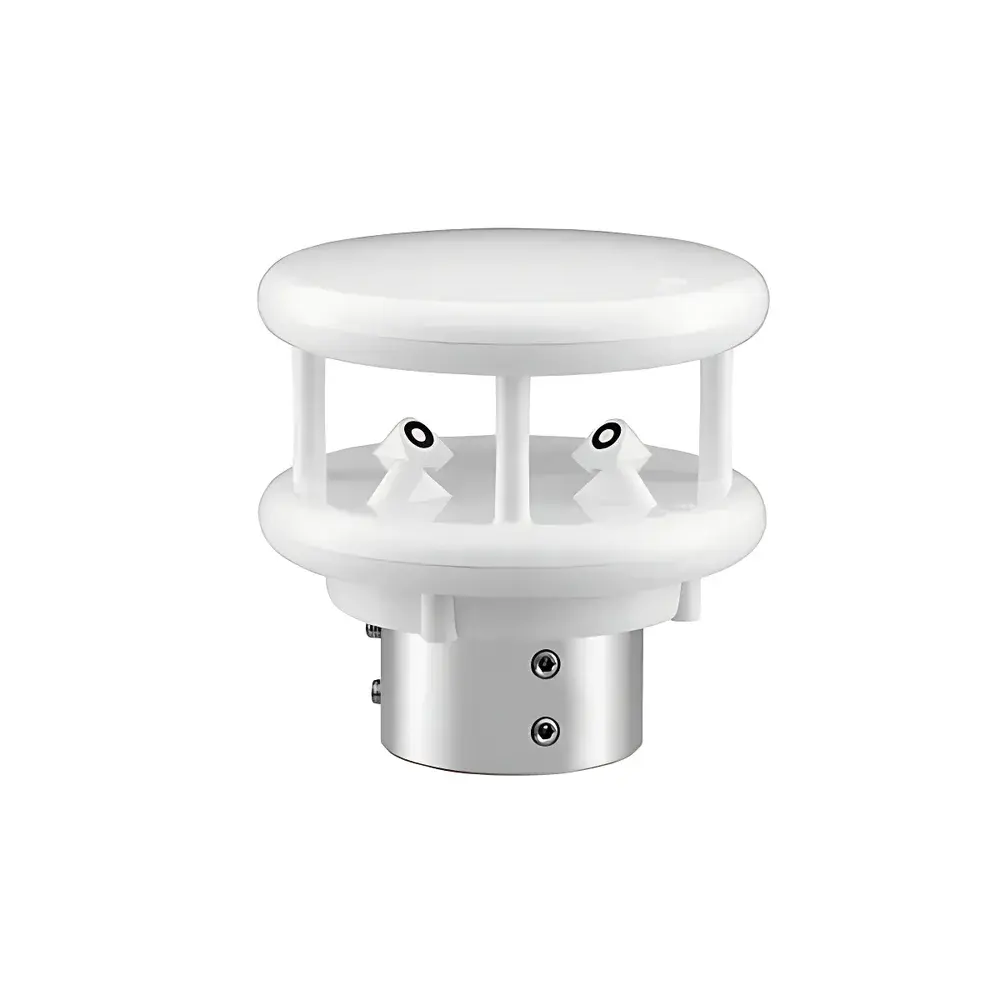
Lufft V200A-UMB Ultrasonic Wind Sensor
| Brand | Lufft |
|---|---|
| Origin | Imported |
| Model | V200A-UMB |
| Instrument Type | Ultrasonic Anemometer |
| Resolution | 0.1 m/s |
| Measurement Range | 0–90 m/s |
| Accuracy | ±0.3 m/s or ±3% RMS (0–35 m/s), whichever is greater |
| Operating Temperature | −40 to +60 °C (with integrated heater) |
| Relative Humidity Range | 0–100% RH |
| Output Interfaces | Digital (RS-485, SDI-12, Modbus RTU) and Configurable Analog (4–20 mA, 0–10 V, or frequency output) |
| Measured Parameters | Wind Speed, Wind Direction, Virtual Temperature, Atmospheric Pressure, Air Density |
Overview
The Lufft V200A-UMB is a high-reliability, all-in-one ultrasonic wind sensor engineered for continuous, maintenance-free environmental monitoring in demanding outdoor applications. It operates on the time-of-flight (TOF) principle—measuring the differential transit times of ultrasonic pulses across orthogonal transducer pairs—to derive true 3D wind vector components with no moving parts. Unlike mechanical cup-and-vane anemometers, the V200A-UMB eliminates mechanical wear, inertia-induced lag, and directional dead zones. In addition to wind speed and direction, it integrates MEMS-based capacitive barometric pressure sensing and calculates virtual temperature from the speed of sound in air—enabling real-time derivation of air density using the ideal gas law. This multi-parameter capability supports advanced meteorological modeling, energy yield assessments, and atmospheric boundary layer studies without requiring external sensor fusion.
Key Features
- True ultrasonic wind measurement with no moving parts—ensuring long-term stability and zero mechanical drift
- Integrated heating element enables reliable operation down to −40 °C, preventing ice accumulation on transducers and maintaining measurement continuity in freezing fog, snow, or rime conditions
- Simultaneous output of five core atmospheric parameters: wind speed, wind direction, virtual temperature, atmospheric pressure, and air density—reducing system integration complexity
- Dual-output architecture: RS-485 (Modbus RTU, SDI-12 compatible) and configurable analog outputs (4–20 mA, 0–10 V, or pulse/frequency) for seamless integration into SCADA, PLC, and legacy data loggers
- Robust IP66-rated aluminum housing with marine-grade stainless-steel fasteners—certified for outdoor deployment in coastal, industrial, and high-UV environments
- Low power consumption (<1.5 W typical, <3.5 W with heater active) suitable for solar-powered remote stations
Sample Compatibility & Compliance
The V200A-UMB is designed for open-air atmospheric sampling under unobstructed exposure per WMO Guide to Meteorological Instruments and Methods of Observation (CIMO Guide, Chapter 8). Its physical footprint and mounting geometry comply with ISO 16485:2021 (Wind measurement—Requirements for ultrasonic anemometers) and IEC 61000-6-2/6-4 for electromagnetic compatibility. The pressure sensor meets EN 13723:2018 accuracy requirements for barometric measurements in environmental monitoring. While not certified as a medical or safety-critical device, its design supports GLP-aligned data acquisition when deployed with audit-trail-capable data loggers. No calibration traceability to NIST or PTB is embedded—but factory calibration reports (including wind tunnel verification at multiple speeds and directions) are supplied with each unit.
Software & Data Management
The sensor communicates natively via ASCII-based protocols (SDI-12, Modbus RTU) and supports configurable output intervals (1 s to 30 min). Lufft’s free UMB ConfigTool enables field configuration of units, averaging periods, heater activation thresholds, and alarm conditions (e.g., signal loss, heater fault). When integrated with third-party platforms such as Campbell Scientific LoggerNet, DTN Meteotest, or WindPRO, the V200A-UMB delivers time-synchronized, timestamped datasets compliant with CF Metadata conventions. Raw ultrasonic TOF values are not exposed—only validated, temperature-compensated, and turbulence-filtered physical quantities are transmitted, ensuring consistency across firmware updates. Optional firmware extensions support MQTT publishing for IIoT edge deployments.
Applications
- Meteorological networks and national weather services requiring WMO-compliant wind profiling at synoptic and mesoscale sites
- Wind resource assessment for onshore and offshore wind farm development—including IEC 61400-12-1 pre-construction measurement campaigns
- Airport and seaport ASOS/AWOS systems where icing resilience and rapid response to wind shear events are critical
- Thermal power plant stack emission dispersion modeling, where air density and virtual temperature inform buoyancy-driven plume rise calculations
- Research-grade eddy covariance flux towers measuring sensible and latent heat exchange—leveraging high-frequency wind vector data (up to 20 Hz optional firmware)
- Urban climate monitoring and smart city infrastructure integrating real-time ventilation potential mapping
FAQ
Does the V200A-UMB require periodic recalibration?
No scheduled recalibration is mandated by Lufft. Long-term drift is minimized by thermal compensation algorithms and stable MEMS pressure elements. Users are advised to perform functional verification annually using a reference anemometer per ISO 17025-accredited procedures if used in regulated reporting contexts.
Can the heater be controlled externally?
Yes—the heater operates automatically below −5 °C by default, but digital control via Modbus register allows manual override or integration with ambient temperature inputs from co-located sensors.
Is the air density output derived or measured?
Air density is calculated in real time using the ideal gas law: ρ = P / (Rspecific × Tv), where P is measured barometric pressure, Tv is virtual temperature, and Rspecific is the specific gas constant for dry air adjusted for humidity—no separate hygrometer is required.
What is the maximum cable length for RS-485 communication?
Up to 1,200 meters is supported with proper twisted-pair shielding and termination, consistent with EIA/TIA-485-A specifications.
Is the V200A-UMB suitable for marine salt-spray environments?
Yes—its anodized aluminum housing, stainless-steel hardware, and conformal-coated PCBs meet ISO 9223 C5-M corrosion classification requirements for offshore installations.
Related Products







