
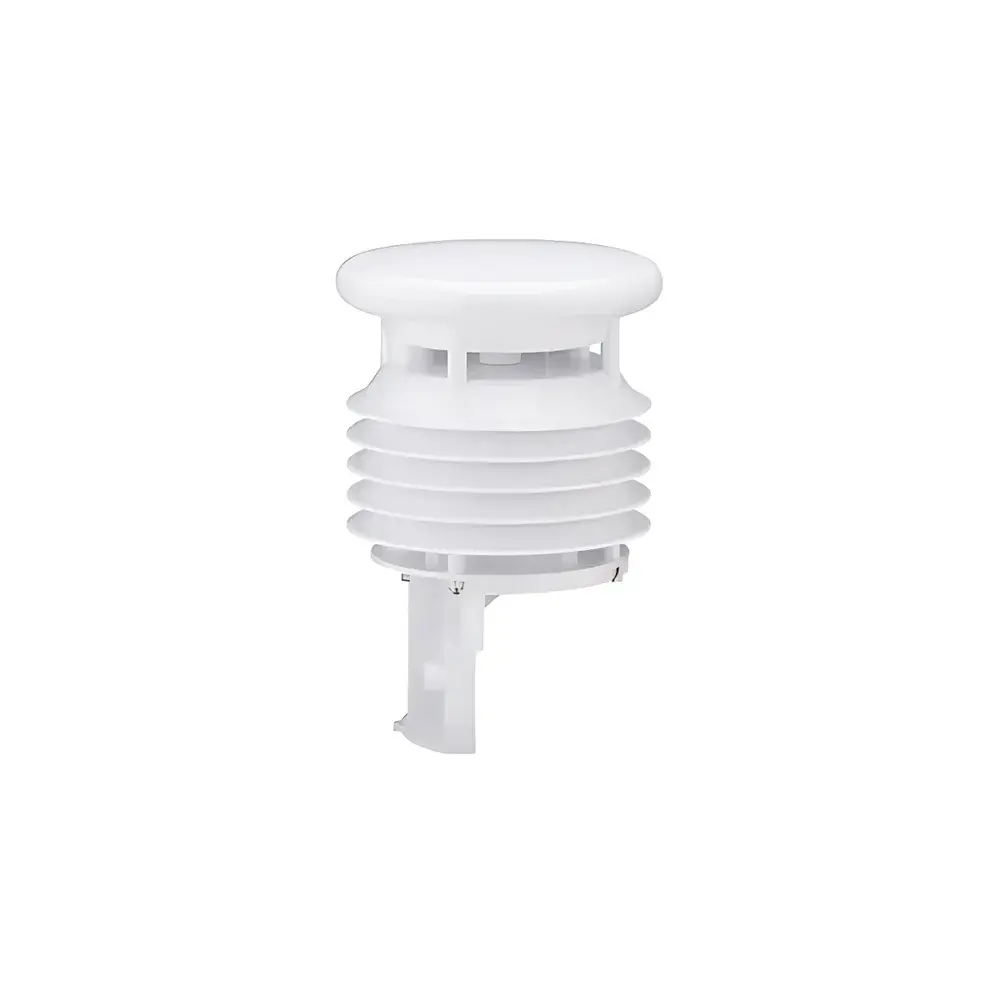
Lufft WS300-UMB All-in-One Weather Station
| Brand | Lufft |
|---|---|
| Model | WS300-UMB |
| Measurement Parameters | Air Temperature, Relative Humidity, Atmospheric Pressure, Dew Point Temperature |
| Sensor Principles | NTC Thermistor (Temperature), Capacitive Polymer (Humidity), MEMS Barometric Sensor (Pressure) |
| Power Supply | Low-power design, compatible with solar power systems |
| Enclosure | Compact, integrated, IP66-rated housing |
| Fan-Assisted Aspiration | Integrated active ventilation fan for radiation-shielded temperature/humidity measurement |
| Communication Interfaces | RS-232, RS-485, SDI-12, Modbus RTU, CAN bus, UMB-ASCII |
| Expandability | Supports external rain gauge, PT100/PT1000 temperature probes, and third-party analog/digital sensors |
| Compliance | CE, RoHS, WEEE, EN 61326-1 (EMC), EN 61000-6-2/-6-4 |
| Operating Temperature Range | –40 °C to +70 °C |
| Storage Temperature Range | –40 °C to +70 °C |
| Relative Humidity Range | 0–100 % RH (non-condensing) |
| Pressure Range | 500–1100 hPa |
| Typical Power Consumption | <1.5 W (standby), <3.2 W (fan active) |
Overview
The Lufft WS300-UMB is a compact, fully integrated all-in-one weather station engineered for long-term, unattended environmental monitoring across diverse operational domains. Designed around precision micro-electro-mechanical systems (MEMS) and high-stability solid-state sensing elements, the WS300-UMB delivers continuous, traceable measurements of ambient air temperature, relative humidity, atmospheric pressure, and derived dew point temperature. Its core architecture employs an actively ventilated radiation shield—driven by a low-noise, brushless DC fan—to ensure thermodynamic equilibrium between sensor elements and ambient air, minimizing solar loading errors and thermal lag. This aspiration system conforms to WMO guidelines for Class B passive/active shielding, enabling reliable data acquisition under high-solar-exposure conditions typical of roadside, photovoltaic farm, or airport apron deployments. The device operates on ultra-low power consumption, supporting off-grid operation via standard 12 V DC input—including compatibility with solar-charged battery systems—making it suitable for remote installations where grid access is unavailable or unreliable.
Key Features
- Integrated sensor suite housed in a single IP66-rated, UV-stabilized polycarbonate enclosure for mechanical robustness and environmental resilience.
- Active aspiration system with intelligent fan control: fan activates automatically when solar irradiance exceeds predefined thresholds or ambient temperature gradients exceed calibration stability limits.
- NTC thermistor (Class A per IEC 60751) for temperature measurement with ±0.2 °C accuracy over –20 °C to +60 °C range; capacitive polymer humidity sensor with ±2 % RH accuracy (10–90 % RH, 23 °C).
- High-resolution MEMS barometric pressure sensor with ±0.1 hPa absolute accuracy and long-term drift <0.1 hPa/year, temperature-compensated across full operating range.
- UMB-ASCII protocol support enables seamless integration into existing UMB-based telemetry networks widely deployed across European infrastructure monitoring systems.
- Multi-protocol communication stack (RS-232/485, SDI-12, Modbus RTU, CAN) ensures interoperability with SCADA platforms, PLCs, and legacy environmental data loggers without protocol gateways.
- Expandable architecture supports connection of external tipping-bucket rain gauges (pulse or analog), Pt100/Pt1000 reference thermometers, and calibrated anemometers via configurable digital I/O or analog inputs.
Sample Compatibility & Compliance
The WS300-UMB is designed for outdoor deployment in non-explosive atmospheres per ATEX Category 3G (optional certification available). It complies with electromagnetic compatibility standards EN 61326-1 (industrial environment) and EN 61000-6-2 (immunity) / EN 61000-6-4 (emissions). Its sensor outputs meet traceability requirements for environmental reporting under ISO/IEC 17025-accredited laboratories when used with documented calibration certificates (NIST-traceable options available). The device supports audit-ready data logging with timestamped metadata, fulfilling foundational requirements for GLP-aligned environmental monitoring programs. While not intrinsically certified for hazardous locations, its ingress protection (IP66) and wide operating temperature range validate suitability for coastal, alpine, desert, and urban canyon environments.
Software & Data Management
Data acquisition and configuration are managed via Lufft’s free UMB ConfigTool (Windows-based) or through standardized ASCII command sets accessible via terminal emulation. Raw sensor values are output at user-configurable intervals (1 s to 24 h), with internal buffering up to 4 MB. The station supports both polled and autonomous transmission modes. When integrated into larger monitoring networks using UMB-ASCII or Modbus, it natively supports time-synchronized data frames with embedded CRC checksums. For regulatory compliance applications—such as those governed by EU Directive 2008/50/EC (ambient air quality) or national road weather information systems (RWIS)—the WS300-UMB can be configured to generate CSV or XML-formatted reports compliant with EN 13319 and ASTM E2584 data exchange conventions. Optional firmware updates enable future-proofing for evolving telemetry protocols and security patches.
Applications
- Road weather information systems (RWIS): Real-time input for black ice prediction, salting dispatch optimization, and visibility assessment along highways and mountain passes.
- Photovoltaic yield forecasting: Correlation of module temperature, irradiance proxy (via dew point depression), and ambient pressure for performance ratio modeling.
- Hydrometeorological networks: Integration into national water resource monitoring frameworks for evapotranspiration estimation and flood early-warning systems.
- Air quality monitoring stations: Provision of meteorological context (stability class, mixing height estimation) essential for dispersion modeling and source apportionment studies.
- Civil aviation and port authority operations: Surface weather observation supporting NOTAM generation, wind shear detection, and runway condition reporting per ICAO Annex 3 requirements.
- Smart city infrastructure: Embedded environmental layer for adaptive lighting, irrigation scheduling, and public health alert systems.
FAQ
Does the WS300-UMB require periodic recalibration?
Yes. Lufft recommends annual verification against traceable reference standards; field recalibration is possible using portable metrology-grade references for temperature and humidity. Pressure sensor drift remains within specification for ≥2 years under stable thermal conditions.
Can the device operate without the internal fan?
Yes—fan operation is configurable. However, disabling aspiration degrades temperature/humidity accuracy under direct solar exposure (>500 W/m²), particularly during low-wind conditions. WMO-compliant accuracy requires active aspiration.
Is MODBUS TCP supported?
No. The WS300-UMB implements Modbus RTU over RS-485 only. Ethernet or TCP/IP connectivity requires an external protocol converter or gateway.
What is the maximum cable length for RS-485 communication?
Up to 1,200 meters at 9.6 kbps, assuming proper twisted-pair cabling with termination resistors and grounding per TIA/EIA-485-A.
Are calibration certificates included with shipment?
A factory calibration report (ISO/IEC 17025 accredited, optional upon order) is provided. NIST-traceable certificates require separate procurement and additional lead time.
Related Products







