
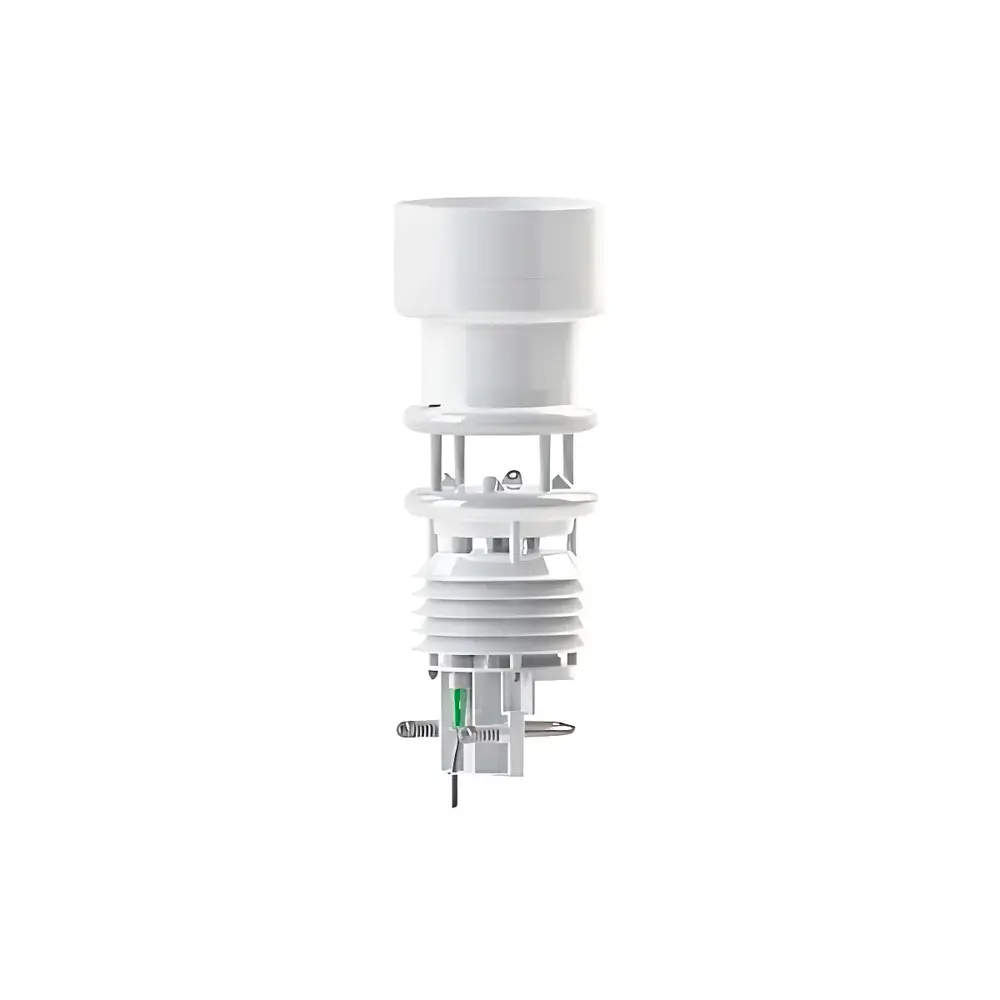
Lufft WS601-UMB Ultrasonic Weather Station
| Brand | Lufft |
|---|---|
| Model | WS601-UMB |
| Measurement Parameters | Wind Speed, Wind Direction, Air Temperature, Relative Humidity, Atmospheric Pressure, Precipitation |
| Principle | Ultrasonic Time-of-Flight (Wind), NTC Thermistor (Temperature), Capacitive Polymer Sensor (Humidity), MEMS Capacitive Barometer (Pressure), Tipping-Bucket Rain Gauge (Precipitation) |
| Power Supply | Low-power design, solar-compatible |
| Enclosure | Compact all-in-one housing with active ventilation fan and heated ultrasonic transducers |
| Output | Wind quality indicator, integrated electronic compass, optional external temperature probe support |
| Communication Protocols | Modbus RTU/ASCII, SDI-12, CAN bus, ASCII serial, optional MQTT/HTTP for IoT integration |
| Compliance | IP66 rated enclosure, CE marked, RoHS compliant |
Overview
The Lufft WS601-UMB is a compact, all-in-one ultrasonic weather station engineered for continuous, high-reliability environmental monitoring in demanding outdoor applications. It employs time-of-flight ultrasonic anemometry to simultaneously determine wind speed and direction without moving parts—eliminating mechanical wear and ensuring long-term stability under icing, dust, or high-wind conditions. Air temperature is measured using a precision NTC thermistor housed within a ventilated radiation shield; relative humidity is derived from a polymer capacitive sensor with temperature compensation; atmospheric pressure is acquired via a calibrated MEMS capacitive barometric sensor; and precipitation is quantified using a calibrated tipping-bucket rain gauge meeting WMO guidelines for accuracy and drainage response. The system integrates an active ventilation fan to minimize thermal lag and solar heating artifacts, while heated ultrasonic transducers prevent ice accumulation—critical for consistent performance in sub-zero climates.
Key Features
- Ultrasonic wind measurement with built-in electronic compass for true north-referenced directional output and real-time wind quality assessment (e.g., signal-to-noise ratio, data validity flag)
- Low-power architecture optimized for solar-powered deployments: typical average consumption < 1.5 W (with fan and heater cycled per ambient conditions)
- Integrated active ventilation fan ensures representative air sampling and reduces radiative heating error on temperature/humidity sensors
- Heated ultrasonic transducers maintain operational readiness down to –30 °C, validated per IEC 60068-2-1 and IEC 60068-2-30 test profiles
- Modular sensor architecture supports optional external Pt100 or Pt1000 temperature probes for surface or soil profiling
- Ruggedized aluminum housing rated IP66, conformal-coated PCBs, and stainless-steel mounting hardware for extended service life in coastal, industrial, or high-UV environments
Sample Compatibility & Compliance
The WS601-UMB is designed for unattended operation across diverse environmental regimes—from alpine meteorological networks to roadside ITS infrastructure and utility-scale solar farms. Its sensor suite meets fundamental metrological requirements outlined in WMO Guide to Instruments and Methods of Observation (CIMO Guide, Chapter 12) for synoptic and climatological observations. The tipping-bucket rain gauge complies with ISO 9060:2018 Class B specifications for precipitation intensity and accumulation accuracy. All electrical interfaces adhere to IEC 61000-4 immunity standards (ESD, surge, fast transient burst). The device carries CE marking under the EMC and RoHS directives and is supplied with factory calibration certificates traceable to national metrology institutes (e.g., PTB, NIST).
Software & Data Management
Data acquisition and configuration are managed via Lufft’s UMB-Config software (Windows-based) or through standardized ASCII command sets over RS-485 or RS-232. The station natively supports Modbus RTU/ASCII (slave mode), SDI-12 (for integration with Campbell Scientific or similar dataloggers), and CAN bus (J1939-compliant). For modern IIoT deployments, optional firmware enables MQTT v3.1.1 publishing to TLS-secured brokers or HTTP POST to RESTful endpoints—supporting JSON payloads with timestamped, quality-flagged measurements. Internal non-volatile memory retains ≥30 days of 1-minute averaged data during communication outages. Audit trails, configuration change logs, and sensor health diagnostics are accessible via serial interface, facilitating GLP/GMP-aligned maintenance records.
Applications
- Road weather information systems (RWIS): Real-time input for fog, black ice, and wind hazard alerts per ASTM E2774 and EN 12830 standards
- Photovoltaic plant performance monitoring: Correlation of irradiance (when paired with pyranometer), temperature, wind, and soiling rate models
- Hydrological and flood forecasting networks: Integrated rainfall + evapotranspiration estimation using Penman-Monteith inputs
- Air quality monitoring stations: Meteorological context for PM₂.₅, NO₂, and O₃ concentration interpretation per EU Directive 2008/50/EC
- Aviation and port operations: Turbulence index derivation, crosswind component calculation, and low-visibility event correlation per ICAO Annex 3 and IMO Resolution A.1120(30)
FAQ
Does the WS601-UMB require periodic recalibration?
Yes—Lufft recommends annual verification against traceable reference standards for temperature, humidity, and pressure; wind and rain sensors are field-validated every 24 months per ISO/IEC 17025-accredited procedures.
Can the station operate reliably in heavy snowfall or freezing rain?
Yes—the heated ultrasonic transducers and active ventilation system mitigate ice bridging and snow accumulation; the tipping-bucket rain gauge includes a heated rim option (WS601-UMB-HR) for enhanced winter performance.
Is the device compatible with third-party SCADA platforms?
Yes—native Modbus RTU/ASCII and SDI-12 protocols ensure seamless integration with Siemens Desigo, Schneider EcoStruxure, or Ignition SCADA systems without proprietary middleware.
What is the typical data latency for real-time transmission?
With RS-485 at 19.2 kbps and default 10-second polling, end-to-end latency from sensor reading to host system is ≤150 ms; MQTT over cellular adds variable network-dependent delay (typically 200–800 ms).
How is sensor health monitored remotely?
The station reports internal diagnostics—including heater status, fan RPM, ultrasonic signal amplitude, and battery voltage—via dedicated Modbus registers or ASCII status frames, enabling predictive maintenance workflows.







