
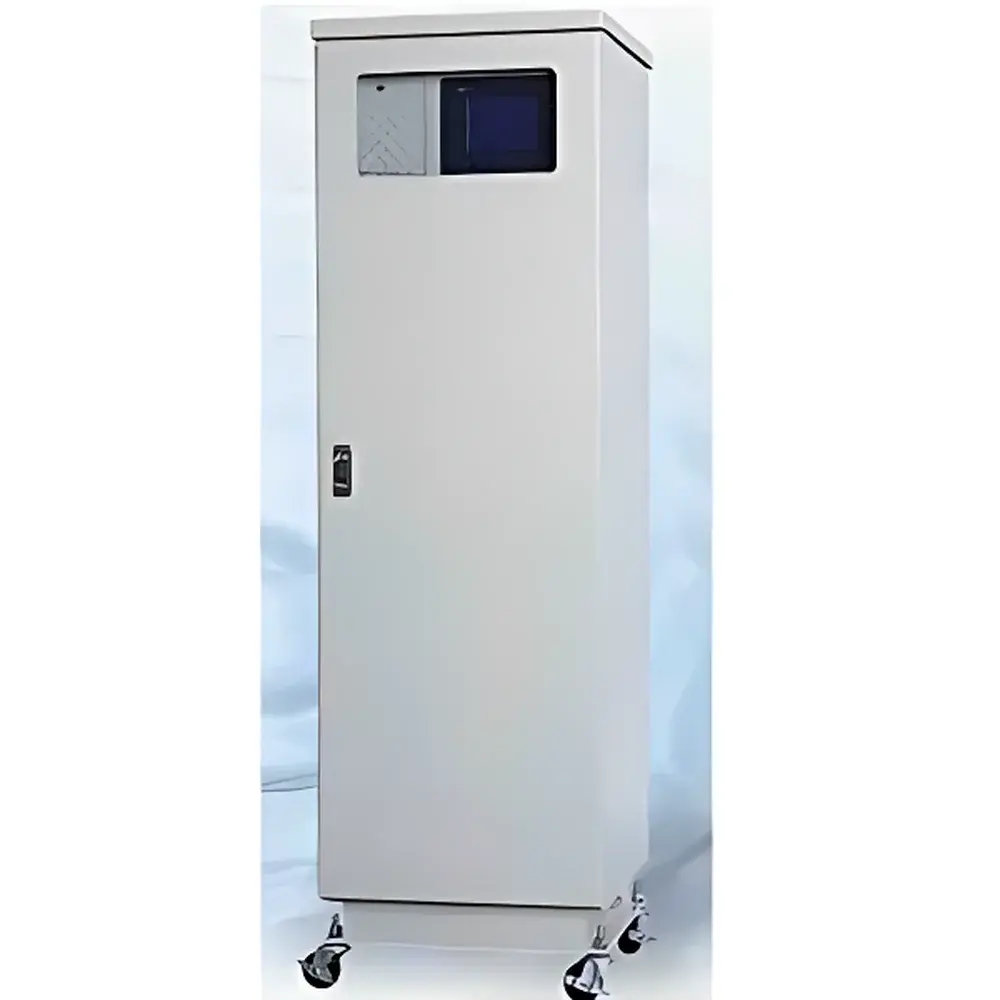
HACH XAT-200 Series Online Iron Analyzer (Fe)
| Brand | HACH |
|---|---|
| Origin | Imported |
| Manufacturer Type | Manufacturer |
| Model | XAT-200 |
| Measurement Principle | TPTZ-based spectrophotometry at 595 nm |
| Measurement Range | 0–0.5 mg/L Fe |
| Accuracy | ±5% FS |
| Repeatability | ±5% FS |
| Cycle Time | 60–999 min (user-configurable) |
| Sample Temp | 10–40 °C |
| Sample pH | 5–9 |
| Suspended Solids (SS) | <20 mg/L |
| Particle Size | <20 µm |
| Dilution/Wash Water Pressure | 0.05–0.15 MPa |
| Wash Water Flow | 0.2–1 L/min |
| Wash Water Temp | 15–35 °C |
| Wash Water Conductivity | <0.1 mS/m |
| Carrier Gas Pressure | 0.4–0.7 MPa |
| Gas Consumption | 10 NL/min |
| Analog Output | DC 4–20 mA (1 channel, 600 Ω load) |
| Digital I/O | Relay outputs for alarm, fault, and power-loss signals (DC 24 V / 1 A or AC 125 V / 0.3 A) |
| Data Storage | Internal CF card with auto-backup |
| Power Supply | AC 220 V ±10%, 50/60 Hz |
| Power Consumption | ~800 VA |
| Weight | ~120 kg |
| Operating Environment | 10–40 °C, ≤80% RH (non-condensing), indoor installation only |
Overview
The HACH XAT-200 Series Online Iron Analyzer is an industrial-grade, fully automated process analyzer engineered for continuous, unattended quantification of dissolved and particulate-bound iron (Fe) in water streams. It employs the validated TPTZ (2,4,6-tris(2-pyridyl)-s-triazine) spectrophotometric method—a standardized colorimetric technique recognized for its selectivity toward Fe2+ under controlled acidic-reducing conditions. Unlike conventional grab-sample methods, the XAT-200 integrates high-temperature acid digestion (HCl-mediated hydrolysis at elevated pressure and temperature) to convert colloidal iron and particulate iron oxides into soluble Fe2+, ensuring comprehensive recovery prior to complexation with TPTZ. The resulting blue-colored Fe2+–TPTZ complex is measured at 595 nm using a stable optical path and temperature-compensated photometer. This approach delivers robust performance in demanding applications where iron speciation, matrix interference, and long-term drift control are critical—particularly in boiler feedwater, desalination pretreatment, municipal surface water intake, and industrial cooling circuits.
Key Features
- Integrated high-pressure acid digestion module enabling complete dissolution of colloidal and suspended iron species (e.g., FeOOH, Fe2O3) prior to analysis
- Automated reagent handling, sample dilution, reaction timing, and system cleaning—reducing manual intervention and operator dependency
- Touchscreen HMI with intuitive navigation, real-time status visualization, and configurable measurement cycle (60–999 minutes)
- Dual-stage fluidic architecture with precision peristaltic pumps and solenoid valves for reproducible sample/reagent metering
- Onboard CF card supporting time-stamped data logging, automatic backup, and audit-ready export (CSV format)
- Self-diagnostic routines including flow verification, photometric zero/span validation, reagent depletion alerts, and heater/temperature fault detection
- Modular design allowing future expansion with additional analyte modules (e.g., Mn, Cu, Zn) on shared platform hardware
Sample Compatibility & Compliance
The XAT-200 is validated for use with low-turbidity aqueous matrices meeting defined physicochemical constraints: pH 5–9, temperature 10–40 °C, suspended solids <20 mg/L, and particle diameter <20 µm. Samples exceeding these limits require pre-filtration or conditioning upstream. The analyzer complies with fundamental requirements of ISO 5667-3 (water sampling), ASTM D1068 (iron in water), and supports GLP/GMP-aligned operational practices through timestamped event logs, password-protected configuration access, and non-volatile memory retention. While not inherently 21 CFR Part 11 compliant out-of-the-box, its data integrity framework—including immutable CF card storage, user action logging, and relay-based alarm traceability—facilitates integration into regulated environments when deployed with validated SOPs and external audit systems.
Software & Data Management
Data acquisition and instrument control are managed via embedded firmware with no external PC dependency. All measurements, diagnostic events, calibration records, and alarm triggers are stored locally on the internal CF card with millisecond-level timestamps. Export is supported via USB interface (no network connectivity required), enabling secure offline transfer to LIMS or SCADA systems. The HMI provides real-time trend plots, historical data review (up to 30 days at default 15-min intervals), and customizable alarm thresholds with hysteresis. Analog output (4–20 mA) is linearly scaled to the full 0–0.5 mg/L range and isolated for noise immunity in industrial settings. Optional thermal printer support enables hard-copy record generation for shift handover or field verification.
Applications
- Continuous monitoring of iron in boiler feedwater to prevent deposition-related tube fouling and corrosion under deposit (CUD)
- Early detection of iron leaching from aging cast-iron distribution mains in drinking water networks
- Process control of iron removal efficiency in coagulation/flocculation units at water treatment plants
- Quality assurance in ultrapure water (UPW) loops used in semiconductor manufacturing
- Monitoring iron breakthrough in ion exchange or reverse osmosis pretreatment stages
- Compliance tracking against regulatory limits (e.g., WHO Guideline Value: 0.3 mg/L; US EPA Secondary Standard: 0.3 mg/L)
FAQ
What iron species does the XAT-200 detect?
It measures total recoverable iron—including dissolved Fe2+/Fe3+, colloidal iron, and fine particulate iron oxides—after high-temperature HCl digestion.
Is sample filtration required before analysis?
Yes, if suspended solids exceed 20 mg/L or particles exceed 20 µm; inline 20-µm cartridge filters are recommended upstream.
How often must reagents be replaced?
TPTZ, hydroxylamine chloride, and acetate buffer are supplied in sealed cartridges with shelf-life tracking; typical replacement interval is 30–90 days depending on cycle frequency and reagent consumption rate.
Can the XAT-200 be integrated into a DCS or PLC system?
Yes, via its 4–20 mA analog output and dry-contact relay outputs for alarms and status signals; Modbus RTU over RS-485 is available as an optional communication module.
Does the analyzer meet NIST-traceable calibration requirements?
The instrument accepts certified iron standard solutions (e.g., NIST SRM 1643e); factory calibration is performed using traceable standards, and user-initiated calibration verification is supported through the HMI.







