
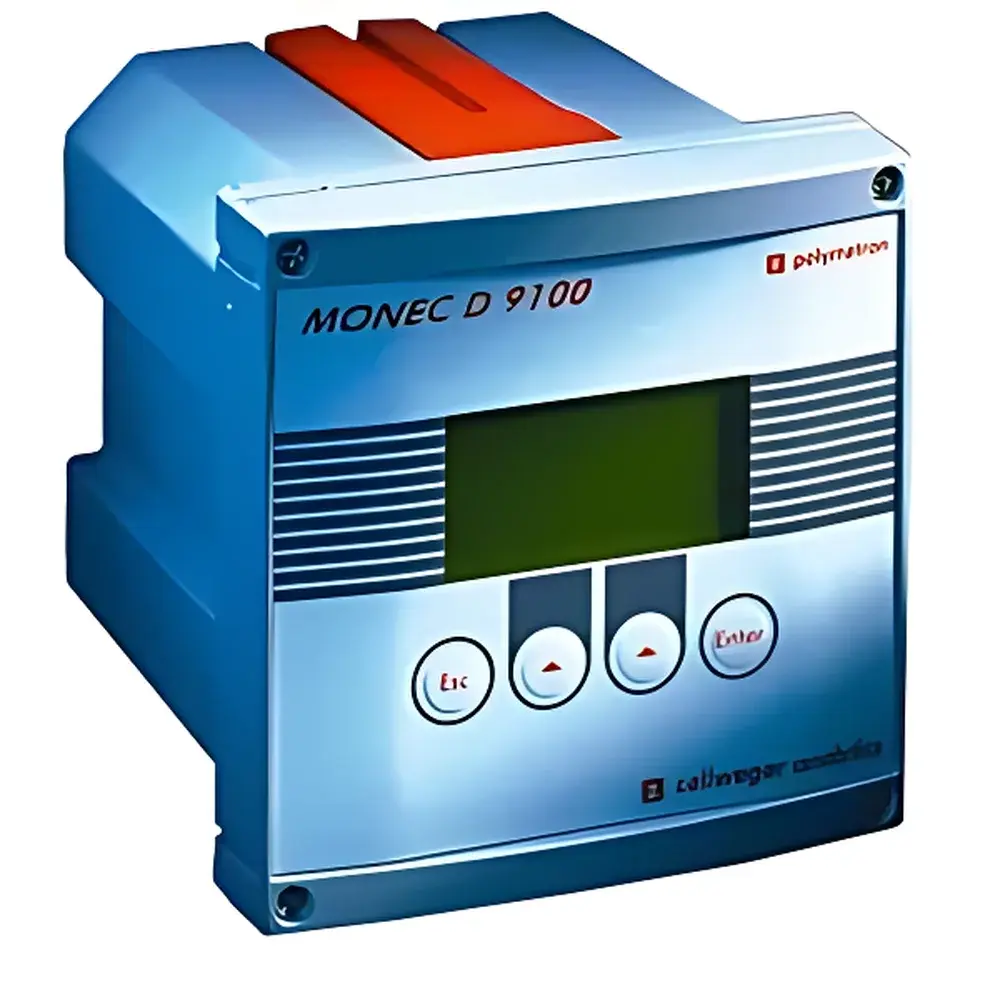
HACH Polymetron 9125 Conductivity/Resistivity Transmitter System
| Brand | HACH |
|---|---|
| Origin | USA |
| Manufacturer | HACH Company |
| Import Status | Imported |
| Model | 9125 |
| Pricing | Upon Request |
| Conductivity Ranges | 0.01–200 µS/cm (with 8310 electrode, k=0.01 cm⁻¹), 0.1–2 mS/cm (with 8311 electrode, k=0.1 cm⁻¹), 1–20 mS/cm (with 8312 electrode, k=1 cm⁻¹) |
| Accuracy | ±1% of reading (conductivity/resistivity), ±0.4 °C (temperature) |
| Temperature Range Display | −20 to 200 °C |
| Temperature Compensation | Automatic nonlinear compensation optimized for ultrapure water |
| Sensor Compatibility | Two-electrode contact-type (8310/8311/8312) and inductive (toroidal) probes |
| Diagnostic Capability | Built-in self-check for two-electrode sensors |
| Output Options | 4–20 mA analog output (isolated), RS-485, Profibus DP, Modbus RTU (JBUS), optional 4 relay outputs |
| Enclosure Rating | IP66/NEMA 4X |
Overview
The HACH Polymetron 9125 is a high-integrity, microprocessor-based conductivity and resistivity transmitter engineered for continuous, high-precision monitoring in critical water quality applications—particularly ultrapure water (UPW) systems found in semiconductor manufacturing, pharmaceutical production, and power generation. Operating on the principle of conductance measurement via either contact (two-electrode) or inductive (toroidal) sensing, the 9125 delivers stable, traceable readings across three decades of conductivity range through interchangeable sensor cells. Its core architecture integrates real-time, non-linear temperature compensation algorithms specifically validated per ASTM D1125 and IEC 60746-3 for UPW resistivity extrapolation below 18.2 MΩ·cm, eliminating reliance on linear approximations that introduce systematic error at sub-ppb ionic concentrations.
Key Features
- Universal transmitter platform supporting both contact-type (8310/8311/8312) and inductive sensors—enabling single-device deployment across raw water, process streams, and final UPW loops.
- Dedicated non-linear temperature compensation firmware compliant with USP and EP 2.2.39 guidelines for resistivity validation in pharmaceutical water systems.
- Integrated sensor self-diagnostic function for two-electrode probes, continuously verifying electrode integrity, cell constant stability, and cable continuity without manual intervention.
- High-immunity analog output (4–20 mA, galvanically isolated) with configurable damping and linear/square-root scaling—certified to IEC 61326-1 for electromagnetic compatibility in industrial control environments.
- Multi-protocol digital communication: native support for Modbus RTU (JBUS), Profibus DP v1, and RS-485, enabling seamless integration into DCS, SCADA, and MES platforms with full register mapping documentation.
- IP66/NEMA 4X-rated polycarbonate enclosure with UV-stabilized gasketing—rated for outdoor installation and washdown environments per UL 50E and EN 60529.
Sample Compatibility & Compliance
The Polymetron 9125 is validated for use with HACH’s traceable, NIST-traceable calibration-certified electrodes: 8310 (k = 0.01 cm⁻¹, ideal for UPW resistivity >10 MΩ·cm), 8311 (k = 0.1 cm⁻¹, optimized for deionized water and boiler feedwater), and 8312 (k = 1.0 cm⁻¹, suited for cooling tower and wastewater effluent). All configured systems meet ISO/IEC 17025 requirements for measurement uncertainty estimation when paired with certified reference solutions (e.g., KCl standards traceable to NIST SRM 3194). The transmitter supports audit-ready operation under FDA 21 CFR Part 11 when used with HACH’s DataStream software, providing electronic signature capability, change logging, and user-access-level controls.
Software & Data Management
Configuration, calibration, and diagnostics are managed via HACH’s PC-based Polymetron Configuration Tool (PCT), which enforces parameter lockout, stores calibration history with timestamps and operator IDs, and exports CSV-formatted logs compatible with LIMS and SAP QM modules. When deployed with HACH PlantManager or integrated into cloud-enabled architectures via MQTT/OPC UA gateways, the 9125 supports predictive maintenance alerts—such as drift detection beyond ±0.5% of span over 72 hours or temperature sensor deviation exceeding ±0.3 °C—ensuring uninterrupted compliance during GLP/GMP audits.
Applications
- Real-time resistivity verification in semiconductor fab UPW distribution networks (per SEMI F63).
- Continuous conductivity monitoring of purified water (PW) and water for injection (WFI) in biopharmaceutical clean steam and storage loops.
- Condensate polishing system supervision in fossil and nuclear power plants (ASTM D4582).
- RO permeate quality assurance and EDI stack performance trending.
- Environmental compliance reporting for NPDES discharge permits requiring conductivity-based TDS estimation.
FAQ
Can the 9125 be calibrated using non-HACH standard solutions?
Yes—provided the solution’s certified conductivity value and temperature coefficient are entered manually; however, NIST-traceable HACH standards (e.g., 8400 series) are required for regulatory submissions under cGMP.
Does the transmitter support automatic range switching between electrodes?
No—range selection is fixed per installed sensor; multi-range operation requires manual reconfiguration or use of a dual-sensor manifold with external logic control.
Is the 4–20 mA output intrinsically safe?
The standard output is not IS-rated; for hazardous locations, an approved signal isolator (e.g., Pepperl+Fuchs KFD2-ST2-Ex2) must be installed upstream per ATEX/IECEx Zone 2 requirements.
How is sensor fouling detected in two-electrode mode?
The built-in self-check evaluates AC impedance magnitude and phase angle at multiple frequencies; deviations exceeding factory-set thresholds trigger a “Sensor Fault” status and inhibit output updates until corrective action is confirmed.
What cybersecurity protocols does the 9125 support?
As a serial-only device, it has no network interface; cyber-hardening is achieved at the system level via segregated Modbus TCP gateways with TLS 1.2 encryption and role-based access control enforced by the host SCADA.







