
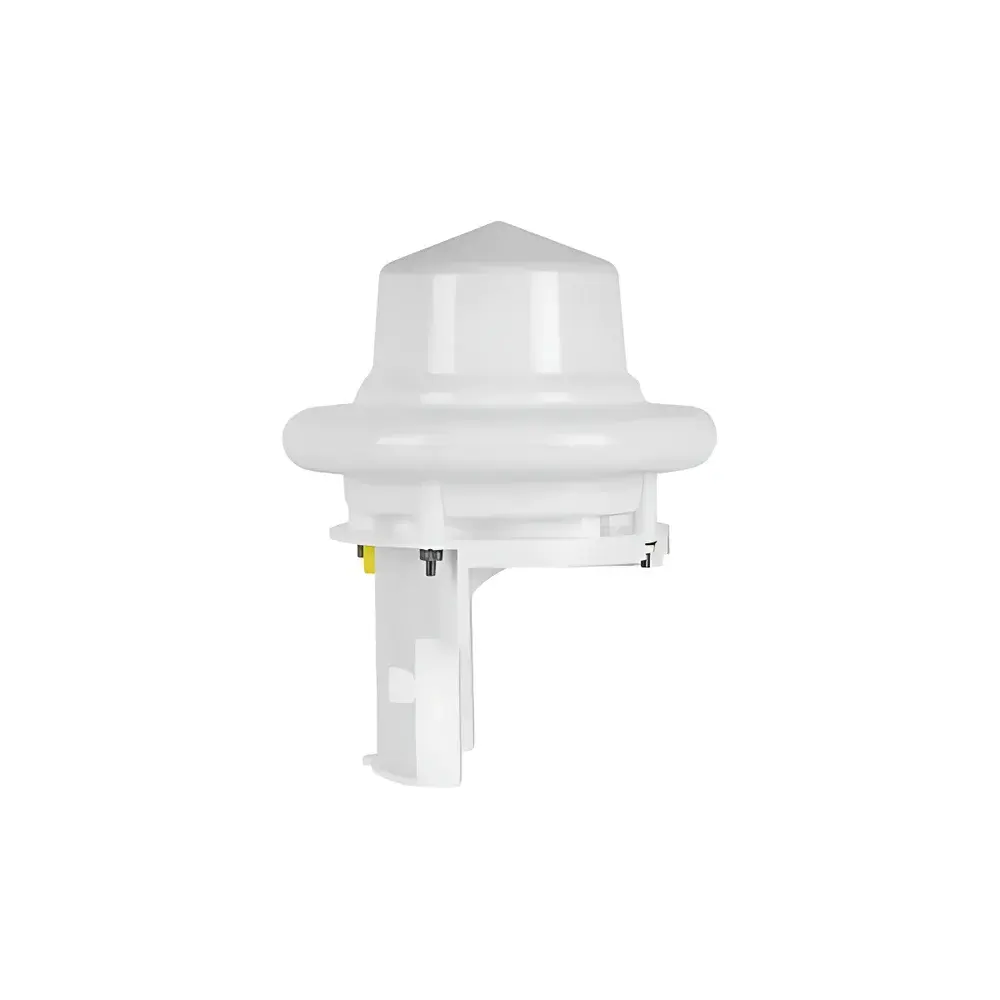
Lufft WS100-UMB Radar Precipitation Sensor
| Brand | Lufft |
|---|---|
| Origin | Germany |
| Model | WS100-UMB |
| Measurement Principle | 24 GHz Doppler radar-based particle detection |
| Power Supply | DC 12–36 V (solar-compatible) |
| Operating Temperature | −40 °C to +70 °C |
| Heating Function | Integrated radar dome heater |
| Communication Protocols | Modbus RTU, SDI-12, CAN, ASCII, MQTT (optional) |
| IP Rating | IP66 |
| Maintenance | No moving parts, maintenance-free design |
| Compliance | CE, RoHS, EN 61326-1 (EMC), EN 61000-6-2/6-4 |
Overview
The Lufft WS100-UMB Radar Precipitation Sensor is a solid-state, non-contact meteorological instrument engineered for continuous, high-reliability precipitation monitoring in demanding outdoor environments. Unlike traditional tipping-bucket or weighing gauges, the WS100-UMB employs a 24 GHz frequency-modulated continuous-wave (FMCW) Doppler radar system to detect and characterize individual hydrometeors—raindrops, snowflakes, drizzle, graupel, and wet hail—within a defined vertical sampling volume directly above the sensor aperture. By analyzing the radial velocity and radar cross-section of each particle, the device computes real-time precipitation rate (mm/h), accumulated rainfall (mm), precipitation type classification, and particle size distribution (PSD) without mechanical wear or calibration drift. Its physics-based retrieval algorithm operates independently of catchment efficiency errors common in mechanical gauges, making it particularly suitable for applications where measurement continuity, long-term stability, and discrimination between liquid/solid phases are critical.
Key Features
- Solid-state design with no moving parts—eliminates mechanical failure modes and enables >10-year operational lifetime under field conditions
- Integrated heated radar dome prevents ice/snow accumulation and ensures uninterrupted operation down to −40 °C
- Low-power architecture (typical 1.2 W standby, 2.8 W active) compatible with solar/battery-powered remote deployments
- Multi-protocol interface support—including Modbus RTU over RS-485, SDI-12, CAN bus, ASCII serial, and optional MQTT for cloud integration—enabling seamless interoperability with SCADA, IoT platforms, and legacy weather networks
- Compact, ruggedized aluminum housing (IP66-rated) with corrosion-resistant finish for permanent outdoor installation
- Embedded temperature and humidity compensation algorithms ensure consistent performance across wide environmental gradients
Sample Compatibility & Compliance
The WS100-UMB is designed to operate unattended in diverse climatic zones—from arid desert corridors to high-humidity coastal regions and alpine permafrost zones. It complies with European electromagnetic compatibility standards (EN 61326-1) and immunity requirements (EN 61000-6-2 for industrial environments; EN 61000-6-4 for emission control). While not certified for aviation-grade primary measurements per ICAO Annex 3 or WMO Guide to Meteorological Instruments and Methods of Observation (CIMO Guide), its output meets data quality thresholds for secondary observational networks supporting road weather information systems (RWIS), hydrological modeling inputs, and environmental compliance reporting. The sensor’s precipitation type classification logic aligns with WMO-defined hydrometeor categories and supports configurable thresholds for user-defined event definitions (e.g., “freezing rain alert” or “snowmelt onset”).
Software & Data Management
The WS100-UMB delivers raw Doppler spectra and processed meteorological variables via configurable output intervals (1–300 seconds). Firmware updates and parameter configuration are performed locally via USB-C or remotely over Modbus/CAN. Lufft’s open-data architecture enables direct ingestion into third-party platforms including Campbell Scientific LoggerNet, Siemens Desigo CC, and AWS IoT Core. For regulatory or audit-trail contexts, the sensor supports time-synchronized logging (NTP or GPS-synced timestamps) and can be integrated into GLP/GMP-aligned data acquisition workflows when paired with compliant edge gateways that enforce 21 CFR Part 11 electronic signature and audit trail capabilities. All firmware and configuration files are digitally signed to ensure integrity and traceability.
Applications
- Road weather information systems (RWIS): Real-time detection of precipitation phase transitions critical for anti-icing decision support and dynamic message sign activation
- Railway infrastructure monitoring: Early warning of track-surface icing, snow accumulation, and thunderstorm-induced flash flood risk
- Photovoltaic plant performance analytics: Correlation of soiling rates, irradiance loss, and precipitation events to optimize cleaning schedules
- Hydrological network densification: High-temporal-resolution input for distributed rainfall-runoff models and flood forecasting systems
- Airport surface observation: Supplemental precipitation typing for low-visibility operations and NOTAM generation
- Environmental research stations: Long-term hydrometeor characterization for climate trend analysis and model validation
FAQ
Does the WS100-UMB require periodic recalibration?
No. The sensor uses stable microwave electronics and factory-traceable radar calibration; no field recalibration is specified by the manufacturer under normal operating conditions.
Can it distinguish between drizzle and light rain?
Yes. Its Doppler velocity–size resolution enables differentiation of droplet populations with fall speeds below 1 m/s (drizzle) versus 1–9 m/s (rain), supported by internal PSD binning and statistical clustering algorithms.
Is the heating function controllable externally?
Yes. Dome heater activation can be triggered automatically by ambient temperature or manually via Modbus register write, allowing energy optimization in mild climates.
What is the effective sensing range and vertical sampling volume?
The nominal detection range is 0–10 m above the sensor aperture, with a conical field-of-view of ±15°, resulting in an effective sampling diameter of ~3.5 m at 10 m height.
How does it handle wind-blown precipitation or splashing?
The directional radar beam and Doppler filtering reject off-axis motion and ground clutter; however, installation must follow WMO-recommended exposure guidelines (e.g., ≥2 m above ground, away from obstructions) to minimize horizontal advection effects.
Related Products







