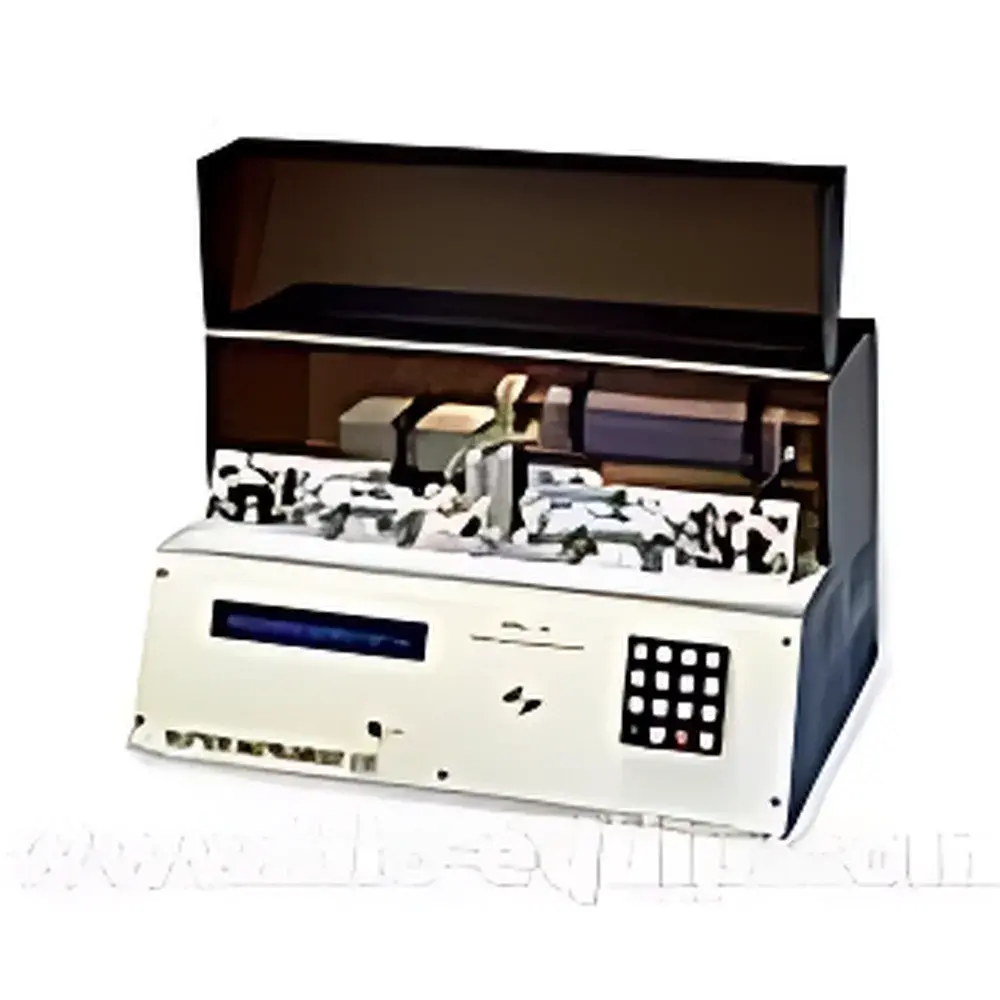
Sutter P-97 Programmable Horizontal Micropipette Puller
| Brand | Sutter |
|---|---|
| Origin | USA |
| Model | P-97 |
| Type | Horizontal programmable micropipette puller for electrophysiology and microinjection |
| Heating mechanism | Resistive filament (tungsten/platinum coil) with precision-controlled current |
| Pulling force | Pneumatically actuated, programmable pressure and release timing |
| Control system | Embedded microprocessor with 100-program non-volatile memory |
| Display | Vacuum fluorescent display (VFD) |
| Filament and solenoid power supply | Constant-current |
| Electrode symmetry | Dual symmetric pipettes per pull |
| Tip diameter reproducibility | ≤0.06 µm (SEM-verified), routinely <0.1 µm |
| Cooling mode | Optional external airflow for large-diameter/multi-barrel glass |
| Compliance | Designed for GLP/GMP-aligned lab environments |
Overview
The Sutter P-97 Programmable Horizontal Micropipette Puller is an engineered solution for the reproducible fabrication of ultra-fine glass and quartz micropipettes used in patch-clamp electrophysiology, intracellular recording, single-cell microinjection, and nanoliter-scale fluid delivery. Unlike vertical pullers relying on gravity-driven separation, the P-97 employs a horizontally oriented, pneumatically actuated pulling mechanism combined with precisely regulated resistive heating—based on the Flaming/Brown principle—to achieve controlled softening and axial elongation of capillary glass. The instrument utilizes a tungsten or platinum filament coil to heat the glass capillary locally while programmable gas pressure applies calibrated tensile force. This dual-parameter control—temperature (via filament current), pressure (magnitude and duration), and cooling dynamics—enables deterministic shaping of taper geometry, tip diameter, shank profile, and symmetry across thousands of pulls. Its architecture is purpose-built for laboratories requiring traceable, repeatable electrode fabrication under standardized operating conditions.
Key Features
- Horizontal dual-pull configuration producing two symmetric, high-precision micropipettes per cycle
- Integrated humidity-controlled chamber minimizing environmental drift in pull reproducibility
- Constant-current power supply for both filament and pull solenoid—ensuring thermal and mechanical stability
- Programmable pneumatic system with adjustable pressure ramping, hold time, and release timing
- 100-user-storable protocols with write-protection lock and embedded date/time stamping
- Vacuum fluorescent display (VFD) offering wide-angle visibility and real-time parameter feedback (e.g., heating duration, pressure status)
- Ramp detection function for automatic filament and glass compatibility calibration during setup
- Dedicated cycle modes optimized for patch-clamp electrodes, intracellular recording pipettes, and multi-barrel injection needles
- Enhanced mechanical design: low-thermal-mass filament clamps, spring-loaded capillary holders, and optional forced-air cooling for large-diameter or multi-channel glass
- Internal memory verification and speed-sensing feedback loop for maximal repeatability (±0.02 µm tip consistency, SEM-validated)
Sample Compatibility & Compliance
The P-97 accommodates standard borosilicate (e.g., 1.5 mm OD × 0.86 mm ID), soda-lime, and fused quartz capillaries ranging from 0.5 mm to 2.0 mm outer diameter—including double-barrel, triple-barrel, and theta-tube configurations. It supports both filament-heated and laser-assisted variants (when interfaced with compatible external modules). All operational parameters—including pressure profiles, heating duration, and cooling sequences—are fully programmable and logged. The system meets foundational requirements for method validation in academic and preclinical research settings. While not certified as medical device hardware, its design aligns with ISO/IEC 17025 principles for test equipment traceability and supports documentation practices consistent with GLP (Good Laboratory Practice) and GMP-adjacent workflows. Protocol storage, date-stamping, and write protection facilitate internal audit readiness and cross-lab protocol transfer.
Software & Data Management
The P-97 operates via an embedded real-time microcontroller with no external PC dependency. Its firmware enables full parameter definition—including ramp rate, peak temperature equivalent (via filament current setpoint), dwell time, pull pressure, acceleration/deceleration profiles, and post-pull venting sequence. Each stored program includes metadata: creation date, last edit timestamp, user ID field (manually entered), and version flag. The VFD provides immediate visual confirmation of active parameters and execution status. For laboratories integrating into electronic lab notebooks (ELN) or LIMS, ASCII-formatted log exports (via optional RS-232 or TTL serial interface) allow timestamped pull records—including success/failure flags, measured pull speed deviation, and filament resistance diagnostics—to be archived. No proprietary drivers or cloud services are required; all data remains under local institutional control.
Applications
- Production of low-resistance, low-capacitance patch-clamp electrodes for whole-cell, cell-attached, and perforated-patch configurations
- Fabrication of sharp intracellular recording electrodes with sub-100 nm tips and controlled taper angles for minimal membrane damage
- Manufacture of microinjection needles for CRISPR/Cas9 delivery, mRNA transfection, and organelle targeting
- Custom shaping of theta-tube pipettes for simultaneous drug application and recording
- Development of quartz-based electrodes for high-frequency impedance measurements or photostimulation coupling
- Method development for novel glass compositions (e.g., aluminosilicates) where viscosity–temperature relationships differ significantly from standard borosilicate
FAQ
What glass types and dimensions are compatible with the P-97?
Standard borosilicate (e.g., BF150-86-10), soda-lime, and fused quartz capillaries from 0.5 mm to 2.0 mm outer diameter are supported—including double-barrel, triple-barrel, and custom-drawn theta tubes.
Does the P-97 require external compressed air or vacuum sources?
No—the instrument includes an integrated, filtered, humidity-regulated air supply with adjustable pressure output (0–100 psi); optional external air connection is available for high-throughput labs.
How is tip diameter reproducibility verified?
Tip geometry is validated using scanning electron microscopy (SEM); typical batch variation is ≤0.06 µm, with routine production achieving <0.1 µm median outer diameter.
Can programs be shared between multiple P-97 units?
Yes—protocols are exportable via serial interface as plain-text files and can be loaded onto other P-97 systems without recalibration, provided filament and glass batches are matched.
Is FDA 21 CFR Part 11 compliance supported?
The P-97 does not include electronic signature or audit-trail modules required for full Part 11 compliance; however, its timestamped, write-protected protocols and manual user logging support hybrid paper–digital workflows compliant with basic regulatory expectations.