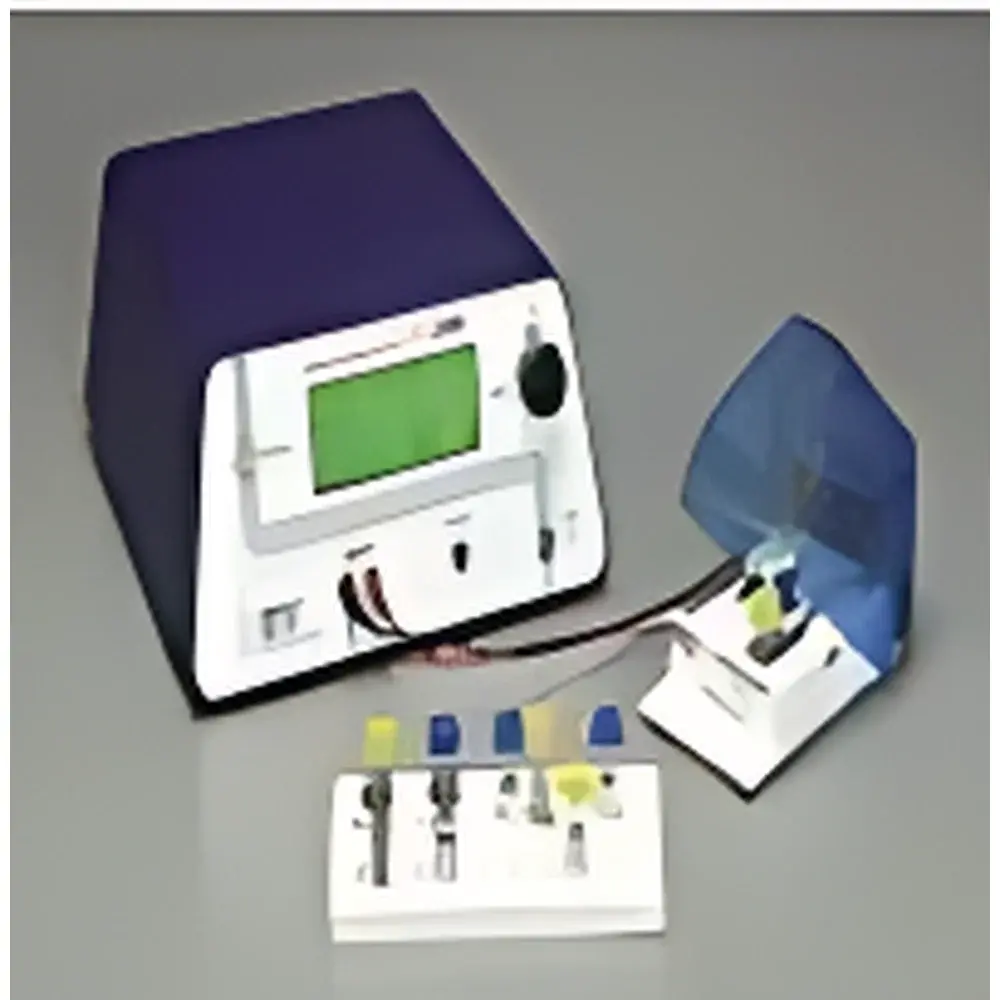
BTX ECM830 Square Wave Electroporator
| Brand | Harvard Apparatus |
|---|---|
| Origin | USA |
| Model | ECM830 |
| High-Voltage Mode | 50–3000 V (5 V step), 56 Ω, 111 µF, pulse width 10–600 µs (1 µs resolution) |
| Low-Voltage Mode | 5–500 V (1 V step), 56 Ω, 4000 µF, pulse width 10–999 µs / 1–999 ms / 1–10 s (1 µs / 1 ms / 0.1 s resolution) |
| Pulse Number | 1–99 |
| Inter-Pulse Interval | 100 ms–10 s |
Overview
The BTX ECM830 Square Wave Electroporator is a precision-engineered, benchtop electroporation system designed for reproducible and controllable delivery of nucleic acids, proteins, drugs, or other macromolecules into prokaryotic and eukaryotic cells—both in vitro and in vivo. Developed by BTX (now part of Harvard Apparatus), the ECM830 implements true square-wave pulse delivery—a departure from exponential decay waveforms—to enable precise control over electric field strength, pulse duration, and temporal spacing. This architecture minimizes thermal damage and membrane destabilization beyond the required transient pore formation, thereby significantly improving post-electroporation cell viability without compromising transfection or transformation efficiency. Its dual-mode operation (high-voltage and low-voltage) supports diverse applications ranging from bacterial plasmid transformation and yeast electroporation to primary mammalian cell transfection, embryonic manipulation, plant protoplast transfection, and intratumoral or intramuscular gene delivery in rodent models.
Key Features
- True square-wave output with independently adjustable voltage, pulse width, number of pulses, and inter-pulse interval—enabling rigorous experimental optimization and protocol standardization.
- Dual operating modes: high-voltage mode (50–3000 V, 111 µF, 10–600 µs) for hard-to-transfect cells and small-volume cuvettes; low-voltage mode (5–500 V, 4000 µF, extended pulse range up to 10 s) for sensitive primary cells, tissues, and in vivo applications.
- High-resolution LCD interface displaying real-time voltage peak, pulse width, pulse count, and inter-pulse interval—facilitating on-the-fly parameter validation and troubleshooting.
- Integrated arc suppression circuitry and short-circuit protection to safeguard both operator safety and instrument integrity during high-energy discharges.
- Thermally stable design with internal preheat cycle (20 min recommended after ambient storage in humid environments) and forced-air cooling between pulses to ensure consistent output and long-term reliability.
- Compliant with IEC 61010-1 safety standards for laboratory electrical equipment; designed for use in GLP-compliant laboratories requiring traceable, repeatable electroporation conditions.
Sample Compatibility & Compliance
The ECM830 accommodates a broad spectrum of sample formats and biological systems through compatibility with BTX’s full ecosystem of electrodes—including standard 0.1 cm, 0.2 cm, and 0.4 cm gap cuvettes; specialized in vivo needle electrodes; multi-well plate adapters (e.g., MOS series); and fusion-specific electrodes for somatic hybridization. It supports electroporation of bacteria (e.g., E. coli, Bacillus), yeast (S. cerevisiae, P. pastoris), insect cells (Sf9, S2), mammalian suspension and adherent lines (HEK293, CHO, Jurkat, primary T cells), plant protoplasts, oocytes, embryos, and solid tissues. All protocols are compatible with common electroporation buffers (e.g., cytomix, PBS-based low-conductivity solutions) and require strict attention to buffer purity, electrode cleanliness, and cuvette gap calibration—key variables influencing effective field strength (E = V/d). The system meets requirements for documentation and audit readiness under FDA 21 CFR Part 11 when paired with BTX VIP 3000 monitoring software and timestamped parameter logging.
Software & Data Management
While the ECM830 operates as a standalone hardware platform with intuitive front-panel controls, it integrates seamlessly with the BTX VIP 3000 Voltage Integrity Processor—a dedicated monitoring system that records actual delivered voltage, current waveform, and energy dissipation per pulse in real time. When used with optional footswitch activation and external data acquisition modules, the ECM830 supports automated protocol execution and electronic lab notebook (ELN) integration. Parameter settings are retained in non-volatile memory across power cycles, and all user-defined protocols can be archived via manual transcription or external logging. For regulated environments, the system supports GLP/GMP-aligned workflow documentation, including operator ID, date/time stamps, and deviation notes—ensuring full traceability for regulatory submissions or internal quality audits.
Applications
- Gene delivery: Plasmid DNA, siRNA, CRISPR RNP, and mRNA transfection into difficult-to-transfect cell types including primary neurons, hematopoietic stem cells, and iPSC-derived lineages.
- Cell engineering: Electroporation-assisted nuclear transfer, embryo microinjection support, and somatic cell nuclear reprogramming.
- Molecular biology: High-efficiency bacterial and yeast transformation for cloning, library construction, and synthetic biology workflows.
- In vivo research: Intradermal, intramuscular, intratumoral, and intracranial delivery in murine and larger animal models using BTX’s sterile needle electrodes.
- Bioproduction: Scalable transfection of suspension CHO or HEK293 cells for transient protein expression and vaccine antigen production.
- Plant biotechnology: Protoplast transfection for genome editing and trait development in monocot and dicot species.
FAQ
What is the difference between square-wave and exponential-decay electroporation?
Square-wave systems like the ECM830 deliver constant voltage for the entire pulse duration, enabling precise control over field strength and exposure time—critical for optimizing viability and efficiency in sensitive cell types. Exponential-decay systems produce rapidly diminishing voltage, making parameter reproducibility more challenging.
Can the ECM830 be used for in vivo electroporation?
Yes—the system is validated for in vivo applications using BTX’s sterile, insulated needle electrodes and appropriate low-voltage, long-duration pulse protocols optimized for tissue penetration and reduced muscle contraction.
How does the ECM830 ensure parameter accuracy and repeatability?
Voltage output is calibrated to ±0.5% full-scale accuracy; display resolution is ±3% of reading. Pulse timing is controlled via crystal-stabilized digital circuitry with sub-microsecond jitter, and all parameters are verified against internal reference standards prior to shipment.
Is the ECM830 compliant with FDA 21 CFR Part 11?
The base unit itself does not include electronic signature or audit trail functionality; however, when operated with BTX VIP 3000 and configured with secure user access, timestamped logging, and exportable CSV reports, it supports Part 11 compliance in conjunction with institutional SOPs.
What maintenance is required for long-term reliability?
Routine cleaning of electrode contacts, periodic verification of cuvette gap dimensions, and annual calibration (recommended by Harvard Apparatus Service) ensure continued performance. Internal desiccant packs should be replaced if humidity indicators show saturation, especially after extended storage in high-humidity environments.