
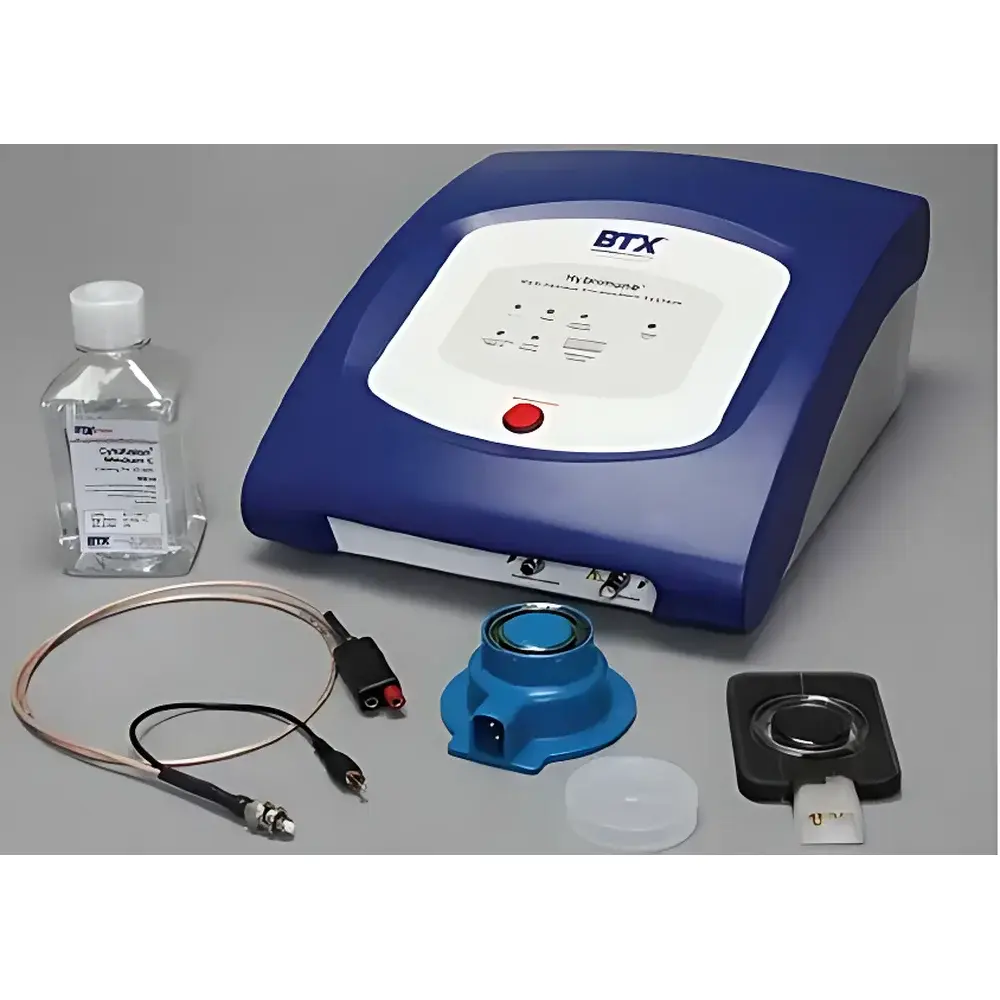
BTX Hybrimune Large-Scale Cell Fusion System
| Brand | Harvard Apparatus |
|---|---|
| Origin | USA |
| Manufacturer Type | Authorized Distributor |
| Origin Category | Imported |
| Model | Hybrimune Large-Scale Fusion System |
| Pricing | Available Upon Request |
Overview
The BTX Hybrimune Large-Scale Cell Fusion System is a purpose-engineered electroporation and electrofusion platform developed by BTX (now part of Harvard Apparatus) for high-efficiency, reproducible somatic cell fusion in research and bioproduction settings. Leveraging proprietary three-phase pulsed electric field (PEF) technology, the system applies precisely controlled non-sinusoidal waveforms—comprising pre-fusion, fusion, and post-fusion phases—to induce reversible membrane permeabilization and promote cytoplasmic continuity between adjacent cells. Unlike conventional single-pulse electroporators, the Hybrimune architecture delivers temporally resolved voltage modulation across distinct physiological stages: gentle alignment and dielectrophoretic positioning during the pre-fusion phase; transient pore formation and membrane destabilization during the fusion phase; and rapid resealing support during the post-fusion phase. This staged waveform strategy minimizes thermal accumulation, preserves membrane integrity, and significantly improves hybridoma yield and viability—particularly critical when working with sensitive primary cells or large-volume suspensions (up to 9 mL). Designed for integration into GLP-compliant workflows, the system supports full audit-trail-capable parameter logging and meets fundamental electrical safety requirements per IEC 61010-1.
Key Features
- Three-phase programmable pulse architecture: independently adjustable pre-fusion (ascending non-sinusoidal), fusion (DC square-wave), and post-fusion (descending non-sinusoidal) waveforms
- Dual-volume fusion chambers: optically transparent 2 mL chamber (bottom-glass for real-time microscopic monitoring of pearl-chain formation) and robust 9 mL chamber for scalable hybridoma generation
- Precision parameter resolution: voltage step increments down to 0.1 V (AC) and 5 V (DC); pulse duration resolution of 10 µs; timing intervals adjustable in 1 ms increments
- Thermally managed operation: optimized electrode geometry and pulse duty cycling maintain ambient temperature control (20–30 °C) without external cooling
- Fusion-optimized buffer compatibility: validated with BTX-specific low-conductivity, high-osmolarity fusion buffers to maximize membrane fluidity and minimize electroporation-induced cytotoxicity
- Full PC-based control via intuitive GUI: all parameters—including frequency (0.2–2.0 MHz), voltage amplitude, pulse count, inter-pulse interval (0.125–10 s), and cycle repetition—are programmable and recallable
Sample Compatibility & Compliance
The Hybrimune system is validated for use with mammalian lymphocytes, myeloma cells, primary fibroblasts, and plant protoplasts under standardized fusion protocols. Chamber dimensions (45.72 mm outer diameter, 38.10 mm inner diameter, 3.81 mm gap width) ensure uniform field distribution across both 2 mL and 9 mL volumes—critical for maintaining consistent electric field strength (V/cm) regardless of scale. The system complies with ISO 13485 design controls for laboratory instrumentation and supports documentation practices aligned with FDA 21 CFR Part 11 for electronic records and signatures when used with validated software configurations. All fusion buffers are manufactured under ISO 9001-certified processes and supplied with CoA documentation.
Software & Data Management
The Hybrimune Control Software (v3.x) provides deterministic protocol execution, real-time parameter feedback, and timestamped event logging. Each run generates a structured .csv log file containing waveform metadata, user ID, date/time stamp, chamber ID, and all applied parameters—enabling traceability for internal audits or regulatory submissions. The software supports protocol libraries with version-controlled templates, password-protected access levels (operator, supervisor, administrator), and exportable reports compliant with ALCOA+ data integrity principles. Optional integration with LIMS via TCP/IP API enables automated job dispatch and result ingestion.
Applications
- Monoclonal antibody development: high-yield hybridoma generation from murine splenocytes and SP2/0 or NS-1 myeloma lines
- Somatic cell nuclear transfer (SCNT) studies requiring precise cytoplast–karyoplast alignment
- Interspecific plant protoplast fusion for crop trait introgression
- Stem cell heterokaryon formation to study epigenetic reprogramming dynamics
- Delivery of large macromolecular complexes (e.g., CRISPR ribonucleoproteins) into suspension-adapted CHO or HEK293 cells
- Process development for therapeutic cell line engineering under QbD frameworks
FAQ
What distinguishes the Hybrimune’s three-phase waveform from standard electroporation pulses?
The pre-fusion ascending waveform gently aligns cells via dielectrophoresis; the DC fusion pulse creates synchronized, transient pores; the post-fusion descending waveform stabilizes membranes and reduces residual stress—collectively improving fusion efficiency by up to 3.2× versus single-pulse methods.
Can the 2 mL chamber be used for live-cell imaging during pulsing?
Yes—the fused quartz bottom enables high-resolution phase-contrast or fluorescence microscopy observation of pearl-chain formation and membrane fusion events in real time.
Is the system compatible with Good Manufacturing Practice (GMP) environments?
While not a GMP-certified device per se, its design, documentation, and software features (audit trail, user access control, electronic signature support) facilitate qualification for use in early-phase biomanufacturing process development under ICH Q5A and Q5B guidelines.
How is calibration verified?
Harvard Apparatus provides annual NIST-traceable calibration services for voltage output, pulse timing accuracy, and chamber impedance verification—documentation includes as-found/as-left reports and uncertainty budgets.
Are replacement fusion chambers supplied sterile?
Chambers are gamma-irradiated and supplied double-bagged with EO indicator; sterility is certified per ISO 11137 and supported by manufacturer CoA.




