
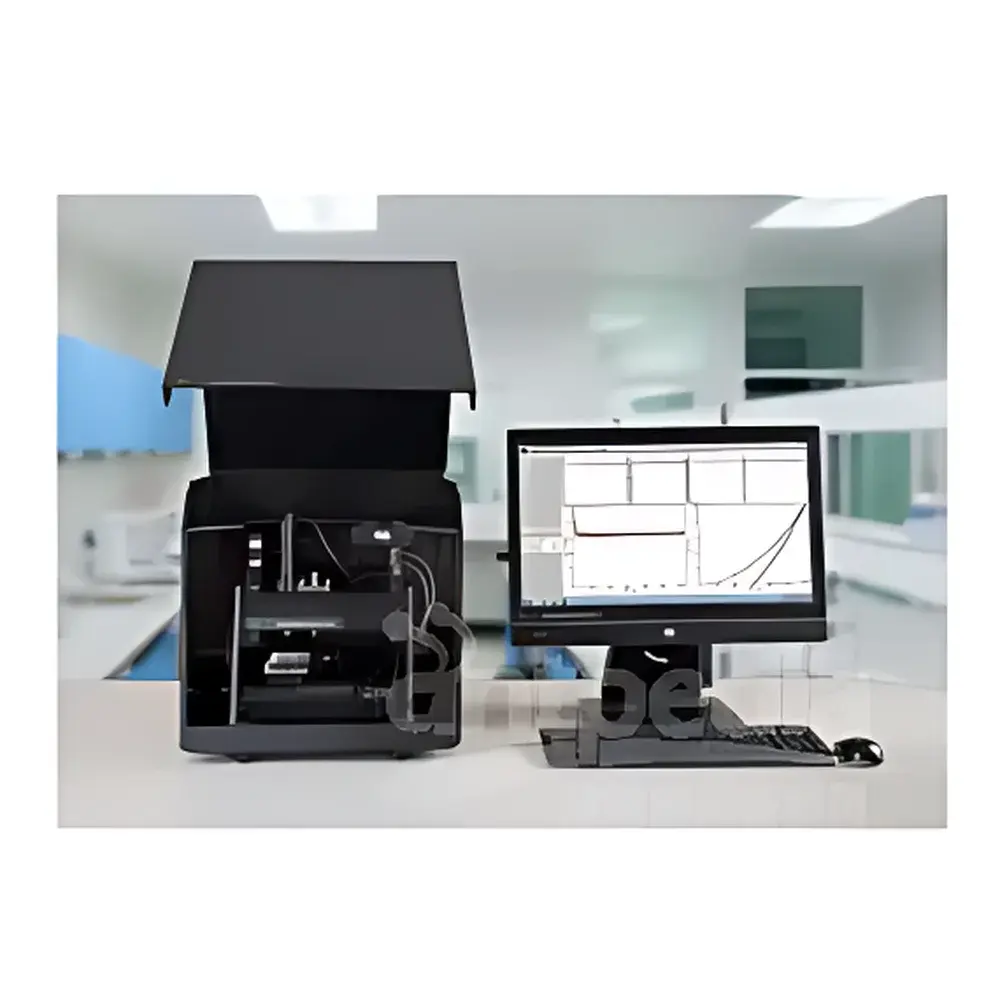
KLA iMicro Desktop Micro-Indentation In-Situ Mechanical Testing System
| Brand | KLA |
|---|---|
| Origin | USA |
| Model | iMicro |
| Maximum Load Capacity | 1 N |
| Force Resolution | 6 nN |
| Force Noise Floor | <200 nN |
| Indentation Depth Range | up to 80 µm |
| Depth Resolution | 0.04 nm |
| Depth Drift Rate | <0.05 nm/s |
| Time Constant | 20 µs |
| Scratch Option | up to 50 mN load, 2.5 mm lateral displacement, 500 µm/s max speed |
| Stage Travel (X/Y/Z) | 100 mm × 150 mm × 25 mm |
| Load Stiffness | >3,500,000 N/m |
| Tip Calibration | Integrated TiP-Calibration system |
| Software Platform | InView (scriptable experiment design), optional NanoBlitz 3D topography & tomography module |
Overview
The KLA iMicro Desktop Micro-Indentation In-Situ Mechanical Testing System is a high-precision, electromagnetically actuated micro-mechanical characterization platform engineered for quantitative nanoscale and microscale mechanical property measurement under controlled environmental and loading conditions. Based on the established principles of quasi-static and dynamic depth-sensing indentation—rooted in the Oliver–Pharr method—the iMicro delivers traceable, reproducible measurements of hardness, reduced elastic modulus, storage and loss moduli (via dynamic contact stiffness analysis), and creep behavior across a broad spectrum of materials. Its 1 N maximum force capacity, sub-nanometer depth resolution (0.04 nm), and ultra-low thermal drift (<0.05 nm/s) enable rigorous mechanical assessment of heterogeneous, layered, and time-dependent systems—including thin films, coatings, biomaterials, polymers, ceramics, and metallic alloys—without requiring vacuum or cryogenic infrastructure. Designed as a benchtop instrument with modular expandability, the iMicro bridges the performance gap between conventional nanoindenters and macro-scale mechanical testers, making it suitable for both routine quality control and advanced R&D workflows in academic, industrial, and regulatory environments.
Key Features
- Electromagnetic actuation architecture with decoupled force and displacement sensing—ensuring linearity, stability, and minimal hysteresis across the full 6 nN–1 N force range.
- Real-time closed-loop control with 20 µs system time constant, enabling high-fidelity dynamic mechanical analysis (DMA) at frequencies up to 1 kHz.
- Integrated TiP-Calibration system: fully automated, software-driven tip geometry and area function calibration using certified reference materials—eliminating manual probe qualification and reducing setup variability.
- High-stiffness mechanical frame (>3,500,000 N/m load stiffness) minimizes frame compliance effects, critical for accurate modulus quantification in stiff substrates and multilayer stacks.
- Large travel motorized stage (X: 100 mm, Y: 150 mm, Z: 25 mm) accommodates oversized or topographically complex samples—including cross-sectioned devices, MEMS components, and biological tissue sections—without repositioning.
- Optional scratch testing module: precise control of normal load (up to 50 mN), lateral displacement (±2.5 mm), and scanning velocity (up to 500 µm/s) for adhesion, wear resistance, and coating delamination analysis per ASTM C1624 and ISO 20502.
Sample Compatibility & Compliance
The iMicro supports mechanical testing of materials spanning six orders of magnitude in modulus—from soft hydrogels (~1 kPa) to hard ceramic coatings (>300 GPa). Its low-force sensitivity and adaptive control algorithms allow stable indentation on viscoelastic, anisotropic, and irradiated specimens without pile-up or sink-in artifacts. The system complies with ISO 14577 (Metallic materials — Instrumented indentation test), ASTM E2546 (Standard Guide for Instrumented Indentation Testing), and supports audit-ready data capture aligned with GLP and GMP requirements. Full experimental metadata—including environmental conditions, calibration logs, operator ID, and timestamped raw force–displacement curves—is embedded in every dataset. Optional FDA 21 CFR Part 11-compliant electronic signatures and audit trail modules are available for regulated pharmaceutical and medical device development labs.
Software & Data Management
The iMicro is operated via InView—a Python-scriptable, modular software environment designed for both novice and expert users. InView provides intuitive graphical experiment builders for standard hardness/modulus mapping, as well as advanced scripting interfaces for custom loading protocols (e.g., strain-rate jumps, cyclic loading, stress relaxation, harmonic force modulation). All data are stored in vendor-neutral HDF5 format with embedded metadata schemas compliant with FAIR (Findable, Accessible, Interoperable, Reusable) principles. Optional NanoBlitz software extends functionality to 3D mechanical property mapping, including nano-mechanical tomography, phase-resolved modulus reconstruction, and spatially resolved viscoelastic parameter extraction from large-area grid indentations (≥10,000 points). Raw data export supports MATLAB, Python (NumPy/Pandas), and third-party statistical analysis platforms.
Applications
- Thin-film and multilayer modulus profiling in semiconductor packaging and optoelectronic devices.
- Hardness and creep kinetics of high-entropy alloys and additively manufactured microstructures.
- Mechanical heterogeneity mapping in bone, cartilage, and dental composites for regenerative medicine.
- Adhesion strength and interfacial fracture energy quantification in PVD/CVD coatings via scratch testing.
- In-situ mechanical response during thermal cycling or humidity exposure using environmental stages (optional).
- Correlation of nano-mechanical properties with TEM/EBSD microstructural data for failure mechanism studies.
FAQ
What is the minimum measurable hardness value with the iMicro?
The iMicro can reliably quantify hardness down to ~0.1 GPa (e.g., soft polymers, gels) when using appropriate tip geometry and low-load protocols; accuracy depends on surface roughness, tip calibration, and signal-to-noise ratio.
Is the system compatible with vacuum or inert gas environments?
Yes—optional environmental chambers support operation under nitrogen, argon, or vacuum (down to 10⁻³ mbar), enabling corrosion-sensitive or reactive material testing.
Can I perform continuous stiffness measurement (CSM) at variable frequencies?
Yes—InView supports real-time CSM with user-defined oscillation amplitudes (1–50 nm) and frequencies (0.1–100 Hz), allowing direct extraction of storage/loss moduli versus depth.
Does the iMicro support third-party tip geometries?
Yes—custom Berkovich, cube-corner, spherical, and flat-punch tips from certified suppliers (e.g., Bruker, Hysitron) are fully supported via user-defined area functions in TiP-Calibration.
How is traceability maintained for ISO/IEC 17025 accreditation?
KLA provides NIST-traceable calibration certificates for force and displacement sensors, documented uncertainty budgets, and full metrological chain documentation upon request—meeting ILAC-MRA requirements for accredited laboratories.



