
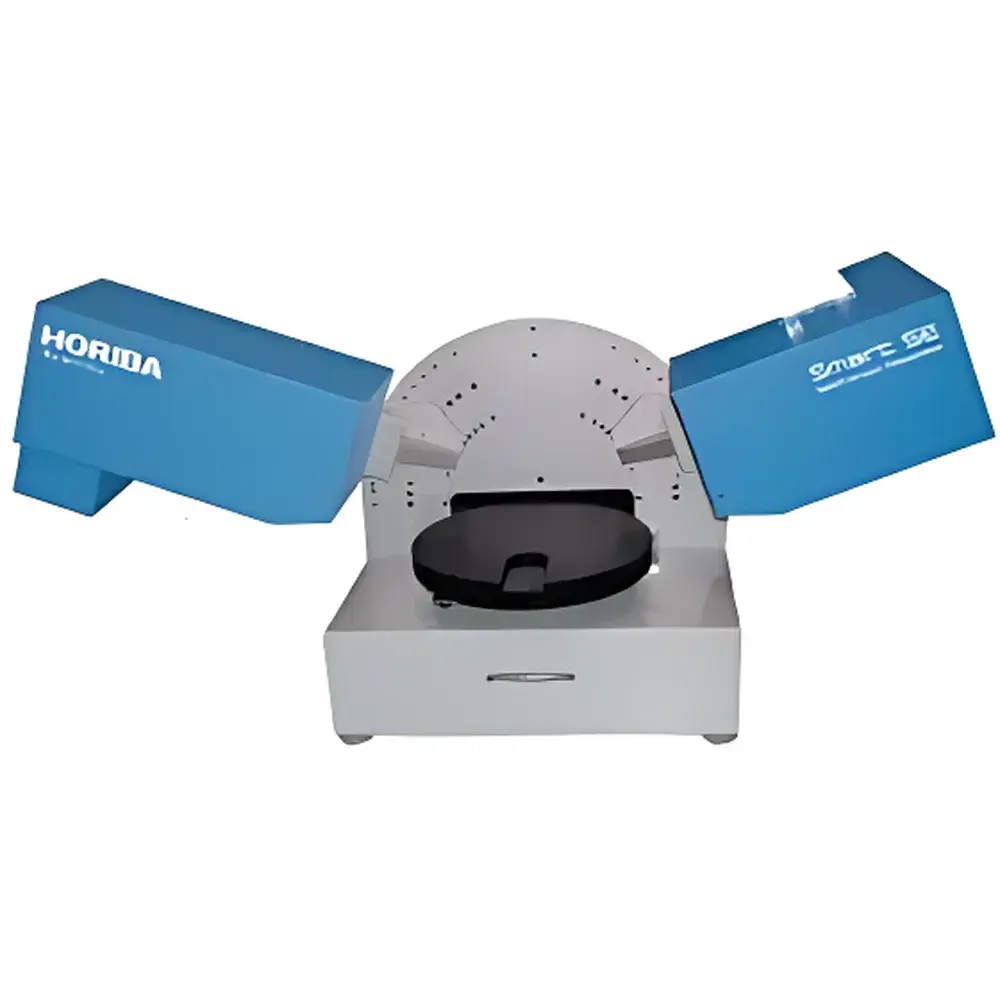
HORIBA Smart SE Intelligent Multi-Function Spectroscopic Ellipsometer
| Brand | HORIBA |
|---|---|
| Origin | France |
| Model | Smart SE |
| Spectral Range | 450–1000 nm |
| Spot Size Options | Multiple Micro-Spot Sizes with Real-Time Visual Observation |
| Incidence Angle | Variable (Motorized Multi-Angle Capability) |
| Measurement Speed | Full-Spectrum Acquisition in <1 Second |
| Single-Measurement Time | <2 s (Typical, Including Stage Positioning) |
| Sample Stage | Motorized XYZ Translation (200 mm × 200 mm Travel, Z-Travel >35 mm) |
| Detector | CCD-Based Spectral Analyzer |
| Modulation Technology | Liquid Crystal Variable Retarder (LCVR), No Moving Parts in Optical Path |
| Configuration Flexibility | Supports Both In-Line Process Integration and Stand-Alone Lab Use |
| Compliance | Designed for ISO/IEC 17025-Compatible Metrology Environments |
| Software | HORIBA DeltaPsi² Platform with Audit Trail, User Access Control, and Exportable Raw Data (CSV, XML, HDF5) |
Overview
The HORIBA Smart SE is a compact, high-performance spectroscopic ellipsometer engineered for rapid, non-destructive characterization of thin films and surface layers in research, development, and quality control environments. It operates on the fundamental principle of spectroscopic ellipsometry—measuring the change in polarization state of light upon reflection from a sample surface across a defined wavelength range (450–1000 nm). By analyzing the complex ratio ρ = tan(Ψ)·exp(iΔ), the instrument quantifies optical constants (n, k) and geometric parameters—including thickness, composition, and interfacial roughness—of single-layer and multilayer structures with sub-nanometer sensitivity. Its modular architecture supports both offline benchtop deployment and integration into semiconductor fabrication lines or coating process tools, enabling real-time monitoring without compromising measurement fidelity.
Key Features
- Liquid crystal variable retarder (LCVR) modulation ensures stable, drift-free polarization control with zero mechanical wear—no rotating compensators or motorized waveplates in the optical path.
- CCD-based detection enables simultaneous acquisition of the full spectrum (450–1000 nm) in under one second, delivering high signal-to-noise ratio and excellent reproducibility.
- Motorized multi-angle incidence capability allows automated Ψ/Δ acquisition at user-defined angles (typically 45°–75°), enhancing model uniqueness and reducing correlation between fitted parameters.
- Real-time micro-spot visualization system integrates coaxial imaging with adjustable spot sizes (down to ~50 µm), enabling precise targeting of patterned features, defects, or heterogeneous regions without prior alignment markers.
- Automated XYZ stage (200 mm × 200 mm travel, Z-lift >35 mm) supports large-area mapping, step-and-repeat measurements, and compatibility with standard wafer carriers (up to 8-inch diameter).
- One-click measurement workflow—from auto-alignment and background correction to optical model selection, fitting, and report generation—reduces operator dependency and training overhead.
Sample Compatibility & Compliance
The Smart SE accommodates rigid and semi-rigid substrates including silicon wafers, glass slides, metal foils, polymer films, and transparent conductive oxides. Its non-contact, non-invasive nature preserves sample integrity during repeated analysis. The system meets foundational requirements for traceable thin-film metrology in regulated settings: raw data export formats (CSV, XML, HDF5) support downstream validation; DeltaPsi² software implements configurable user roles, electronic signatures, and time-stamped audit trails aligned with FDA 21 CFR Part 11 principles. While not certified as GMP-compliant out-of-the-box, the platform is routinely deployed in GLP-conforming laboratories and qualifies for inclusion in ISO/IEC 17025 scope documentation when validated per client-specific SOPs.
Software & Data Management
DeltaPsi²—the native software suite—provides an integrated environment for instrument control, optical modeling, regression analysis, and reporting. It includes a library of over 200 pre-validated optical models (Cauchy, Tauc-Lorentz, Cody-Lorentz, B-spline) and supports custom dispersion relations. All fitting sessions retain full metadata (wavelength calibration, angle settings, stage coordinates, environmental logs), enabling retrospective re-analysis and method transfer. Data security is enforced via Windows-native authentication, encrypted project files, and optional network-based license management. Export functions comply with FAIR data principles: spectral and psi/delta datasets are stored with SI-traceable units and machine-readable headers.
Applications
- Semiconductor process control: gate oxide, high-k dielectrics, amorphous silicon, and hard masks on 200 mm wafers.
- Optical coating R&D: anti-reflective, dichroic, and interference filters on lenses and laser components.
- Emerging materials: perovskite photovoltaic layers, 2D transition metal dichalcogenides (TMDs), and organic semiconductors.
- Biointerface science: protein adsorption kinetics, lipid bilayer formation, and hydrogel swelling behavior on functionalized surfaces.
- Quality assurance in roll-to-roll manufacturing: inline thickness uniformity mapping of transparent conductive films (ITO, AZO) on flexible PET substrates.
FAQ
Does the Smart SE require external calibration standards?
No—factory calibration is performed using NIST-traceable reference optics and verified annually via internal diagnostic routines. Users may optionally perform daily intensity normalization using a supplied Si reference wafer.
Can it measure transparent substrates like fused silica or CaF₂?
Yes—by selecting appropriate optical models that account for substrate dispersion and implementing multi-layer fitting protocols incorporating substrate optical constants.
Is remote operation supported?
Yes—DeltaPsi² includes TCP/IP-based command-line interface (CLI) and Python API bindings, enabling integration with factory automation systems (SECS/GEM) and custom script-driven workflows.
What maintenance is required beyond routine cleaning?
None—LCVR modulation and solid-state CCD detection eliminate consumables and scheduled mechanical servicing. Annual performance verification is recommended but not mandatory.
How is measurement uncertainty quantified?
DeltaPsi² reports statistical confidence intervals derived from covariance matrix analysis of the regression fit, alongside systematic contributions from wavelength calibration drift and angle encoder resolution (±0.02°).




