
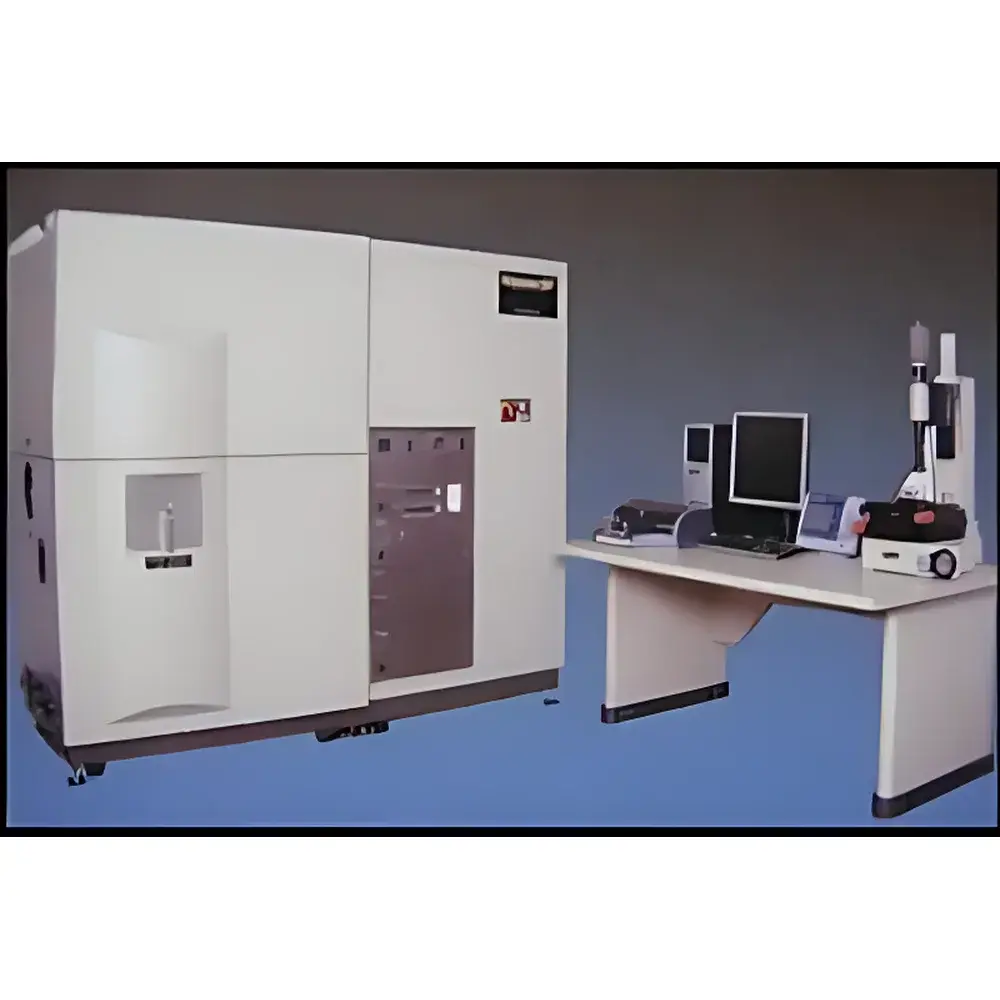
PHI Quantera SXM Scanning X-ray Microprobe XPS System
| Origin | Japan |
|---|---|
| Manufacturer Type | Authorized Distributor |
| Origin Category | Imported |
| Model | PHI Quantera SXM |
| Price | USD 900,000 |
| Vacuum Base Pressure | <5×10⁻¹⁰ Torr |
| Ag 3d₅/₂ FWHM Energy Resolution | <0.50 eV |
| PET C1s (O=C–O) FWHM Energy Resolution | <0.85 eV |
| Minimum Monochromated X-ray Spot Size | 9.0 µm (X) × 9.0 µm (Y) |
| Typical X-ray Spot Sizes | 10.0 µm @ ≤1.25 W |
| XPS Sensitivity | >125 kcps @ 20.0 µm, <1.00 eV resolution |
| Ion Gun Max Current | >5.0 µA at 5 kV |
| Ion Sputtering Pressure | <5×10⁻⁸ Torr during operation |
| Analysis Chamber Material | UHV-compatible stainless steel |
| Ion Pump Speed | 360 L/s (with Ti sublimation pump) |
| Software | MultiPeak™, CasaXPS-compatible data processing suite (peak fitting, least-squares deconvolution, multivariate analysis, chemical-state imaging, line scan extraction, depth profile quantification) |
Overview
The PHI Quantera SXM Scanning X-ray Microprobe is a high-performance, fully automated X-ray Photoelectron Spectroscopy (XPS) system engineered for quantitative surface chemical analysis at the microscale. Operating on the physical principle of the photoelectric effect—where monochromatic X-rays eject core-level electrons from sample surfaces—the instrument measures kinetic energy distributions to determine elemental composition, chemical state, oxidation state, and empirical formula within the top 1–10 nm of solid materials. Its 180° hemispherical electron energy analyzer delivers ultra-high energy resolution (<0.50 eV FWHM on Ag 3d₅/₂), while the scanning monochromated Al Kα source (spot size down to 9.0 µm) enables spatially resolved chemical mapping without compromising spectral fidelity. Designed for UHV environments (<5×10⁻¹⁰ Torr base pressure), the system integrates ion beam sputtering, dual-beam charge neutralization, and precision 5-axis motorized stage control to support rigorous surface science workflows in academic, industrial, and regulatory laboratories.
Key Features
- Monochromated micro-focused X-ray source with selectable spot sizes (9.0–20.0 µm) and power-dependent sensitivity/resolution trade-offs
- 32-channel multi-detector architecture enabling high count-rate acquisition (>125 kcps) with simultaneous energy dispersion
- Automated 5-axis sample stage (X/Y/Z/rotation/tilt) with ±0.1 µm positional repeatability across 100 mm diameter samples
- Dual-beam charge compensation: low-energy electron flood + variable-energy Ar⁺ ion beam for insulating and heterogeneous samples
- High-stability ion gun (≥5.0 µA at 5 kV) with Zalar rotation capability for uniform depth profiling and minimized preferential sputtering
- Angle-resolved XPS (AR-XPS) with motorized aperture selection to optimize information depth (0.5–5 nm) via take-off angle variation
- Integrated UHV chamber with 360 L/s ion pump, titanium sublimation pump, and fully automated bake-out sequence
Sample Compatibility & Compliance
The Quantera SXM accommodates conductive, semiconductive, and insulating solids—including polymers, oxides, catalysts, thin films, and biological coatings—without requiring conductive coating. Its dual-beam charge neutralization ensures stable spectra from SiO₂, PET, and ceramic substrates. The system complies with ISO 18118:2017 (surface chemical analysis — XPS — terminology and conventions), ASTM E1520–20 (standard guide for XPS data reporting), and supports GLP/GMP-aligned audit trails when configured with optional 21 CFR Part 11-compliant software modules. All vacuum components meet ASME BPE and SEMI F22 standards for cleanliness and outgassing performance.
Software & Data Management
Controlled via Windows-based MultiPeak™ software, the system provides full automation of acquisition, calibration, and quantification. Data processing includes background subtraction (Shirley/Tougaard), peak identification (reference database of >10,000 chemical shifts), non-linear least-squares curve fitting (Gaussian/Lorentzian mixtures), multivariate analysis (PCA, MCR), and spatial quantification from chemical-state images, line scans, and depth profiles. Raw and processed datasets are stored in vendor-neutral VAMAS format; export options include ASCII, CSV, and CIF for third-party tools (e.g., CasaXPS, Igor Pro). System logs record operator ID, timestamp, instrument parameters, and calibration history—fully traceable for FDA or ISO 17025 audits.
Applications
- Failure analysis of microelectronic interconnects and gate dielectrics
- Quantitative oxide thickness measurement on Si wafers (Si/SiO₂ interface)
- Chemical-state mapping of battery cathode particles (e.g., Ni-rich NMC surface reconstruction)
- Depth profiling of polymer multilayer films with Zalar rotation correction
- Corrosion product identification on aerospace alloys (e.g., Cr₂O₃ vs. CrOOH)
- Surface segregation analysis in catalytic nanoparticles (Pt–Co bimetallics)
- Quality control of functionalized biomaterial surfaces (e.g., PEG density on medical implants)
FAQ
What vacuum level is required for optimal XPS performance?
The system achieves and maintains <5×10⁻¹⁰ Torr base pressure using a 360 L/s ion pump coupled with a titanium sublimation pump and automated bake-out—essential for minimizing hydrocarbon contamination and ensuring long-term spectral stability.
Can the Quantera SXM perform depth profiling on insulating samples?
Yes. The integrated dual-beam charge neutralization system dynamically balances surface potential during Ar⁺ sputtering, enabling artifact-free depth profiles on glasses, ceramics, and polymer laminates.
Is angle-resolved XPS (AR-XPS) fully automated?
Yes. Motorized aperture selection and stage tilt control are synchronized with acquisition software to execute standardized AR-XPS protocols per ISO 18118 Annex B.
What data formats are supported for export and third-party analysis?
Raw spectra and processed results export in VAMAS, ASCII, and CSV formats; chemical-state images are saved as 16-bit TIFF with embedded metadata for correlation with SEM or AFM data.
Does the system comply with regulatory documentation requirements?
When equipped with optional audit-trail and electronic signature modules, the software meets 21 CFR Part 11 requirements for pharmaceutical and medical device QA/QC labs operating under GxP frameworks.






