
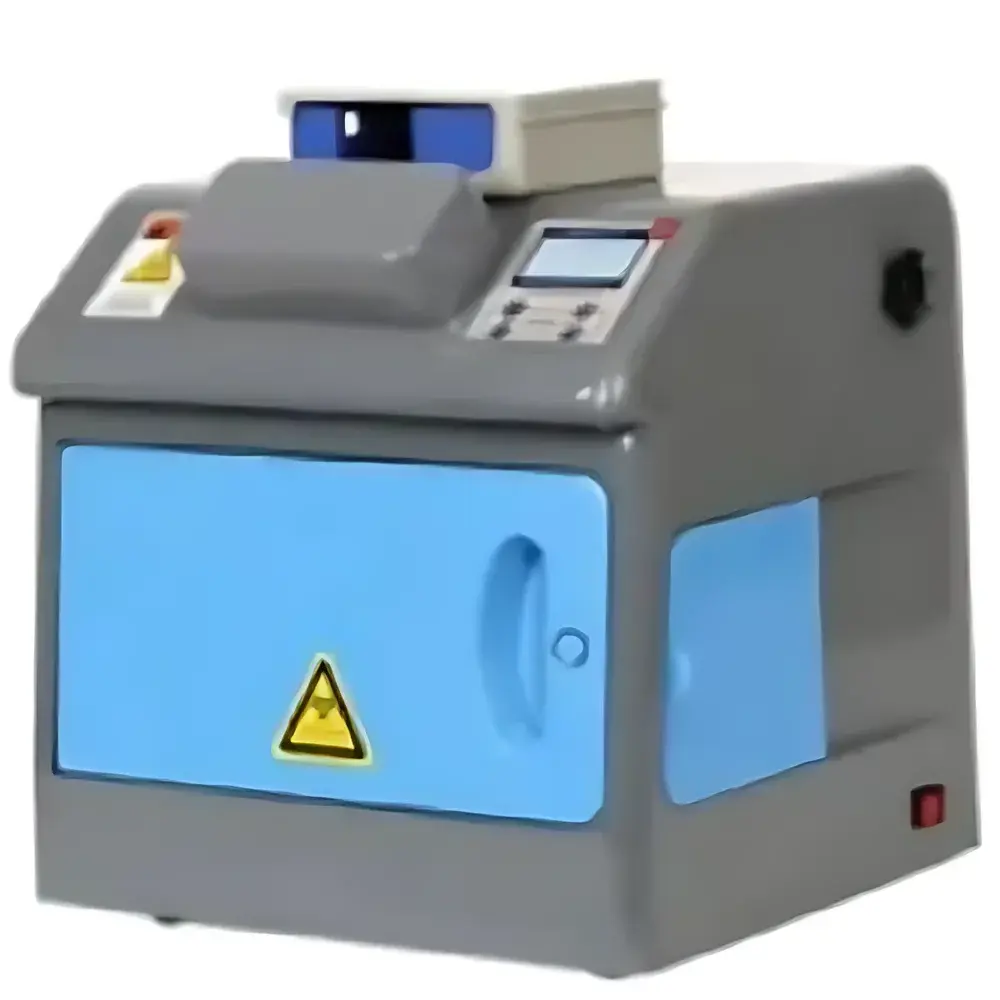
Jiapeng FWA-201B UV Blue Light Transilluminator and Gel Cutter
| Brand | Jiapeng |
|---|---|
| Origin | Shanghai, China |
| Model | FWA-201B |
| Instrument Type | Darkroom-style |
| Wavelength Options | Dual-band (254 nm & 365 nm) |
| UV Filter Dimensions | 200 × 50 mm |
| UV Lamp Power | 16 W |
| Input Voltage | AC 220 V ± 10%, 50/60 Hz |
| UV Intensity at 20 cm | ≥20 µW/cm² |
| Built-in Rechargeable Li-ion Battery | 4800 mAh |
| Display | LCD with Chinese interface |
| Image Storage Capacity | ≥5000 frames |
| Dimensions (L×W×H) | 310 × 200 × 300 mm |
| Weight | 3 kg |
Overview
The Jiapeng FWA-201B UV Blue Light Transilluminator and Gel Cutter is a dedicated darkroom-style fluorescence detection system engineered for rapid, on-site screening of optical brightening agents (OBAs) in food, agricultural commodities, packaging materials, and biological samples. Unlike general-purpose UV transilluminators used in nucleic acid visualization, the FWA-201B is specifically optimized for qualitative and semi-quantitative detection of fluorescent whitening agents—synthetic compounds that absorb UV radiation (primarily at 254 nm and 365 nm) and re-emit visible blue light (typically ~430–450 nm), thereby imparting artificial brightness to substrates. Its dual-wavelength excitation capability enables differential assessment: short-wave UV (254 nm) enhances sensitivity for highly conjugated OBAs (e.g., stilbene derivatives), while long-wave UV (365 nm) provides safer, lower-energy illumination suitable for routine field inspection and minimizes photodegradation of labile samples. The instrument complies with the measurement principle outlined in China’s agricultural industry standard NY/T 1257–2006, “Determination of Fluorescent Substances in Edible Mushrooms,” which specifies UV-induced fluorescence observation under controlled irradiance and viewing conditions.
Key Features
- Darkroom-style enclosed design with dual side access ports and an integrated UV-blocking observation window—ensuring operator safety while enabling real-time visual assessment without exposure.
- Adjustable UV lamp angle and intensity control, allowing precise optimization of illumination geometry and irradiance distribution across heterogeneous sample surfaces (e.g., irregularly shaped mushrooms, folded packaging films).
- Dual-band UV excitation: independently selectable 254 nm (short-wave) and 365 nm (long-wave) modes, each equipped with high-transmission interference filters (200 × 50 mm) to maximize spectral purity and signal-to-noise ratio.
- Onboard 16 W UV lamp assembly with stable output and thermal management, delivering ≥20 µW/cm² irradiance at 20 cm working distance—sufficient to elicit detectable fluorescence from trace-level OBAs in complex matrices.
- Integrated digital imaging module with auto-capture functionality; supports direct image transfer to PC via USB for archiving, comparative analysis, and audit-ready documentation.
- Field-deployable operation: powered by AC 220 V mains or internal 4800 mAh rechargeable Li-ion battery, enabling uninterrupted use during customs inspections, warehouse audits, or mobile laboratory deployments.
Sample Compatibility & Compliance
The FWA-201B accommodates a broad range of solid and semi-solid specimens without requiring extraction or derivatization—including fresh and dried edible fungi (e.g., Lentinula edodes, Agaricus bisporus), cereal products (wheat flour, rice noodles), confectionery (chocolate, cocoa butter), honey, eggshells, paper-based food containers, and plastic packaging films. Its detection workflow aligns with the visual fluorescence interpretation methodology defined in NY/T 1257–2006 and is compatible with supplementary validation protocols referenced in GB 5009.292–2023 (National Food Safety Standard for Determination of Fluorescent Brighteners in Food Contact Materials). While not a quantitative HPLC or LC-MS system, the FWA-201B serves as a Tier-1 screening tool meeting GLP-aligned documentation requirements: all captured images retain timestamp, wavelength mode, and exposure metadata, supporting traceability in quality assurance workflows subject to internal audit or regulatory review.
Software & Data Management
The instrument operates via embedded microcontroller firmware with Chinese-language LCD interface—no external software installation required for basic operation. Image acquisition, storage, and playback are managed locally on-device, with ≥5000 high-resolution frames retained in non-volatile memory. For data export, the USB interface supports mass-storage mode: images transfer as standard JPEG files, enabling integration into existing LIMS or QA documentation systems. Metadata fields include date/time stamp, selected wavelength (254 nm or 365 nm), battery status, and user-defined sample ID tags. Though not FDA 21 CFR Part 11 compliant out-of-the-box (lacking electronic signature and audit trail modules), the raw image archive satisfies ISO/IEC 17025 clause 7.5.2 requirements for result recording integrity when paired with controlled procedural SOPs.
Applications
- Routine OBA screening in food processing facilities to verify compliance with GB 9685–2016 limits for fluorescent whitening agents in food contact materials.
- Border inspection support for customs laboratories assessing imported mushrooms, spices, or packaged foods for unauthorized brightener use.
- Quality control of edible fungi during post-harvest handling—detecting illegal bleaching treatments intended to mask spoilage or aging.
- Verification of paper cup and takeaway container safety prior to distribution, per GB 4806.8–2022 standards.
- Academic and extension service research on natural vs. synthetic fluorescence in plant tissues and fermentation products.
- Training platform for food safety technicians on UV-based adulteration detection principles.
FAQ
Does the FWA-201B provide quantitative concentration results?
No—it is a qualitative and semi-quantitative screening device based on visual or image-based fluorescence intensity comparison. Quantification requires confirmatory analysis via HPLC-FLD or LC-MS/MS.
Can it detect aflatoxins or other mycotoxins?
No. While some aflatoxins fluoresce under UV, the FWA-201B lacks spectral discrimination and calibration for mycotoxin identification. It is validated solely for optical brightening agents per NY/T 1257–2006.
Is the 254 nm UV source safe for prolonged use?
The darkroom enclosure and UV-blocking observation window reduce occupational exposure, but direct skin or ocular exposure to 254 nm radiation must be avoided. Use only in ventilated areas and follow IEC 62471 photobiological safety guidelines.
What maintenance does the UV lamp require?
The 16 W low-pressure mercury lamp has a typical service life of 1,500–2,000 hours. Output intensity should be verified annually using a calibrated UV radiometer; replacement lamps are available as OEM part #FWA-LAMP-254/365.
Is firmware upgrade supported?
Firmware updates are distributed via Jiapeng technical support upon request and require USB-connected PC utility software—not accessible through the onboard interface.




