
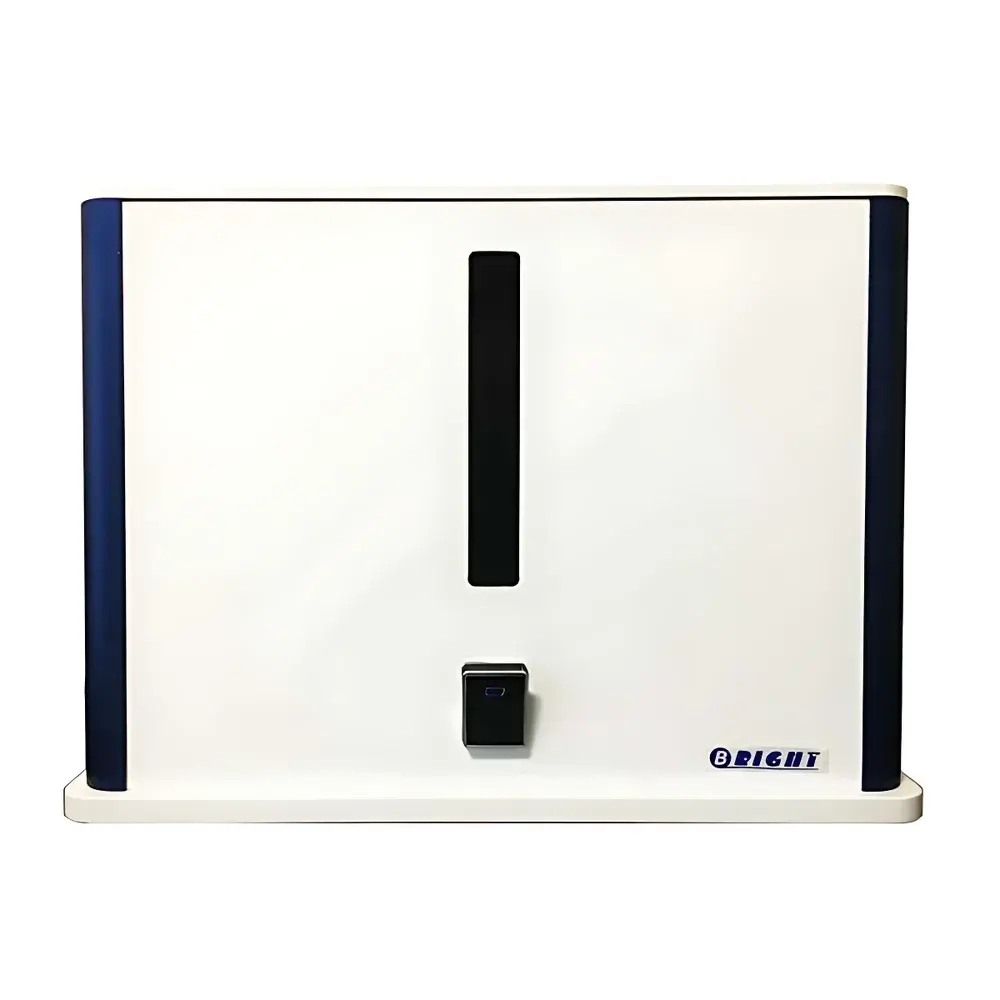
BRIGHT WAS5 Weld Seam Analysis System
| Brand | BRIGHT |
|---|---|
| Origin | United Kingdom |
| Manufacturer Type | Authorized Distributor |
| Origin Category | Imported |
| Model | WAS5 |
| Total Magnification | 3× |
| Zoom Ratio | 2:1 |
| Field of View Diameter | 35 mm |
| Working Distance | 20 mm |
| Objective Type | Integrated Achromatic Stereo Objective |
| Illumination Type | Adjustable LED Ring Light |
| Depth of Field | 1 mm |
| Numerical Aperture | 0.01 |
| Image Sensor | 5.0 MP Color sCMOS |
| Max Display Resolution | 2560 × 1920 |
| Zoom Range | 22× Continuous |
| Min Field Size | 8.3 mm × 6.2 mm |
| Max Field Size | 16.5 mm × 12.3 mm |
| Output Interface | USB 3.0 |
| Power Input | 24 V DC |
| Dimensions (L×W×H) | 330 × 240 × 260 mm |
Overview
The BRIGHT WAS5 Weld Seam Analysis System is a purpose-engineered stereo microscopy platform designed for non-destructive, high-fidelity morphological assessment of weld seams and fusion zones in industrial manufacturing environments. Built upon a coaxial optical architecture with integrated sCMOS imaging and motorized zoom/focus control, the system operates on the principle of stereoscopic observation—leveraging dual optical paths to deliver true 3D depth perception, accurate spatial measurement, and quantitative surface topography characterization. Unlike conventional metallurgical microscopes, the WAS5 prioritizes macro-to-mesoscale inspection (field sizes from 8.3 mm to 16.5 mm), making it ideal for evaluating full weld beads, heat-affected zones (HAZ), undercut, porosity, lack-of-fusion, and crater defects without sectioning or metallographic preparation. Its cold white LED illumination, 1 mm depth of field, and 0.01 NA objective ensure minimal thermal perturbation and consistent contrast across reflective metallic surfaces—critical for reproducible QA/QC workflows in regulated production settings.
Key Features
- Motorized zoom and focus drive system enabling repeatable magnification scaling (22× continuous range) and precise Z-axis positioning for multi-layer image stacking
- Real-time image processing engine supporting RGB channel adjustment (gain, gamma, brightness, contrast), geometric correction (rotation, scaling), and localized enhancement for low-contrast weld boundaries
- Full-range tilt capability (±90°) of the optical head for oblique-angle imaging, enabling cross-sectional profiling and undercut quantification without repositioning the sample
- Integrated 5.0 MP color sCMOS sensor with USB 3.0 interface delivering 2560 × 1920 output resolution at 60 fps—optimized for high-speed documentation and time-resolved process monitoring
- Adjustable LED ring light providing uniform, shadow-free illumination across curved and irregular weld geometries—including fillet welds, butt joints, and T-joints
- Handheld operation mode with stabilization-assisted capture—allowing in-situ inspection of large-scale assemblies (e.g., ship hull sections, wind turbine towers, railcar chassis)
Sample Compatibility & Compliance
The WAS5 accommodates flat, curved, and three-dimensional welded components up to 30 kg in mass and 500 mm in maximum dimension. It supports ferrous and non-ferrous alloys (carbon steel, stainless steel, aluminum, titanium), coated substrates, and clad materials without requiring vacuum, conductive coating, or chemical etching. The system complies with ISO 17637:2016 (non-destructive testing of welds — visual testing of fusion-welded joints) and aligns with ASTM E1921 (standard test method for determining fracture toughness of metallic materials) for qualitative defect classification. All image acquisition, annotation, and report generation workflows support audit-trail logging per FDA 21 CFR Part 11 requirements when deployed under GLP/GMP-compliant quality management systems.
Software & Data Management
ProWeld software serves as the dedicated analytical interface—structured around traceable project-based data organization. Users define product templates (e.g., “Automotive Exhaust Manifold – MIG Weld”), assign weld type (GMAW, GTAW, SAW), set measurement protocols (bead width, reinforcement height, leg length, convexity), and configure pass/fail thresholds per ISO 5817 or AWS D1.1. Automated report generation exports PDF/Excel outputs containing annotated images, dimensional overlays, statistical summaries (mean, std dev, Cp/Cpk), and digital signatures. Metadata—including timestamp, operator ID, calibration status, and environmental conditions—is embedded in each image file (EXIF + custom XML header) to ensure full data lineage and regulatory readiness.
Applications
- Automotive: Validation of laser-MIG hybrid welds on battery enclosures and structural crash members
- Marine & Offshore: In-field inspection of submerged arc welds on deck plating and pipe girth joints
- Power Generation: Assessment of dissimilar metal welds in nuclear piping systems and turbine casings
- Rail Transport: Verification of friction stir weld integrity in aluminum carriage bodies
- Aerospace: Qualification of electron beam welds in airframe subassemblies prior to NDT scheduling
- Heavy Machinery: Routine surveillance of multipass welds on excavator booms and hydraulic manifold blocks
FAQ
Does the WAS5 require external calibration standards for weld measurement traceability?
Yes—BRIGHT supplies NIST-traceable step-height and line-width calibration targets (certified to ISO/IEC 17025). Calibration must be performed quarterly or after mechanical shock events.
Can ProWeld software interface with MES or SAP QM modules?
Via optional OPC UA or REST API add-on, enabling direct transfer of inspection results, non-conformance logs, and SPC data into enterprise quality databases.
Is the system compatible with robotic welding cells for inline monitoring?
The USB 3.0 interface and low-latency image pipeline support integration with industrial PLCs via GenICam-compliant drivers; however, real-time closed-loop control requires supplementary edge-processing hardware.
What is the recommended maintenance interval for the LED illumination system?
The white LED array is rated for 50,000 hours at nominal current; no routine replacement is needed within standard 5-year operational life—only periodic intensity verification using built-in photometric diagnostics.
Does the WAS5 meet IP rating requirements for shop-floor deployment?
The optical head and controller housing are rated IP54 (dust-protected, splash-resistant); optional conformal coating and sealed cable glands enable operation in Class 1 Div 2 hazardous locations.



