
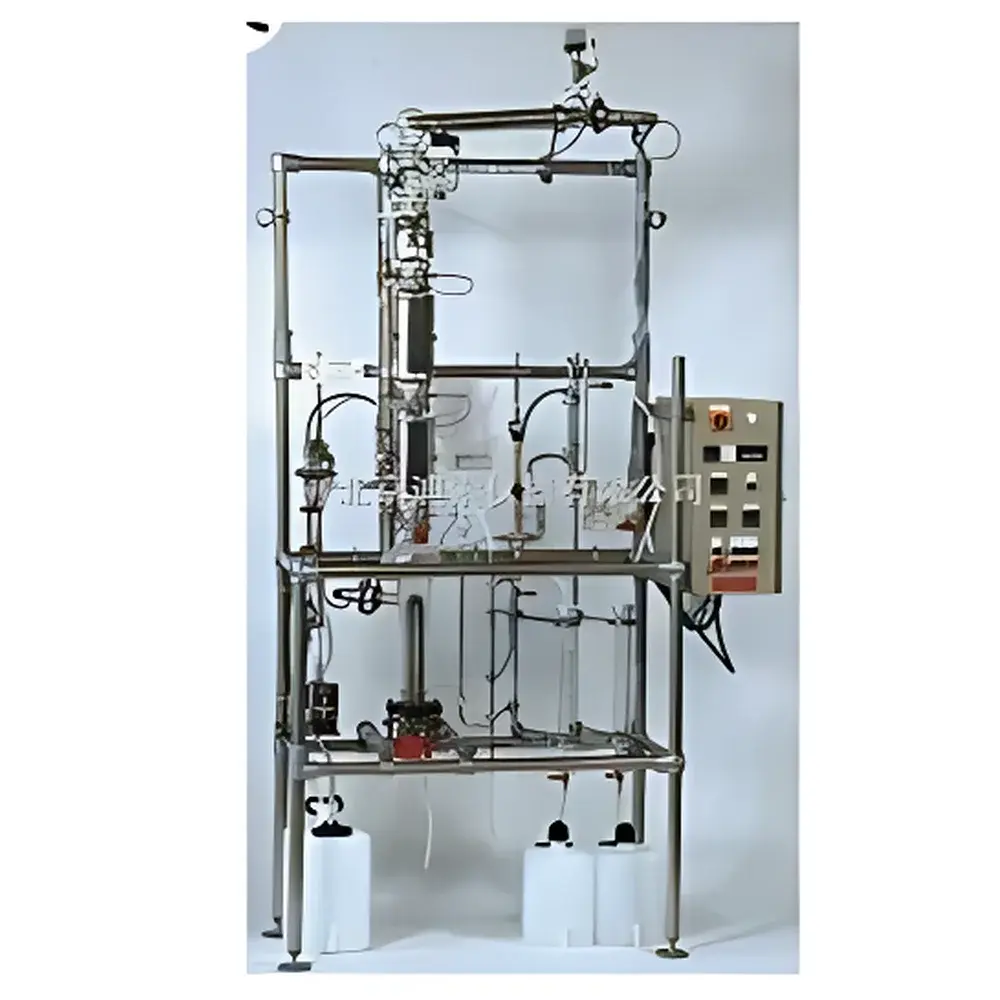
DVV2000 Continuous Distillation Apparatus
| Origin | France |
|---|---|
| Manufacturer Type | Authorized Distributor |
| Origin Category | Imported |
| Model | DVV2000 |
| Pricing | Upon Request |
Overview
The DVV2000 Continuous Distillation Apparatus is a laboratory-scale, benchtop distillation system engineered for controlled, steady-state separation studies of binary and pseudo-binary mixtures—particularly relevant to petroleum refining process development, fuel formulation research, and solvent recovery optimization. Unlike batch distillation units, the DVV2000 operates under continuous feed and product withdrawal conditions, enabling dynamic investigation of mass and energy balances across packed or plate-type columns. Its design adheres to fundamental principles of vapor–liquid equilibrium (VLE) thermodynamics and stage-wise separation modeling, supporting rigorous validation of theoretical plate efficiency, reflux ratio effects, and column pressure drop behavior. The apparatus is calibrated for operation within standard atmospheric pressure environments and integrates thermal management systems suitable for low-boiling organic mixtures such as water–ethanol—a common benchmark system for method verification in ASTM D86, ISO 3405, and IP 123-compliant laboratories.
Key Features
- Continuous-feed configuration with independent control of feed flow rate (adjustable via precision peristaltic or syringe pump interface), preheater temperature (range: ambient to 120 °C, ±1 °C stability), and condenser coolant flow rate (enabling variable reflux ratios from total reflux to minimum reflux conditions)
- Integrated differential pressure transducer across the distillation column to monitor and log column pressure gradient in real time—critical for assessing flooding onset, weeping, and tray/packing efficiency
- Modular column assembly accommodating interchangeable packing geometries (e.g., Raschig rings, structured mesh) or theoretical plate inserts, allowing empirical evaluation of HETP (Height Equivalent to a Theoretical Plate) and Murphree efficiency
- Four-hour uninterrupted operational cycle supported by redundant thermal insulation, PID-controlled heating zones, and fail-safe overtemperature cutoff
- Corrosion-resistant wetted parts constructed from borosilicate glass and PTFE-lined stainless steel, ensuring compatibility with polar and moderately aggressive hydrocarbon streams
Sample Compatibility & Compliance
The DVV2000 is validated for use with miscible liquid mixtures exhibiting relative volatility (α) between 1.2 and 8.0—covering key petroleum fractions including naphtha cuts, oxygenated biofuel blends (e.g., ethanol–gasoline), and refinery intermediate streams. It supports ASTM D1078 (boiling range determination), ASTM D2892 (true boiling point distillation), and ASTM D5250 (continuous distillation simulation) methodologies when paired with appropriate calibration standards and data acquisition protocols. All electronic subsystems comply with CE marking requirements (EMC Directive 2014/30/EU and Low Voltage Directive 2014/35/EU). The apparatus is designed for integration into GLP-compliant workflows, with optional audit trail logging and user access controls available via external SCADA or LIMS interfaces.
Software & Data Management
While the base DVV2000 operates with analog instrumentation and manual data recording, it features standardized 0–10 V and 4–20 mA signal outputs for temperature, pressure, and flow sensors—enabling seamless connection to third-party data acquisition systems (e.g., LabVIEW, MATLAB, or DeltaV). Optional firmware upgrade packages support time-stamped CSV export, real-time trend visualization, and automated calculation of key performance indicators: reflux ratio (R = L/D), distillate yield (% w/w), and cumulative enthalpy balance deviation (<±2.5%). All digital records adhere to ALCOA+ principles (Attributable, Legible, Contemporaneous, Original, Accurate, Complete, Consistent, Enduring, Available) and may be configured to meet FDA 21 CFR Part 11 requirements for electronic signatures and audit trails when deployed with validated software platforms.
Applications
- Process intensification studies for crude assay fractionation and atmospheric/vacuum distillation unit (ADU/VDU) debottlenecking
- Evaluation of novel packing materials and tray designs under representative hydrodynamic conditions
- Thermodynamic parameter regression (e.g., NRTL, UNIQUAC activity coefficients) using experimental VLE data from controlled continuous runs
- Training platform for chemical engineering students in separation processes, emphasizing transient response to feed composition shifts and reflux manipulation
- Supporting R&D for renewable fuel blending—quantifying phase separation limits, azeotrope behavior, and energy demand in ethanol–hydrocarbon co-distillation
FAQ
What types of feed mixtures are compatible with the DVV2000?
The apparatus is optimized for homogeneous, thermally stable liquid mixtures with boiling points below 200 °C and viscosity < 10 cP at operating temperature—such as water–ethanol, isooctane–toluene, and light naphtha fractions.
Is the DVV2000 compliant with ASTM D86 or D1078?
It is not a direct replacement for standardized test methods requiring fixed geometry and prescribed heating rates; however, it serves as a scalable research analog for mechanistic validation prior to full-scale ASTM protocol execution.
Can the column be operated under vacuum?
No—the DVV2000 is designed for atmospheric pressure operation only. Vacuum-capable variants require custom engineering and are not part of the standard DVV2000 configuration.
What safety certifications does the unit carry?
The system carries CE marking per EU directives, includes Class II electrical insulation, and incorporates automatic thermal shutdown at 130 °C to prevent overheating of glass components.
Is remote monitoring supported out of the box?
Basic analog I/O is provided; full remote telemetry requires integration with an external DAQ system or programmable logic controller (PLC). No built-in Wi-Fi or Ethernet interface is included in the base configuration.



