
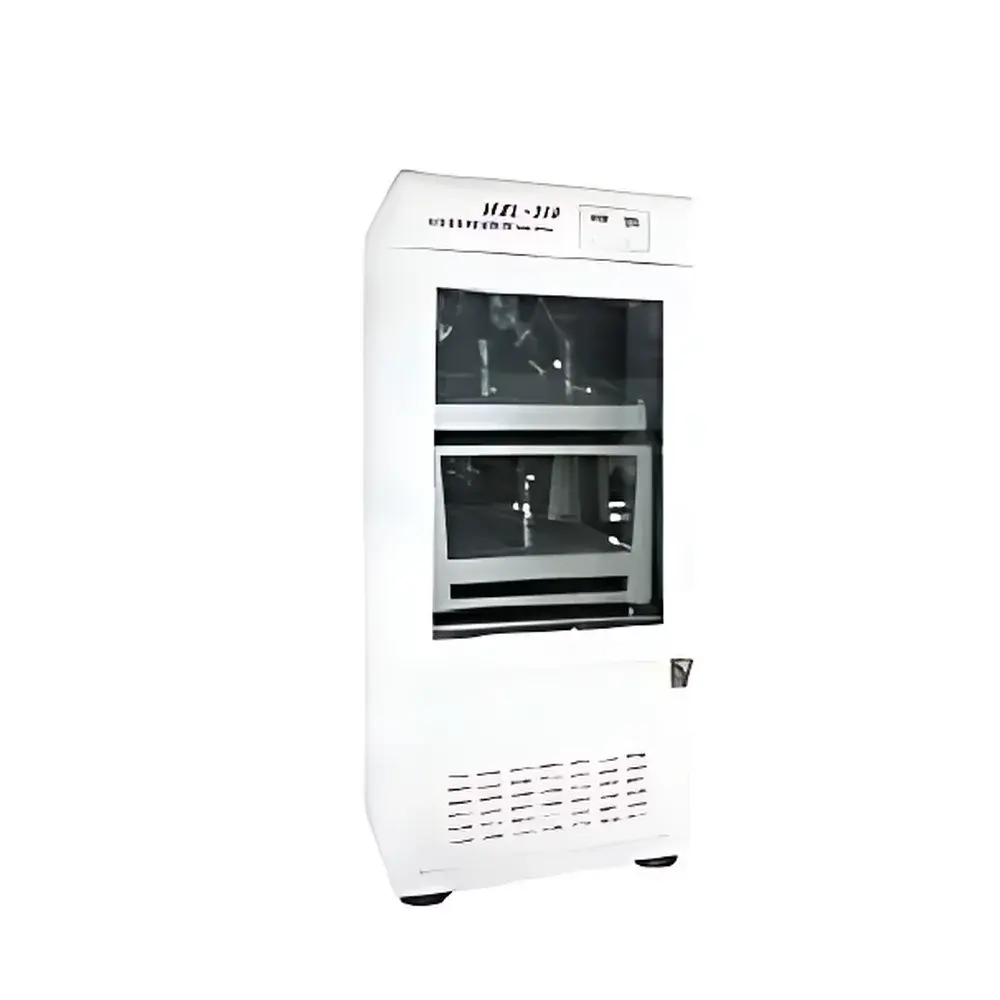
HZL-250/280 Constant-Temperature Orbital Shaking Incubator
| Origin | Jiangsu, China |
|---|---|
| Manufacturer Type | Authorized Distributor |
| Product Origin | Domestic (PRC) |
| Model | HZL-250/280 |
| Pricing | USD 3,200 (FOB Jiangsu) |
| Instrument Category | General-Purpose Orbital Shaker Incubator |
| Timer Range | 0–999 hours (digital programmable) |
| Oscillation Speed | 40–280 rpm (stepless adjustment) |
| Orbit Diameter | 25 mm |
| Temperature Range | 5–60 °C (ambient 25 °C) |
| Temperature Uniformity | ±0.1 °C across chamber |
| Chamber Volume | 250 L / 280 L variants |
| Shelf Configuration | Dual-tier stainless steel shaking platform |
| Input Power | 700 W (220 V, 50 Hz) |
| Compressor Power | 180 W (HZL-250) / 250 W (HZL-280) |
| External Dimensions (W×D×H) | 700 × 700 × 1500 mm |
Overview
The HZL-250/280 Constant-Temperature Orbital Shaking Incubator is an engineered platform for simultaneous temperature-controlled incubation and orbital agitation—designed to support aerobic microbial culture, suspension cell propagation, enzyme reaction kinetics, and biochemical assay development in academic, pharmaceutical, and industrial life science laboratories. Built upon a dual-platform orbital drive architecture with PID-controlled refrigeration-heating dual-system regulation, the unit maintains stable thermal environments across its large-volume chamber while delivering precise, low-shear mechanical agitation. Its core operational principle integrates Peltier-assisted cooling (supplemented by hermetic compressors) with resistive heating elements and forced-air convection, ensuring uniform temperature distribution (±0.1 °C) throughout the working volume—even during continuous shaking at maximum speed (280 rpm). The system operates within a biologically relevant temperature range of 5–60 °C, making it suitable for mesophilic bacterial growth (e.g., E. coli, Bacillus subtilis), yeast fermentation, mammalian suspension cultures (e.g., CHO, Sf9), and temperature-sensitive protein expression protocols.
Key Features
- Dual independent shaking platforms: Two horizontally mounted stainless steel trays (each configurable with universal clamps or flask holders) enable parallel experiments under identical thermal and agitation conditions.
- Stepless speed control: Digital DC motor drive delivers smooth, vibration-dampened oscillation from 40–280 rpm with repeatability ≤ ±1 rpm over 24-hour operation.
- PID-driven thermal management: Microprocessor-based feedback loop regulates compressor output and heating power to maintain setpoint stability; real-time deviation logging supports GLP-compliant validation.
- Orbital motion profile: 25 mm diameter circular orbit minimizes shear stress on sensitive cells while maximizing oxygen transfer efficiency in Erlenmeyer flasks and baffled bioreactors.
- Robust chamber construction: 304 stainless steel interior with double-layer insulated glass door and silicone gasket seal ensures long-term corrosion resistance and minimal heat loss.
- Programmable timer function: Adjustable interval ranging from 1 minute to 999 hours, with auto-shutdown and resume-on-power-restoration capability.
Sample Compatibility & Compliance
The HZL-250/280 accommodates standard laboratory vessels including 50 mL–5 L Erlenmeyer flasks, roller bottles, multi-well plates (with adapter), and custom bioreactor bags (up to 5 L working volume per platform). Flask clamping systems are compatible with borosilicate glass, PETG, and polycarbonate materials. The unit complies with IEC 61010-1:2010 safety standards for laboratory equipment and meets electromagnetic compatibility requirements per EN 61326-1:2013. While not certified for ISO Class 5 cleanroom use, its sealed chamber design and smooth interior surfaces support routine cleaning with 70% ethanol or 0.5% sodium hypochlorite—facilitating adherence to internal biosafety SOPs and cGMP environmental monitoring guidelines.
Software & Data Management
The integrated LCD interface provides real-time display of setpoint vs. actual temperature, current rpm, elapsed time, and system status (compressor active, heater active, error codes). Optional RS-485 serial output enables connection to external SCADA or LIMS platforms for automated data capture (temperature, speed, runtime). Audit trail functionality records parameter changes with timestamp and operator ID when used with compliant third-party software—supporting FDA 21 CFR Part 11 requirements where electronic records are employed. No proprietary cloud service or mobile app is included; all firmware updates are performed via USB flash drive using manufacturer-provided binaries.
Applications
- Microbial strain cultivation and inoculum expansion under controlled aeration and temperature
- Suspension-adapted mammalian and insect cell line maintenance (e.g., hybridoma, HEK293)
- Enzymatic hydrolysis, ligand-binding assays, and immunoaffinity capture optimization
- Environmental microbiology studies requiring long-term incubation at sub-ambient temperatures (e.g., psychrophilic isolates at 5–15 °C)
- Biopolymer synthesis (e.g., alginate, chitosan) under shear-controlled gelation conditions
- Quality control testing of media sterility and growth performance per USP <71> and EP 2.6.27
FAQ
What is the maximum flask size supported per platform?
Each platform accommodates up to four 2 L Erlenmeyer flasks or two 5 L flasks with appropriate clamping hardware.
Is the unit suitable for CO₂-sensitive applications?
No—this model lacks CO₂ supplementation or pH monitoring capabilities; it is intended for ambient-air aerobic culture only.
Can the two platforms operate at different temperatures or speeds?
No—the entire chamber shares a single temperature control zone, and both platforms rotate synchronously at the same rpm.
What maintenance intervals are recommended for compressor longevity?
Compressor oil level and condenser coil cleanliness should be verified every 6 months; refrigerant pressure checks are advised annually by qualified HVAC-R technicians.
Does the device meet UL or CSA certification requirements?
It carries CE marking per applicable EU directives but does not hold UL 61010-1 or CSA C22.2 No. 61010-1 certification; users in North America must verify local regulatory acceptance prior to installation.





