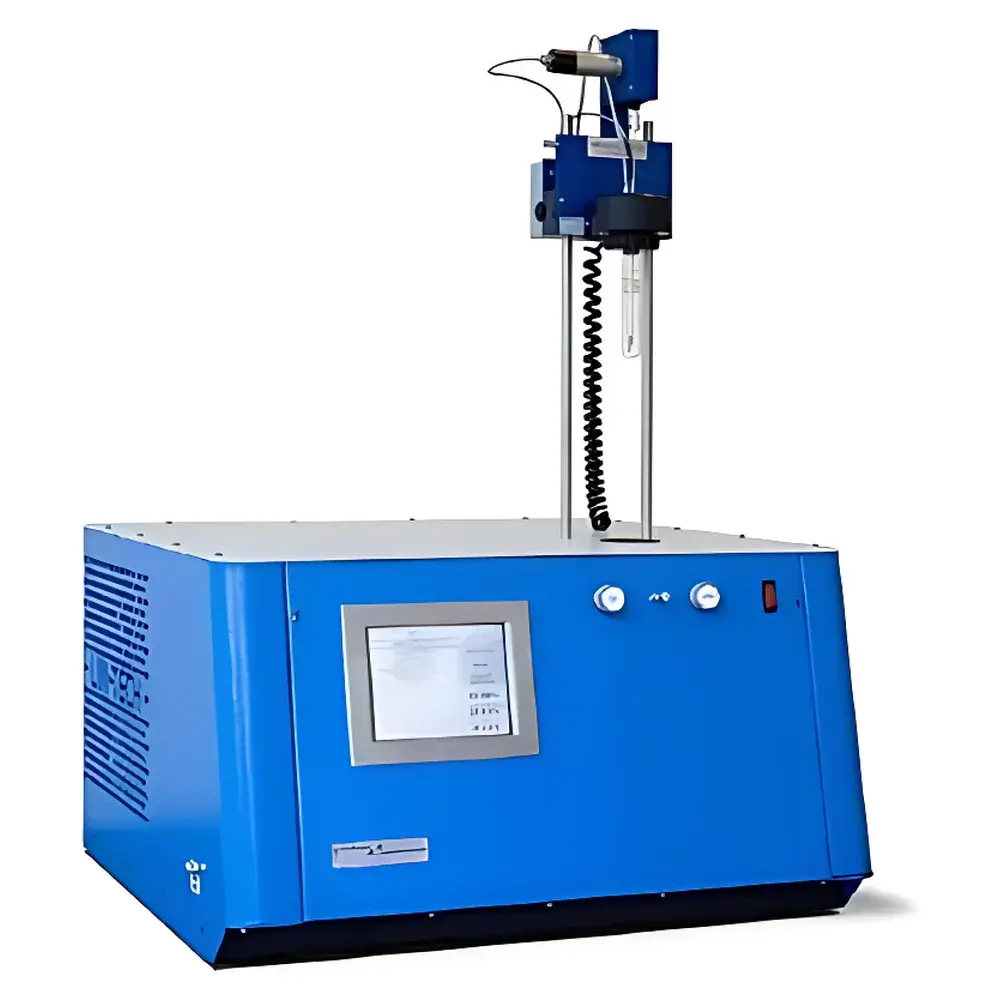
NewLab 300/2 Automatic Cloud and Pour Point Analyzer
| Brand | Linetronic |
|---|---|
| Origin | Switzerland |
| Model | 300/2 |
| Temperature Range | +80 °C to –80 °C |
| Temperature Resolution | 0.06 °C |
| Temperature Accuracy | ±0.1 °C |
| Cooling System | Dual-stage compressor (–85 °C min) or single-stage compressor (–40 °C min) |
| Temperature Sensor | PT100 Class A |
| Detection Method | Coaxial fiber-optic IR pulse reflection with mirror-based crystallization monitoring |
| Compliance | ASTM D1177, D2386, D5901, D5972, D1655 |
| Software | LabLink v.x (Windows 2000/XP/Vista), supports up to 10 analysis heads, LIMS-compatible, 21 CFR Part 11-ready audit trail capability |
Overview
The NewLab 300/2 Automatic Cloud and Pour Point Analyzer is a precision-engineered instrument designed for the reliable, standardized determination of cloud point (CP) and pour point (PP) in petroleum-based fluids. Developed by Linetronic in Switzerland and built to meet stringent international testing protocols, it operates on the principle of optical detection of hydrocarbon crystallization under controlled cooling. As the sample cools under continuous mechanical agitation, paraffinic wax crystals begin to form—altering the reflectivity of an integrated optical mirror surface. A coaxial infrared fiber-optic probe emits pulsed IR light and captures real-time changes in backscatter intensity, enabling unambiguous identification of the first visible crystal formation (cloud point) and subsequent cessation of flow (pour point). This method ensures high reproducibility across diverse sample matrices—including aviation turbine fuel (Jet A-1, JP-8), aviation gasoline (AVGAS), engine coolants, brake fluids, antifreeze formulations, and industrial lubricants—without operator intervention during critical phase transitions.
Key Features
- Compliant with globally recognized standards: ASTM D1177, D2386, D5901, D5972, D1655; IP 16, 435, 528, 529; ISO 3013; EN 23015; DIN 51597.
- Dual-stage refrigeration system achieves stable bath temperatures down to –85 °C, enabling full-range testing from +80 °C to –80 °C; optional single-stage configuration available for applications requiring only –40 °C minimum.
- PT100 Class A platinum resistance thermometer ensures traceable temperature measurement with ±0.1 °C accuracy and 0.06 °C digital resolution.
- Optical detection architecture features a coaxial fiber-optic IR probe paired with a calibrated stainless-steel mirror surface—eliminating subjective visual assessment and reducing inter-laboratory variability.
- Miniature motor-driven stirrer maintains consistent shear profile throughout cooling, conforming to standard-defined agitation rates per ASTM and IP methods.
- Integrated safety architecture includes dual pressure controllers (per compressor stage), thermal cut-off switches, solenoid-controlled heating/cooling jacket valves, and internal compressor overload protection.
- Modular test vessel design conforms precisely to ASTM D2386 and ISO 3013 dimensional specifications, including calibrated immersion depth markers and secure glass tube clamping mechanism.
Sample Compatibility & Compliance
The NewLab 300/2 accommodates a broad spectrum of transparent to lightly colored petroleum distillates and formulated fluids. Validated applications include jet fuels, diesel blends, biodiesel mixtures (B5–B20), hydraulic oils, transformer oils, and glycol-based coolant solutions. All measurements are performed under strictly defined environmental conditions (ambient ≤32 °C, RH ≤80 %) and comply with CE marking requirements for electromagnetic compatibility and electrical safety (EN 61000-6-3, EN 61000-6-2, EN 61010-1). The system supports GLP/GMP-aligned workflows through configurable user access levels, electronic signature support, and full audit trail generation in LabLink software—meeting foundational expectations for FDA 21 CFR Part 11 compliance when deployed with appropriate IT infrastructure and procedural controls.
Software & Data Management
LabLink software provides comprehensive instrument control, method management, and data integrity assurance. It runs natively on Windows platforms (2000 through Vista) and supports concurrent operation of up to ten independent analysis heads. The interface is organized into four functional modules: Analysis (with preloaded standard methods and customizable research protocols), Diagnostics (real-time I/O monitoring and sensor voltage/temperature mapping), Calibration (automated PT100 verification, date-stamped calibration logs, compensation value entry, and graphical calibration curve display), and Data Processing (operator ID tagging, Excel-compatible .csv export, searchable database storage for >60,000 results, and LIMS integration via ODBC or direct file drop). All analytical events—including method start/stop, alarm triggers, calibration actions, and manual interventions—are time-stamped and logged with user attribution, satisfying traceability requirements for accredited laboratories.
Applications
This analyzer serves as a core tool in refinery QC labs, aviation fuel certification facilities, military logistics depots, and third-party testing organizations. Typical use cases include batch release testing of Jet A-1 fuel against DEF STAN 91-91 and NATO F-34 specifications; cold flow improver (CFI) efficacy evaluation in diesel; pour point specification verification for marine distillate fuels (ISO 8217); and stability assessment of biofuel blends under low-temperature storage conditions. Its ability to execute both cloud and pour point determinations within a single automated sequence—without manual repositioning or parameter re-entry—reduces turnaround time and minimizes analyst exposure to cryogenic hazards.
FAQ
What standards does the NewLab 300/2 support for cloud and pour point testing?
It fully implements ASTM D1177, D2386, D5901, D5972, D1655; IP 16, 435, 528, 529; ISO 3013; EN 23015; and DIN 51597.
Can the instrument perform both cloud point and pour point measurements automatically in one run?
Yes—after detecting cloud point via optical crystallization onset, the system automatically initiates controlled reheating to determine pour point using the same sample and detection path.
Is LabLink software compatible with modern Windows operating systems?
LabLink v.x is certified for Windows 2000, XP, and Vista; migration paths to Windows 10/11 are supported via virtualized runtime environments validated by Linetronic technical services.
How is temperature calibration managed and documented?
The system performs automated PT100 calibration routines with date-stamped records, graphical deviation plots, and printable calibration certificates—all accessible via the dedicated Calibration menu.
Does the analyzer meet regulatory requirements for electronic records in regulated industries?
When configured with password-protected user roles, audit trail activation, and electronic signature enforcement, LabLink satisfies baseline 21 CFR Part 11 expectations for record retention and integrity in pharmaceutical-adjacent fuel testing environments.