
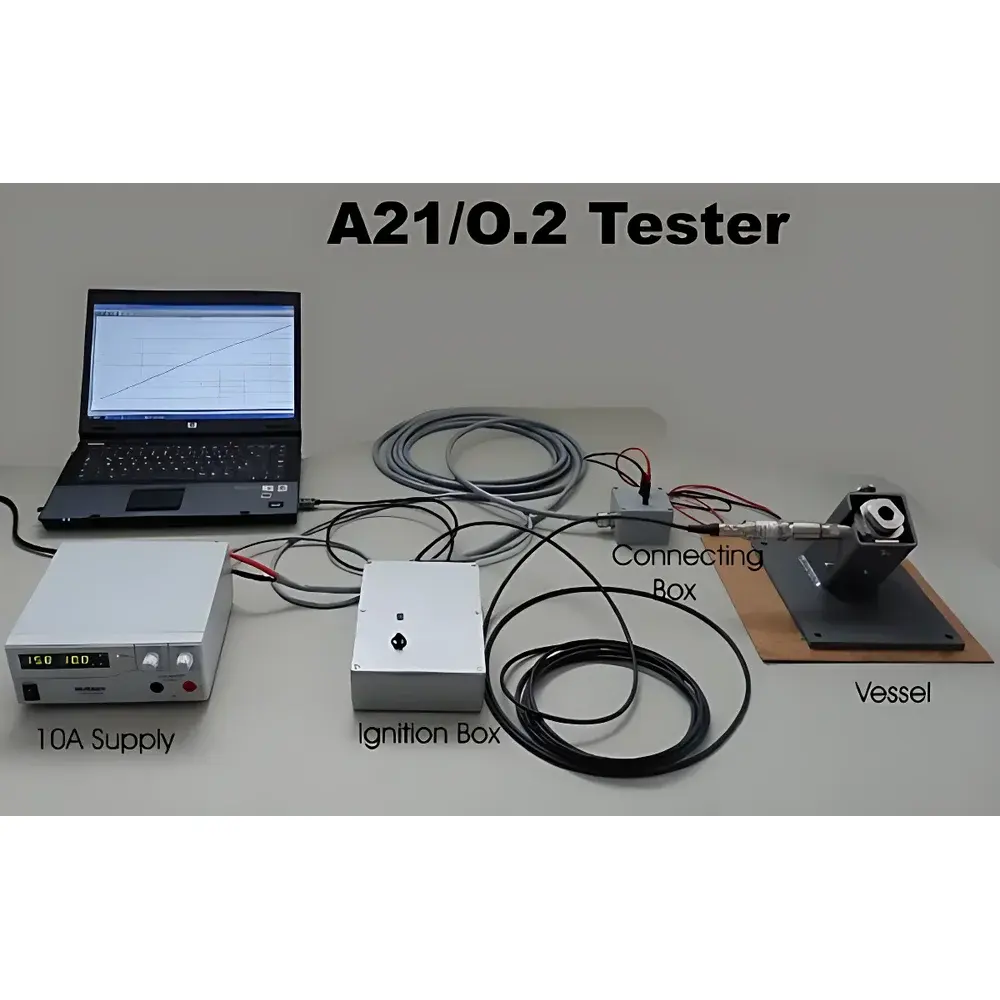
A.21/O.2 Liquid Oxidizing Properties Tester (Germany-manufactured)
| Origin | Germany |
|---|---|
| Manufacturer Type | Authorized Distributor |
| Origin Category | Imported |
| Model | A.21/O.2 |
| Pricing | Available Upon Request |
Overview
The A.21/O.2 Liquid Oxidizing Properties Tester is a precision-engineered laboratory instrument designed to evaluate the oxidizing potential of liquid substances under standardized closed-vessel conditions, in strict accordance with internationally recognized transport safety protocols. It operates on the principle of controlled combustion initiation within a sealed stainless-steel pressure vessel, where the test sample is homogeneously mixed with a defined quantity of combustible reference material (typically cellulose). The system monitors real-time pressure rise kinetics following electrical ignition — a direct indicator of enhanced combustion intensity or spontaneous ignition propensity induced by the oxidizer. This method quantifies the substance’s capacity to accelerate flame propagation or lower ignition thresholds relative to non-oxidizing controls. The apparatus fulfills the rigorous experimental requirements specified in the United Nations Recommendations on the Transport of Dangerous Goods: Manual of Tests and Criteria, 4th Revised Edition (UN RTDG), and its national adoption GB/T 21620–2008, “Dangerous Goods – Test Method for Oxidizing Properties of Liquids.” Its design prioritizes operational safety, measurement reproducibility, and regulatory traceability — essential attributes for classification laboratories supporting UN GHS hazard communication, SDS authoring, and regulatory submissions to authorities including ECHA, DOT, and IMDG.
Key Features
- Robust stainless-steel pressure vessel with integrated side arm for controlled gas-phase sampling and pressure transduction
- High-speed piezoresistive pressure transducer with ±0.2 ms temporal resolution, calibrated across 690–2070 kPa (0–500 psi), chemically inert to hot decomposition gases and corrosive oxidation byproducts
- Dedicated ignition control unit featuring isolated 10 A / 16 V constant-current power supply and fail-safe circuitry for consistent energy delivery
- Electronically triggered ignition system utilizing a precisely dimensioned NiCr wire (0.6 mm Ø, 25 cm length, 3.85 Ω/m resistance) ensuring repeatable thermal pulse initiation
- Pressure-relief safety mechanism incorporating a certified aluminum burst disc (0.2 mm thickness, nominal burst pressure ≈ 320 psi) compliant with ISO 4126-2
- Modular mechanical architecture enabling rapid reconfiguration for supplementary tests, including time-pressure (T-P) analysis per UN Test O.1
- Remote operation capability: ignition control box physically separated from the reaction chamber via shielded cabling, minimizing operator exposure during high-energy events
Sample Compatibility & Compliance
The A.21/O.2 supports testing of homogeneous liquid samples, suspensions, and low-viscosity pastes within standard mass/volume ranges defined by UN RTDG Section 34.4.2 and GB/T 21620–2008 Annex A. Sample containment utilizes chemically resistant seals and inert internal surfaces to prevent catalytic interference. All critical components — pressure sensor, burst disc, and ignition assembly — are individually certified to meet EN 13463-1 (non-electrical equipment for potentially explosive atmospheres) and ISO/IEC 17025 calibration traceability requirements. The system is fully compatible with GLP-compliant workflows, supporting audit-ready documentation through timestamped digital records and configurable metadata fields.
Software & Data Management
Data acquisition is performed using a calibrated digital storage oscilloscope synchronized with the ignition trigger event. Raw time-pressure waveforms are captured at ≥100 kHz sampling rate and stored in binary format for long-term archival. Proprietary software enables entry of contextual metadata (e.g., laboratory ID, sample batch number, operator name, ambient temperature/humidity), automatic calculation of key parameters (maximum pressure rise rate dP/dtmax, time-to-peak pressure tp, final equilibrium pressure Pf), and export to CSV or PDF formats. The software interface complies with FDA 21 CFR Part 11 requirements for electronic records and signatures when deployed on validated IT infrastructure, including user access controls, audit trail logging, and electronic signature capture.
Applications
- Hazard classification of industrial solvents, battery electrolytes, and chemical intermediates for UN Class 5.1 assignment
- Regulatory dossier preparation for REACH registration and CLP notification
- Quality control of oxidizer formulations in pharmaceutical excipient manufacturing
- Research into combustion kinetics of novel energetic liquids and green oxidizers
- Verification of stability claims for peroxide-containing formulations under thermal stress
- Supporting fire-safety engineering assessments for chemical storage and transport packaging design
FAQ
What standards does the A.21/O.2 tester directly support?
It is engineered to execute Test O.2 as described in UN RTDG Manual of Tests and Criteria, 4th revised edition, and fully aligns with GB/T 21620–2008.
Can the instrument be used for solid oxidizers?
No — this model is specifically configured for liquid-phase testing per O.2 methodology; solids require separate apparatus conforming to Test O.1.
Is calibration certification included with delivery?
Yes — each unit ships with a factory-issued calibration certificate traceable to PTB (Physikalisch-Technische Bundesanstalt) standards, covering pressure transducer and timing circuit performance.
How is data integrity ensured during high-pressure transient events?
The oscilloscope-based acquisition system employs hardware-triggered pre- and post-ignition buffering, eliminating waveform truncation and ensuring full capture of sub-millisecond pressure dynamics.
Does the system support automated pass/fail evaluation against UN criteria?
The software provides configurable threshold logic for dP/dtmax and tp, enabling immediate classification per UN Table 34.4.2 decision trees, subject to user-defined acceptance criteria.



