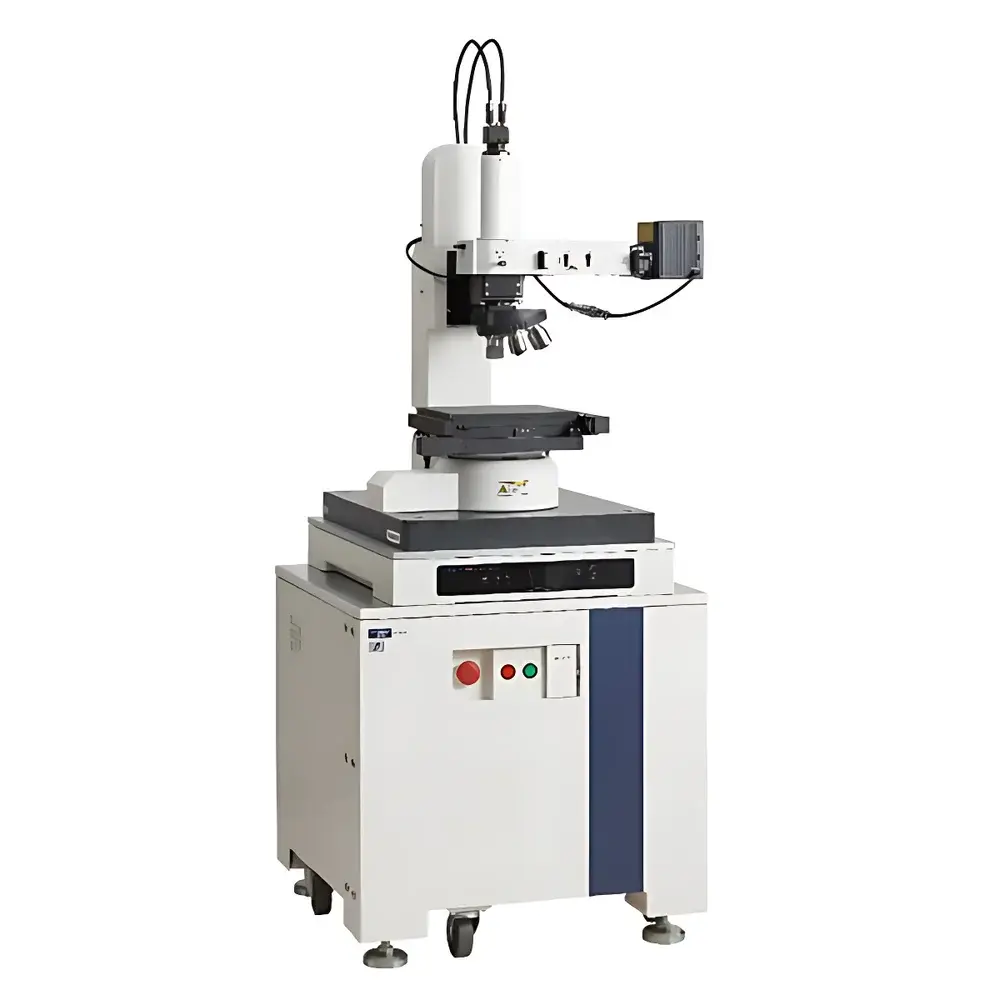
Hitachi VS1800 White-Light Interferometric Profilometer
| Brand | Hitachi |
|---|---|
| Origin | Japan |
| Manufacturer | Hitachi High-Tech Science Corporation |
| Product Type | Non-contact 3D Optical Profilometer / Surface Roughness Analyzer |
| Operating Principle | White-Light Interferometry |
| Model | VS1800 |
| Compliance | ISO 25178-2:2012, ISO 25178-601:2013, ISO 25178-602:2013 |
| Vertical Resolution | ≤ 0.01 nm (Phase-Shifting Mode) |
| Repeatability | < 0.1% (Z-height) |
| Field of View | Up to 6.4 mm × 6.4 mm (single-shot) |
| Measurement Speed | As fast as 5 seconds per acquisition (typical) |
| Optional Module | Large-Inclination Angle Measurement Kit |
Overview
The Hitachi VS1800 is a high-precision, non-contact 3D optical profilometer engineered for nanoscale surface topography characterization using white-light interferometry (WLI). Based on the principle of coherence-controlled interference between reference and object beams, the system captures full-field height data with sub-angstrom vertical resolution—achieving ≤ 0.01 nm in phase-shifting mode—while maintaining robust lateral sampling and measurement stability across diverse material classes. Designed specifically to meet the stringent metrological requirements of advanced R&D and quality control laboratories, the VS1800 delivers traceable, ISO 25178-compliant surface texture analysis without physical contact, eliminating risk of sample deformation, scratching, or contamination. Its architecture integrates proprietary algorithms for fringe contrast optimization, dynamic focus tracking, and multi-layer optical path compensation—enabling reliable measurement of transparent, semi-transparent, and highly reflective surfaces including thin-film stacks, glass substrates, MEMS devices, and polished metal components.
Key Features
- Sub-nanometer vertical resolution: Achieves ≤ 0.01 nm height resolution in phase-shifting interferometry mode, validated per ISO 25178-602:2013 Annex A for repeatability and sensitivity assessment.
- High measurement repeatability: Maintains < 0.1% Z-height repeatability through minimized mechanical drift, active vibration isolation compatibility, and Z-stage position feedback control.
- Large-area single-shot imaging: Captures up to 6.4 mm × 6.4 mm field-of-view in one acquisition, preserving both spatial fidelity and vertical accuracy—ideal for wafer-level inspection and macro-to-micro transition analysis.
- Multi-layer non-destructive analysis: Leverages Hitachi’s proprietary optical modeling engine to resolve individual layer thicknesses and interfacial defects in transparent multilayer structures (e.g., AR coatings, OLED stacks, SiO₂/SiNₓ films) without cross-sectioning.
- Large-inclination angle measurement option: Optional hardware module enables stable fringe capture on surfaces with slopes exceeding ±70°, overcoming classical WLI limitations via adaptive illumination geometry and real-time fringe modulation correction.
- Modular XY stage configuration: Three platform variants available: Type 1 (manual), Type 2 (motorized), and Type 3 (high-accuracy motorized with encoder feedback)—all sharing identical optical core and software architecture for seamless upgrade paths.
Sample Compatibility & Compliance
The VS1800 is validated for use across semiconductor fabrication, automotive powertrain development, pharmaceutical packaging validation, and biomedical device surface engineering. It supports measurement of metallic, ceramic, polymer, and optically complex samples—including anisotropic surfaces, low-reflectivity organics (< 2% reflectance), and high-aspect-ratio microstructures. All surface texture parameters comply with ISO 25178-2:2012 definitions and calculation methods, including amplitude (Sa, Sq, Sz), spatial (Sal, Str, Std), hybrid (Sdq, Sdr), and functional (Sk, Spk, Svk) parameters. System calibration adheres to ISO/IEC 17025 requirements when operated within accredited laboratory environments, and raw data export formats (e.g., .sur, .xyz, .csv) support audit-ready documentation for GLP/GMP-regulated workflows.
Software & Data Management
Hitachi’s proprietary VS-Analyzer software provides ISO 25178 parameter computation, statistical process control (SPC) charting, and automated report generation compliant with FDA 21 CFR Part 11 requirements—including electronic signatures, audit trails, and user-access-level management. The ISO 25178 Parameter Comparison Tool implements hierarchical parameter ranking based on inter-sample variance, enabling rapid identification of statistically discriminative metrics from the full ISO 25178 parameter set (n = 32). Users may define custom analysis sequences, apply batch processing across hundreds of datasets, and maintain version-controlled analysis templates. Raw interferogram data is stored in lossless format with embedded metadata (wavelength, magnification, environmental conditions), ensuring full traceability for regulatory submissions or inter-laboratory comparison studies.
Applications
- Semiconductor: Critical dimension verification of trench profiles, CMP uniformity mapping, and EUV mask defect localization.
- Automotive: Surface finish evaluation of cylinder bores, bearing races, and injection-molded plastic housings under production-line constraints.
- Pharmaceuticals: Quantitative assessment of tablet coating homogeneity, blister-pack seal integrity, and micro-roughness of medical-grade stainless steel implants.
- MEMS & Optics: Stiction risk prediction via Sa–Sdr correlation modeling, anti-reflective coating thickness uniformity, and diffractive optical element (DOE) profile fidelity validation.
- Academic Research: In-situ thermal expansion coefficient derivation from time-resolved topography series, tribofilm evolution monitoring during wear testing, and biomimetic surface replication fidelity quantification.
FAQ
Does the VS1800 require sample preparation prior to measurement?
No—non-contact operation eliminates the need for conductive coating, vacuum pumping, or mechanical fixation. Samples are placed directly on the stage.
Can the system measure transparent thin-film stacks without destructive cross-sectioning?
Yes—proprietary optical modeling allows layer-by-layer thickness extraction and interface defect detection in multilayer dielectrics and polymer laminates.
Is ISO 25178 compliance verified by third-party certification?
The VS1800’s parameter computation engine is internally validated against NIST-traceable step-height standards and conforms to ISO 25178-601:2013 verification procedures; external accreditation is lab-specific.
What environmental conditions are recommended for optimal performance?
Stable ambient temperature (±0.5°C/h), low air turbulence, and vibration-isolated optical tables are recommended; optional active damping modules are available for industrial floor deployment.
How does the large-inclination angle option extend measurement capability?
It modifies illumination incidence and camera alignment dynamically to sustain fringe visibility on steep slopes (up to ±75°), enabling accurate profiling of gear teeth flanks, turbine blade leading edges, and textured mold inserts.