
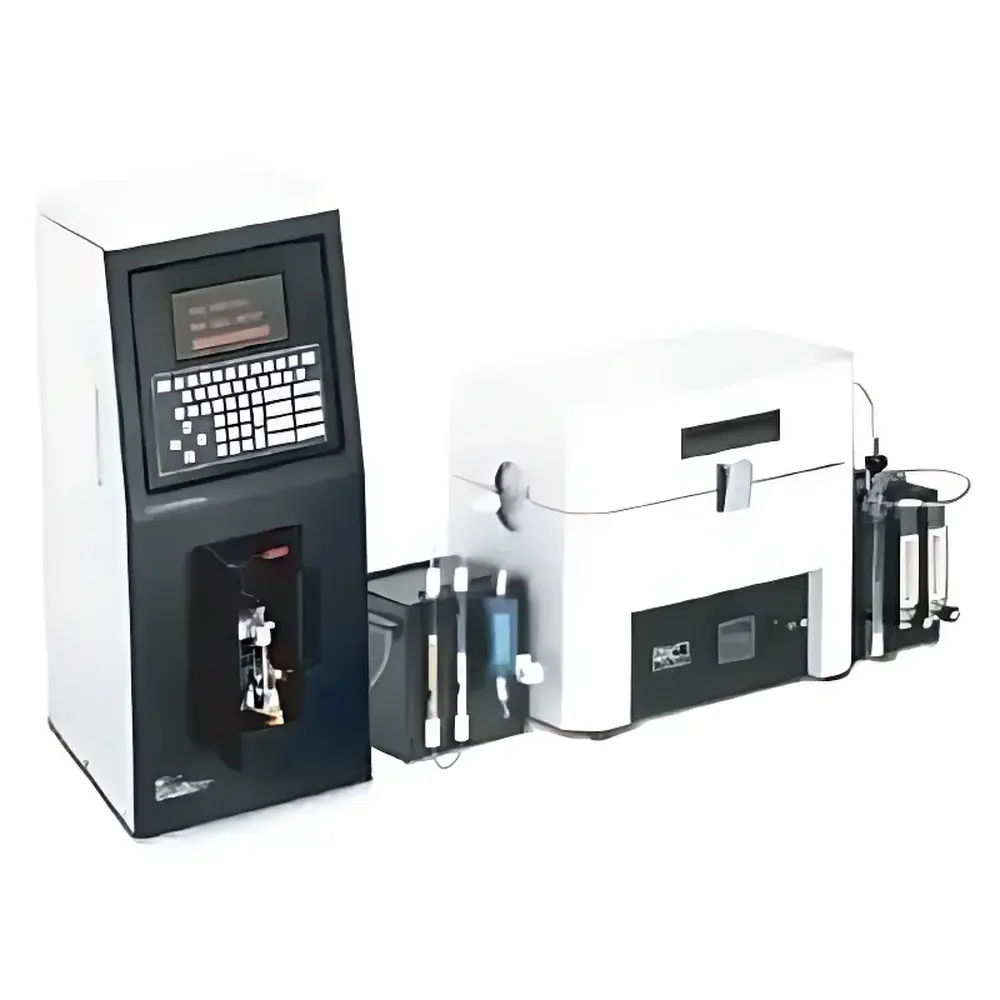
UIC CM120 Total Carbon Analyzer
| Brand | UIC (USA) |
|---|---|
| Origin | USA |
| Model | CM120 |
| Detection Principle | High-Temperature Catalytic Combustion + Potentiometric CO₂ Detection |
| Measuring Range | 1–10,000 µg C per sample |
| Detection Limit | 0.01 µg C |
| Furnace Max Temperature | 1100 °C |
| Sample Types | Solids (soils, sediments, coal, sulfur, sludge) and Suspended-Particle Liquids |
| Compliance | ASTM D7573, ISO 20236, USP <281>, EPA Method 415.1 compatible |
| Data Storage | Internal memory + 3.5″ floppy disk drive |
| Calibration | Factory-calibrated |
Overview
The UIC CM120 Total Carbon Analyzer is a robust, benchtop elemental combustion analyzer engineered for precise quantification of total carbon (TC) in heterogeneous solid and suspended-particle liquid matrices. It operates on the principle of high-temperature catalytic combustion (up to 1100 °C) in an oxygen-rich environment, followed by selective potentiometric detection of evolved CO₂. Unlike wet-chemical or catalytic oxidation methods with limited dynamic range, the CM120 employs a thermally stable, zero-drift CM5014 CO₂-specific potentiometric sensor—eliminating the need for routine user calibration while maintaining trace-level sensitivity (0.01 µg C) and linearity across five orders of magnitude (1–10,000 µg C per analysis). Designed for compliance-critical environments, the system meets methodological requirements referenced in ASTM D7573 (for soil and sediment TC), ISO 20236 (solid waste characterization), and USP (organic carbon in pharmaceutical excipients), supporting GLP and GMP-aligned workflows through audit-ready data handling.
Key Features
- Integrated CM5300 horizontal tube furnace with programmable temperature ramping (ambient to 1100 °C) and dual-stage gas purification: pre-combustion scrubber removes hydrocarbons and moisture from carrier O₂; post-combustion scrubber eliminates SOₓ, NOₓ, halides, and H₂O vapor prior to CO₂ detection.
- CM5014 potentiometric CO₂ analyzer featuring factory-traceable calibration, 0.01 µg C resolution, and selectable display units (µg C, % C, ppm C, mg C/L).
- No-user-calibration architecture: sensor stability validated over >10,000 analyses; drift <0.5% per 24 h under continuous operation.
- Flexible sample introduction via CM5323 (low-capacity) or CM5324 (high-capacity) auto-sampler, compatible with Pt or ceramic boats; tin foil encapsulation ensures complete carbon recovery from refractory matrices (e.g., coal, graphite-rich soils).
- Onboard data management: stores up to 50 sample records (name, mass, volume, surface area); supports batch report generation and ASCII-exportable results via 3.5″ floppy disk—compatible with LIMS integration protocols used in regulated labs.
Sample Compatibility & Compliance
The CM120 accommodates diverse, challenging sample types without pretreatment: dry or moist soils, marine sediments, industrial sludges, elemental sulfur, bituminous coal, pyritic ores, and turbid aqueous suspensions containing particulates ≤500 µm. Its combustion geometry and gas-cleaning train mitigate interferences common in high-sulfur or chloride-rich samples—enabling accurate TC measurement where IR-based analyzers exhibit saturation or baseline drift. The system satisfies regulatory data integrity requirements per FDA 21 CFR Part 11 (when paired with validated floppy-disk logging procedures) and supports full audit trails for ISO/IEC 17025 accreditation. All hardware components comply with UL 61010-1 and CE electromagnetic compatibility directives.
Software & Data Management
The CM120 operates via dedicated front-panel controls with real-time status feedback (furnace temp, CO₂ signal mV, gas flow rate). No PC dependency is required for routine operation; however, optional RS-232 interface enables connection to laboratory PCs for automated report export and long-term archiving. Raw potentiometric voltage signals and integrated peak areas are stored alongside metadata (sample ID, boat ID, ignition time, operator code). Disk-based storage follows FAT12 formatting for cross-platform readability; exported files include timestamped headers and comply with ASTM E1447-22 for analytical data interchange. Firmware updates are delivered via physical floppy media to maintain air-gapped security in classified or validation-controlled facilities.
Applications
- Environmental monitoring: TC quantification in contaminated site soils (EPA Region 4 protocols), landfill leachate solids, and dredged sediments per ASTM D7573.
- Fuel and energy research: carbon content profiling in coals, coke, biochars, and sulfur-bearing feedstocks—critical for calorific value modeling and emissions forecasting.
- Geochemical analysis: organic/inorganic carbon partitioning in carbonate-rich rocks and paleosols using sequential TC–IC subtraction workflows.
- Pharmaceutical QC: residual carbon verification in active pharmaceutical ingredients (APIs) and excipients per USP , especially for non-volatile organics resistant to TOC oxidation.
- Academic teaching labs: hands-on instruction in combustion stoichiometry, redox reaction kinetics, and electrochemical sensor principles—supported by reproducible, low-maintenance operation.
FAQ
Does the CM120 require daily calibration or standardization?
No. The CM5014 CO₂ sensor is factory-calibrated against NIST-traceable CO₂ standards and exhibits <0.3% signal drift over 72 hours. Routine verification uses a single 100-µg C sucrose check standard—recommended weekly for GLP audits.
Can the CM120 measure TOC (total organic carbon)?
Not natively. The CM120 measures TC only. TOC determination requires pairing with a separate inorganic carbon (IC) removal step (e.g., acidification/sparging) and subtraction—workflows documented in ASTM D7573 Annex A3.
What maintenance intervals are recommended for the CM5300 furnace?
Quartz combustion tube replacement every 6 months under continuous use; scrubber cartridges every 200–300 runs depending on sample sulfur/chloride load. Full maintenance logs are retained in onboard memory.
Is the floppy disk data format compatible with modern LIMS?
Yes. ASCII-delimited (.TXT) output files follow ASTM E1447-22 schema and import directly into LabWare, Thermo Fisher SampleManager, and Waters Empower via flat-file ingestion modules.
How is carryover managed between high-carbon and low-carbon samples?
The CM5300 includes an automatic post-run blank cycle: furnace purges at 1100 °C for 90 s under O₂ flow, verified by baseline stabilization (<0.1 mV drift) before next injection—validated per ISO 20236 section 8.4.





