
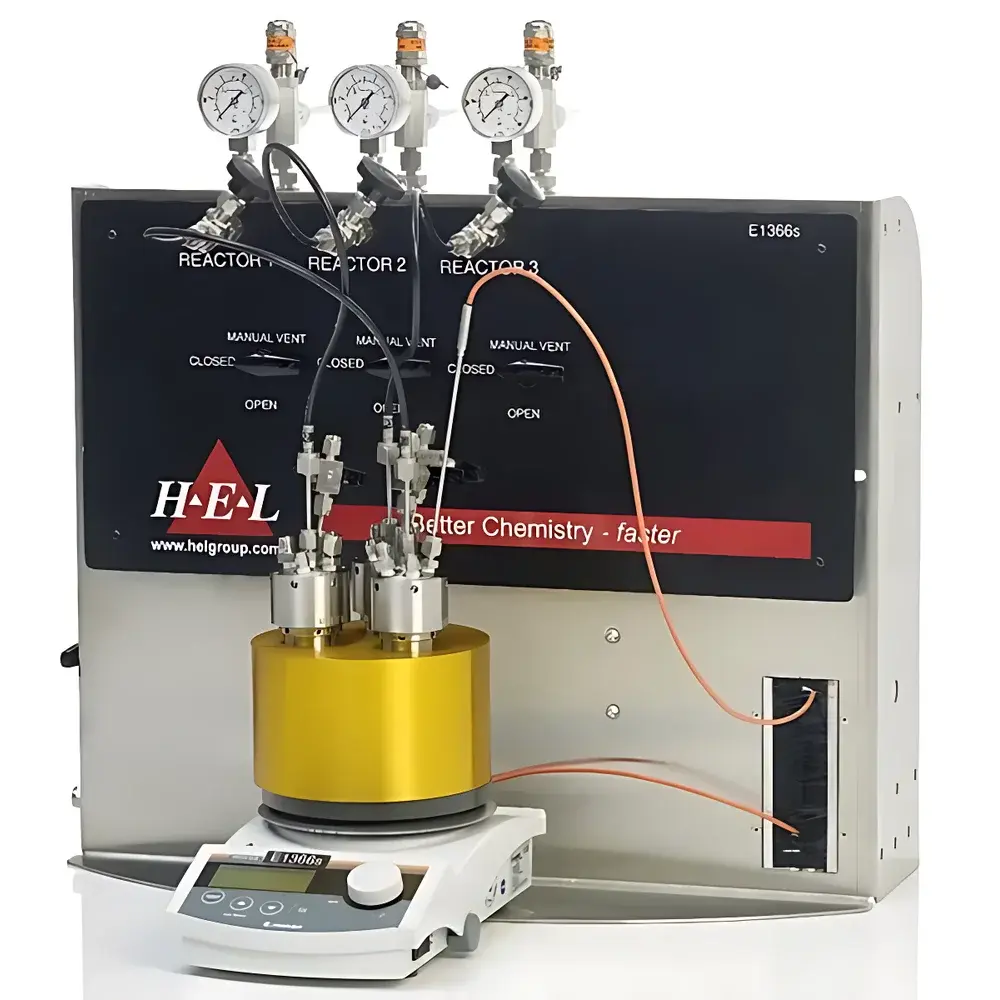
HEL DigiCAT Automated High-Pressure Catalyst Screening Platform
| Brand | HEL |
|---|---|
| Origin | United Kingdom |
| Model | DigiCAT |
| Reaction Pressure | 100 bar (max. 200 bar) |
| Reaction Temperature | 200 °C (max. 300 °C) |
| Catalyst Bed Volume | 75 mL |
| Compatible Reactor Formats | CAT-7, CAT-18, CAT-24, and custom vessels (16–75 mL) |
| Control Interface | PC-based software with integrated electromagnetic inlet/outlet valves, real-time T&P monitoring, safety relief valve setpoint: ~35 bar |
| Heating Method | Bottom-mounted aluminum heating block with PID temperature control |
| Stirring Mechanism | Internal magnetic stirrer drive coupled to external motor via high-strength permanent magnet array |
Overview
The HEL DigiCAT Automated High-Pressure Catalyst Screening Platform is an engineered solution for parallel, statistically robust catalyst evaluation under rigorously controlled thermobaric conditions. Designed specifically for early-stage catalyst development in academic research labs and industrial R&D centers, the DigiCAT platform implements a Couette-type magnetic stirring configuration within sealed, pressure-rated reaction vessels—enabling homogeneous mass transfer and consistent thermal profiles across multiple samples simultaneously. Its core architecture supports reproducible kinetic profiling by maintaining precise isothermal and isobaric environments (up to 200 °C and 200 bar), critical for discriminating subtle differences in turnover frequency (TOF), selectivity, and deactivation behavior among heterogeneous and homogeneous catalyst candidates. Unlike manual batch reactors, the DigiCAT integrates closed-loop process control logic compliant with GLP-aligned experimental workflows—ensuring traceability, repeatability, and audit-ready data capture from initiation to termination of each screening run.
Key Features
- Modular multi-vessel support: Simultaneous operation of up to 24 independent reaction zones using standardized CAT-series vessels (CAT-7, CAT-18, CAT-24) or user-defined reactor geometries (16–75 mL volume range).
- High-fidelity process control: Integrated electromagnetic inlet and vent valves enable automated gas dosing, sequential pressurization, and controlled depressurization—all synchronized with real-time pressure and temperature feedback loops.
- Thermal management system: Precision-machined aluminum heating block mounted directly beneath the reactor array ensures uniform conductive heating; PID-controlled temperature regulation maintains stability within ±1 °C over full operating range (ambient to 300 °C).
- Magnetic agitation architecture: Dual-stage coupling—external stepper motor + internal rare-earth magnet assembly—delivers consistent rotational energy transfer without mechanical seals or rotating feedthroughs, eliminating leakage pathways and enabling long-duration runs under inert or reactive atmospheres.
- Integrated safety infrastructure: ASME-certified pressure containment design; redundant pressure monitoring with configurable alarm thresholds; mechanically set safety relief valve calibrated at ~35 bar for overpressure protection.
Sample Compatibility & Compliance
The DigiCAT platform accommodates a broad spectrum of catalytic systems—including supported metal nanoparticles, metal–organic frameworks (MOFs), single-atom catalysts, and molecular complexes—within chemically resistant vessel liners (Hastelloy C-276, stainless steel 316, or quartz options). All fluid-contact components meet ASTM F899 standards for corrosion resistance in aggressive media. The system’s control firmware and data logging architecture are structured to support compliance with ISO/IEC 17025 requirements for testing laboratories and provide foundational alignment with FDA 21 CFR Part 11 for electronic records and signatures when deployed with validated software configurations. Full hardware documentation—including material certifications, pressure test reports, and electrical safety assessments—is supplied per IEC 61000-6-2/6-4 EMC directives.
Software & Data Management
Operation is managed through HEL’s proprietary CatalystScreen software suite, running on Windows-based host PCs. The interface provides real-time visualization of pressure transients, thermal ramp profiles, valve actuation sequences, and stir speed logs. Experimental protocols are defined via intuitive step-based scripting—supporting conditional branching (e.g., “hold at 120 °C until P stabilizes ±0.5 bar”), time-triggered gas injections, and automatic endpoint detection based on rate-of-change thresholds. All raw sensor data are timestamped, stored in HDF5 format with embedded metadata (user ID, experiment ID, calibration timestamps), and exportable to CSV or MATLAB-compatible structures. Audit trails record operator actions, parameter modifications, and system alarms—facilitating retrospective analysis and regulatory review.
Applications
- High-throughput screening of Fischer–Tropsch, hydrogenation, hydrodeoxygenation (HDO), and CO₂ hydrogenation catalysts.
- Structure–activity relationship (SAR) studies requiring systematic variation of metal loading, support acidity, or ligand architecture.
- Stability assessment under accelerated aging conditions (e.g., 100-h continuous operation at 180 °C/80 bar).
- Reaction optimization across multivariate parameter spaces (T, P, H₂:substrate ratio, residence time) using DoE-driven experimental designs.
- Validation of catalyst performance prior to scale-up in fixed-bed or slurry-phase pilot reactors.
FAQ
What reactor volumes are supported beyond the standard CAT series?
The DigiCAT accepts custom-designed vessels ranging from 16 mL to 75 mL, provided they conform to the platform’s mechanical mounting interface and maximum pressure rating.
Can the system operate under corrosive gas environments such as H₂S or Cl₂?
Yes—when equipped with Hastelloy C-276 reactor bodies and fluoropolymer-sealed valves, the platform maintains integrity in sour gas applications per NACE MR0175/ISO 15156 guidelines.
Is remote monitoring supported?
Local Ethernet connectivity enables integration into lab-wide SCADA networks; however, cloud-based telemetry requires third-party middleware deployment and is not natively enabled out-of-the-box.
How is temperature uniformity verified across all reactor positions?
Each unit undergoes factory validation using embedded PT100 sensors at three radial locations per zone; certificate of conformance includes spatial temperature deviation maps at 100 °C, 200 °C, and 300 °C setpoints.
Does the system include calibration documentation for pressure and temperature sensors?
Yes—NIST-traceable calibration certificates for all primary sensors are shipped with the instrument and updated annually during scheduled maintenance visits.



