
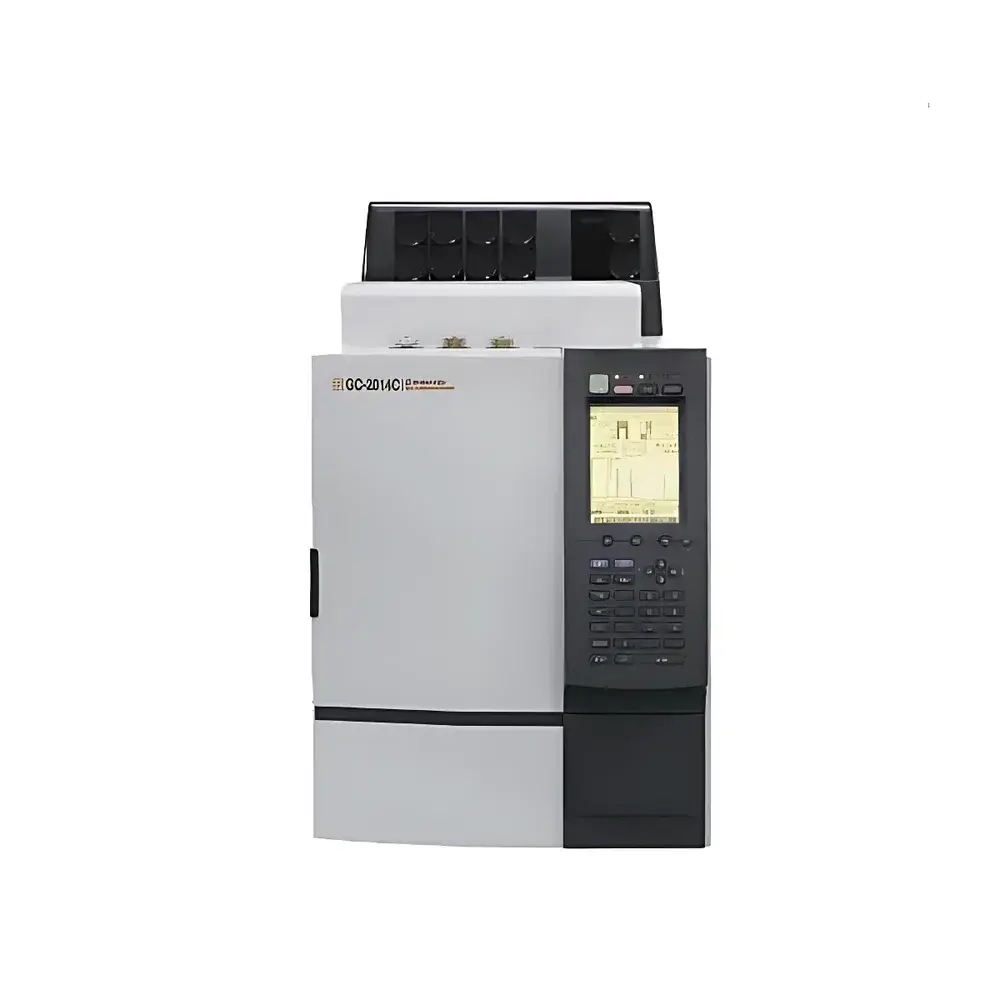

Shimadzu GC-2014C Gas Chromatograph
| Brand | Shimadzu |
|---|---|
| Origin | Japan |
| Model | GC-2014C |
| Instrument Type | Laboratory Gas Chromatograph |
| Application Scope | General-purpose |
| Oven Temperature Control Range | 75–120 °C/min (ramp rate) |
| Temperature Ramp | 100–450 °C in 4.5 min |
| Cooling Rate | 100–0 °C in 4.5 min |
| Carrier Gas Flow Range & Control | 0–200 mL/min |
| Carrier Gas Pressure Range & Control | 150–700 kPa |
| Injector Maximum Operating Temperature | 400 °C |
| Injector Pressure Setting Range | 100–500 kPa |
| Injector Total Flow Setting Range | 200–1200 mL/min |
Overview
The Shimadzu GC-2014C is a laboratory-grade gas chromatograph engineered for precision, reliability, and regulatory compliance in routine and method-development environments. Based on Shimadzu’s proven GC platform architecture, it employs capillary and packed column separation principles governed by partitioning thermodynamics and carrier-gas-driven solute elution kinetics. The instrument utilizes temperature-programmed oven control, electronically regulated carrier gas flow (via Advanced Flow Control, AFC), and modular detector integration to deliver reproducible retention times and quantitative peak area stability—critical for validated workflows in pharmaceutical QC, environmental residue analysis, food safety testing, and petrochemical characterization. Manufactured at Shimadzu’s ISO 9001-certified Suzhou facility under strict global quality protocols, the GC-2014C maintains full traceability to Shimadzu Japan’s design specifications and performance benchmarks.
Key Features
- Modular configuration options: supports both manual and fully automated electronic pressure/flow control (AFC) modes—enabling constant pressure, constant flow, or Shimadzu’s proprietary constant linear velocity (CLV) mode for improved retention time reproducibility across column dimensions and temperatures.
- High-performance oven system with rapid heating (up to 120 °C/min) and cooling (100 → 0 °C in 4.5 min), facilitating high-throughput batch analysis and method optimization cycles.
- Large-volume column chamber (increased internal dimensions) simplifies column installation, maintenance, and replacement—reducing downtime and operator error.
- Multi-injector compatibility: up to three independent inlet units can be installed simultaneously—including split/splitless (SPL-2014), dual-packed (DINJ-2014), and programmable temperature vaporizing (PTV) inlets (optional).
- Four-detector capacity with hot-swappable design: accommodates FID-2014 (flame ionization), TCD-2014 (thermal conductivity), ECD-2014 (electron capture), FPD-2014 (flame photometric), and FTD-2014/FTD-2014C (flame thermionic) detectors—all operating at defined thermal limits (e.g., FPD-2014 up to 350 °C).
- Integrated hardware self-diagnostic routines and real-time status monitoring via large-format backlit LCD with intuitive graphical user interface (GUI) in English—eliminating language barriers during operation and troubleshooting.
Sample Compatibility & Compliance
The GC-2014C is compatible with standard 40-mm threaded glass columns used across Shimadzu’s GC-7 through GC-16 series, ensuring legacy column inventory reuse and minimizing consumables cost. It supports both packed and fused-silica capillary columns (0.1–0.53 mm ID), accommodating volatile and semi-volatile organic compounds (VOCs/SVOCs), residual solvents, pesticides, hydrocarbons, and permanent gases. All configurations meet essential requirements for GLP and GMP-compliant laboratories: audit-trail-enabled GCsolution Lite software provides full electronic record integrity per FDA 21 CFR Part 11, including user authentication, parameter change logging, and secure data archiving. Instrument qualification documentation (IQ/OQ/PQ templates) and calibration verification tools are available upon request for regulated environments.
Software & Data Management
GCsolution Lite is a full-featured, Windows-based chromatography data system (CDS) designed for routine QA/QC labs. It delivers complete workflow support—from method creation and instrument control to peak integration, calibration curve generation, report formatting, and PDF export. Built-in validation features include forced reintegration, baseline correction algorithms, and customizable reporting templates compliant with ISO/IEC 17025 and ASTM D3666. Raw data files (.gcd) are stored in non-proprietary binary format with embedded metadata (acquisition time, method name, operator ID, instrument serial number), enabling long-term archival and third-party data reprocessing. Optional GCsolution Pro extends capabilities to multi-dimensional GC (MDGC), spectral deconvolution, and compliance with EU Annex 11 requirements.
Applications
The GC-2014C serves as a foundational analytical tool across multiple regulated and research-intensive domains. In environmental labs, it quantifies VOCs in air/water per EPA Method 8260 and organochlorine pesticides per EPA Method 8081. Food testing applications include solvent residue screening (ICH Q3C), fatty acid methyl ester (FAME) profiling, and flavor compound analysis. Pharmaceutical labs use it for residual solvent testing (USP ), assay purity assessment, and extractables/leachables studies. Petrochemical users rely on its robustness for hydrocarbon group-type analysis (ASTM D5186, D6730) and refinery gas composition profiling. Its modularity allows seamless adaptation from single-detector QC screening to multi-detector confirmatory workflows.
FAQ
Is the GC-2014C compliant with FDA 21 CFR Part 11?
Yes—when operated with GCsolution Lite v2.5 or later and configured with user authentication, electronic signatures, and audit trail activation, the system meets core technical and procedural requirements of 21 CFR Part 11.
Can I upgrade from manual flow control to AFC after purchase?
Yes—AFC modules (including pressure and flow sensors, solenoid valves, and control electronics) are field-installable as retrofit kits, preserving original instrument warranty coverage.
What column types are supported?
Standard 40-mm threaded glass columns (GC-7 to GC-16 legacy), fused-silica capillaries (0.1–0.53 mm ID), and stainless-steel packed columns—all with compatible ferrule and nut assemblies.
Does the system support unattended overnight operation?
Yes—integrated auto-shutdown, flame monitoring (for FID), and leak detection routines enable safe extended runs; optional autosamplers (e.g., AOC-20i) extend sequence capacity to 162 vials.
Is remote monitoring or control possible?
GCsolution Lite supports LAN-based instrument control and real-time status viewing via browser-accessible web interface (Shimadzu LabSolutions Web), requiring no additional client software installation.





