
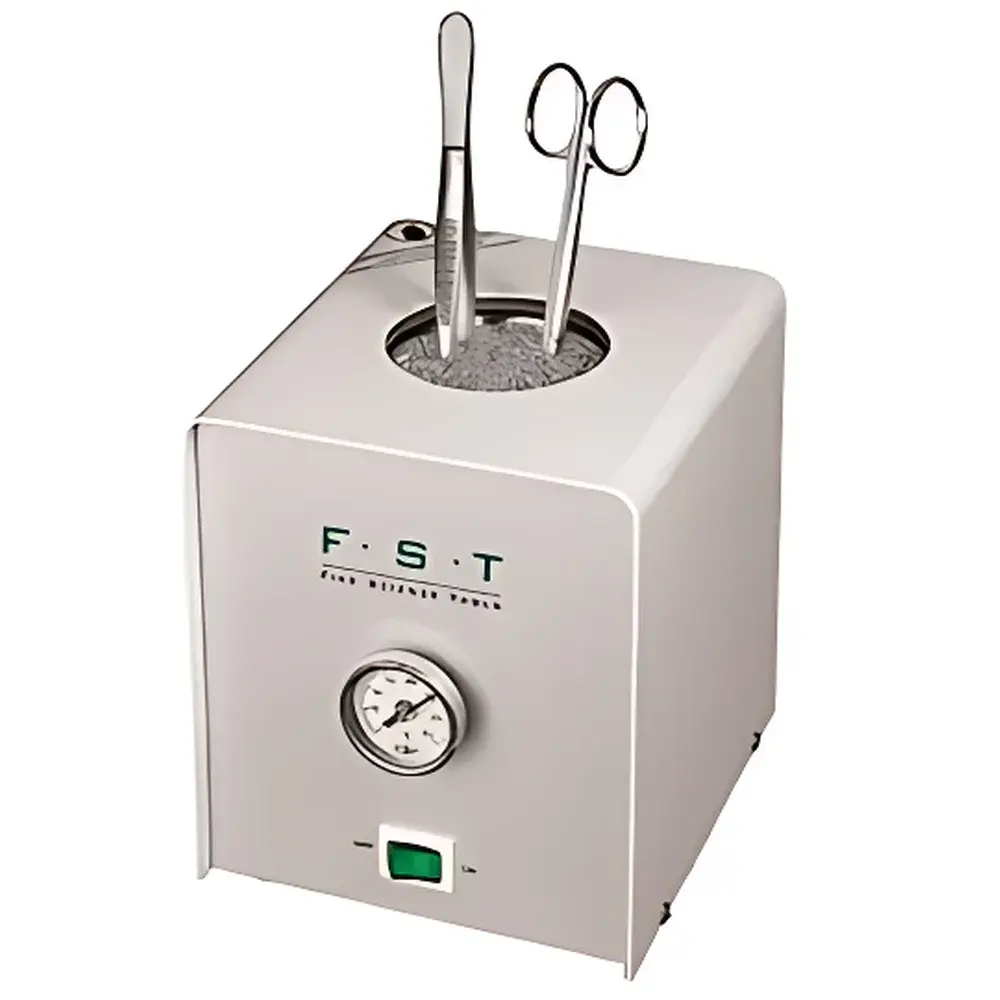
RWD FST250 Dry-Heat Glass Bead Sterilizer
| Brand | RWD |
|---|---|
| Origin | Shenzhen, China |
| Manufacturer Type | Manufacturer |
| Country of Origin | China |
| Model | FST250 |
| Price | Upon Request |
| Chamber Dimensions (H × Ø) | 8 cm × 4 cm |
| Chamber Volume | 100 mL |
| Bead Diameter | 1.5–2.0 mm |
| Operating Temperature Range | 240–270 °C |
| Sterilization Time | ≤20 s |
| Bead Capacity Included | Two packs of 18000-46 glass beads |
| Compliance | NIH-recommended dry-heat sterilization method, chemical-free and flame-free operation |
Overview
The RWD FST250 Dry-Heat Glass Bead Sterilizer is a compact, benchtop thermal sterilization device engineered for rapid, chemical-free decontamination of small solid instruments in life science and animal experiment laboratories. It operates on the principle of conductive dry-heat sterilization: stainless-steel-contained borosilicate glass beads (1.5–2.0 mm diameter) are heated to 240–270 °C and maintained at stable temperature via precision PID-controlled heating elements. When metallic or glass instruments—such as forceps, scissors, scalpels, biopsy needles, inoculation loops, and microsurgical tools—are immersed fully into the agitated bead bath for ≥10 seconds, microbial load—including vegetative bacteria, fungi, and highly resistant bacterial spores—is reliably inactivated through sustained thermal denaturation of proteins and nucleic acids. Unlike autoclaving or chemical immersion, this method avoids moisture retention, corrosion risk, and residual toxicity, making it ideal for heat-stable, non-porous instruments used repeatedly in sterile surgical procedures, rodent survival surgery, and microbiological inoculation workflows.
Key Features
- Compact footprint (≤15 cm × 15 cm base) designed for integration inside laminar flow hoods or biosafety cabinets without compromising airflow integrity
- High-performance stainless-steel bead bath with optimized thermal mass and uniform heat distribution; reaches 250 °C within 15–20 minutes and maintains ±5 °C stability under continuous operation
- Dual-stage safety architecture: independent overtemperature cutoff (280 °C mechanical limit) plus electronic thermal runaway protection
- Precision digital temperature controller with LED display and real-time monitoring—calibration traceable to NIST-traceable reference standards
- Low-power consumption (≤120 W), enabling all-day use without thermal throttling or external cooling requirements
- Tool-free access design: removable stainless-steel lid and seamless bead bath facilitate rapid cleaning, bead replacement, and GLP-compliant maintenance logging
Sample Compatibility & Compliance
The FST250 is validated for sterilizing dry, clean, non-porous instruments ≤4 mm in maximum cross-section and ≤12 cm in length—including stainless-steel needle holders, ophthalmic forceps, microdissection tools, and glass capillary pipettes. It is not suitable for plastic, coated, or temperature-sensitive materials. The sterilization protocol aligns with NIH Office of Animal Care and Use (OACU) guidelines for rapid instrument reprocessing in rodent surgical suites and adheres to ASTM E535-22 (Standard Practice for Validation of Dry-Heat Sterilization Processes). While not a regulated medical device under FDA 21 CFR Part 820, its operational parameters satisfy internal quality system requirements for GLP and AAALAC-accredited facilities performing terminal sterilization of reusable surgical tools between procedures.
Software & Data Management
The FST250 is a standalone analog-digital hybrid instrument with no embedded firmware or network interface. Temperature setpoint and real-time readout are managed via front-panel push-button controls and a high-contrast LED display. For auditability, users are advised to log sterilization cycles manually in laboratory notebooks or electronic lab notebooks (ELNs) per institutional SOPs. Optional accessories include a calibrated NIST-traceable digital thermometer (model DT-250B) for periodic verification of bath temperature uniformity and drift—recommended quarterly per ISO/IEC 17025:2017 Clause 7.8.1. All maintenance records—including bead replacement dates, cleaning logs, and calibration verifications—must be retained for minimum of two years to support GCP/GLP inspections.
Applications
- Routine sterilization of microsurgical instruments during multi-step rodent survival surgeries (e.g., stereotaxic implantation, craniotomy, vascular cannulation)
- Immediate reprocessing of inoculation loops and needles between bacterial streaking steps in BSL-1/BSL-2 microbiology labs
- Decontamination of dissection tools in developmental biology and neuroanatomy labs where ethanol flaming poses fire hazard or aerosol contamination risk
- Supporting ALARA principles in shared core facilities by minimizing exposure time to open flames or volatile disinfectants
- Complementing autoclave workflows for instruments incompatible with steam (e.g., tungsten carbide tips, fine-tipped electrocautery probes)
FAQ
What types of instruments can be safely sterilized in the FST250?
Only dry, clean, solid metal or borosilicate glass instruments with maximum cross-sectional dimension ≤4 mm and length ≤12 cm. Do not insert plastic, rubber-coated, or temperature-sensitive components.
How often must the glass beads be replaced?
Replace monthly or after 500 sterilization cycles—whichever occurs first. Alternatively, beads may be cleaned using mild detergent, thoroughly rinsed with deionized water, dried at 120 °C for 2 hours, and verified for visual clarity and absence of surface pitting prior to reuse.
Is the FST250 compliant with FDA or ISO 13485 requirements?
No—it is classified as a laboratory support instrument, not a medical device. However, its thermal performance meets validation benchmarks referenced in ISO 17665-1 for dry-heat sterilization process development.
Can the unit operate continuously for 8+ hours?
Yes. The thermal management system is rated for uninterrupted operation at 250 °C. External housing surface temperature remains ≤45 °C under ambient conditions (20–25 °C), satisfying IEC 61000-3-2 harmonic current limits.
Does the FST250 require annual calibration?
While not mandatory, RWD recommends annual verification of temperature accuracy using an accredited thermocouple probe (Class A, ±0.5 °C tolerance) per ISO/IEC 17025 Clause 6.5.2. Calibration certificates must reference traceability to national metrology institutes (e.g., NIM, China).
Related Products




