
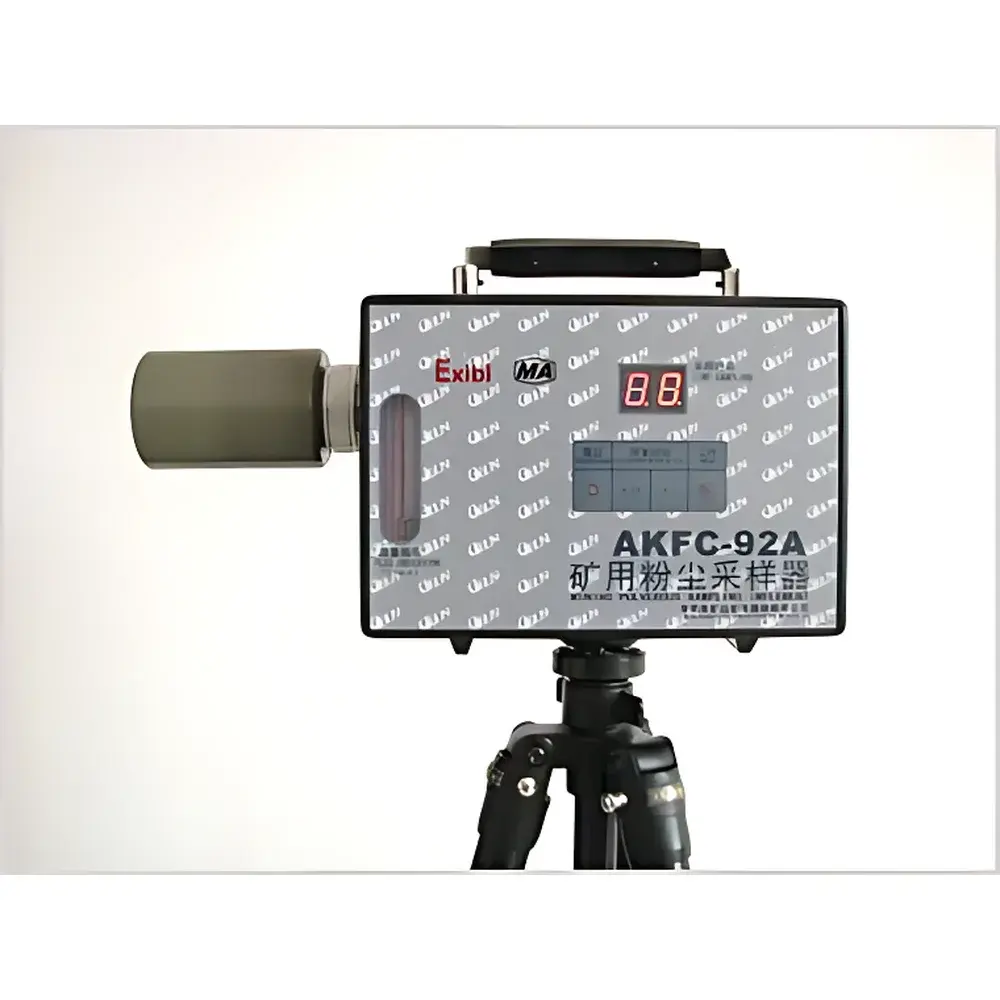
AKFC-92A Mine-Use Intrinsically Safe Dust Sampler
| Origin | Beijing |
|---|---|
| Manufacturer Type | Authorized Distributor |
| Origin Category | Domestic (China) |
| Model | AKFC-92A |
| Pricing | Upon Request |
| Sampling Flow Rate | 20 L/min |
| Maximum Negative Pressure | >3000 Pa |
| Load Capacity | ≥1000 Pa |
| Dust Fraction Measurement | Total Dust & Respirable Dust |
| Timer Range | 0–99 min (adjustable) |
| Continuous Operation Time | >120 min |
| Sound Pressure Level | ≤70 dB(A) |
| Explosion Protection | ibI (150 °C) Intrinsically Safe |
| Operating Temperature | −5 °C to 35 °C |
| Relative Humidity Limit | ≤95% RH |
| Dimensions | 200 × 140 × 80 mm |
| Weight | 1.8 kg |
Overview
The AKFC-92A Mine-Use Intrinsically Safe Dust Sampler is a field-deployable, regulatory-compliant sampling instrument engineered for quantitative assessment of airborne particulate mass concentration in hazardous underground mining environments. It operates on the principle of constant-flow gravimetric sampling—drawing ambient air through a pre-selected collection filter at a precisely regulated volumetric flow rate (20 L/min), enabling subsequent laboratory analysis (e.g., gravimetric or elemental analysis) to determine total dust and respirable dust mass concentrations. Designed explicitly for coal mines and other explosive atmospheres, the device conforms to the intrinsic safety standard ibI (150 °C), ensuring safe operation in methane- and coal-dust-laden environments per IEC 60079-0 and GB 3836 series requirements. Its mechanical architecture integrates a high-efficiency diaphragm pump with closed-loop feedback control, delivering stable flow under variable filter loading conditions—a critical requirement for compliance with ISO 7708:1995 (respirable convention) and the British Medical Research Council (BMRC) inhalability curve.
Key Features
- Intrinsically safe ibI (150 °C) certification—fully compliant with MT 162–1995, JJG (Coal) 03–96, and GB 3836.4–2021 for use in Zone 0/1 explosive gas atmospheres.
- Dual-fraction sampling capability: supports simultaneous or independent collection of total dust (via full-air preseparator) and respirable dust (via impactor-type preseparator calibrated to BMRC separation efficiency).
- Active flow regulation circuitry maintains ±5% stability across load pressures up to 1000 Pa, ensuring adherence to ISO 13137:2013 sampling volume accuracy requirements.
- Programmable digital timer (0–99 min, 1-min resolution) with auto-shutdown and audible low-battery alert.
- Ruggedized ABS polymer housing with anti-static, moisture-resistant, and dust-tight surface treatment (IP54 equivalent).
- No-pulse airflow design minimizes particle re-entrainment and improves filter deposition uniformity.
- Integrated undervoltage protection and thermal monitoring prevent operational failure during extended shifts.
Sample Compatibility & Compliance
The AKFC-92A accommodates standard 37-mm or 25-mm diameter mixed-cellulose ester (MCE), polyvinyl chloride (PVC), or quartz fiber filters—compatible with gravimetric analysis per NIOSH Method 0600 and OSHA ID-142. The respirable preseparator meets the geometric cutoff criteria defined in ISO 7708:1995 and aligns with the BMRC reference curve (median aerodynamic diameter = 4.0 µm, GSD = 1.5). Regulatory alignment includes: GB 16225–1996 (respirable silica), GB 16238–1996 (cement dust), GB 16248–1996 (coal dust), and GB 5748–1985 (dust measurement methodology). Device calibration traceability follows JJG (Coal) 03–96, supporting audit readiness under China’s Coal Mine Safety Regulations and enterprise-level GLP documentation frameworks.
Software & Data Management
As a hardware-only sampling platform, the AKFC-92A does not incorporate embedded software or wireless telemetry. All operational parameters—including start time, duration, and battery status—are manually recorded via field log sheets aligned with ISO/IEC 17025 documentation practices. For digital workflow integration, users may pair the sampler with external electronic logging devices or LIMS-compatible spreadsheets. Audit trails, calibration records, and maintenance logs must be retained per GB/T 27025–2019 (equivalent to ISO/IEC 17025:2017), particularly when used in occupational hygiene programs subject to MSA (Mine Safety Administration) inspections or third-party certification audits.
Applications
- Respirable crystalline silica (RCS) monitoring in coal face, development headings, and conveyor transfer points.
- Exposure assessment for cement, limestone, and abrasive blasting operations in underground construction zones.
- Baseline ambient dust mapping during ventilation system commissioning or after roof bolting activities.
- Compliance verification for daily TWA (Time-Weighted Average) exposure limits under China’s Worksite Occupational Health Standards.
- Field validation of engineering controls (e.g., water sprays, scrubbers) via before-and-after sampling campaigns.
FAQ
Is the AKFC-92A certified for use in gassy coal mines?
Yes—it carries formal ibI (150 °C) intrinsic safety certification per GB 3836.4–2021 and MT 162–1995, permitting deployment in methane-rich environments without risk of ignition.
Can it measure PM2.5 or PM10 directly?
No—the AKFC-92A is a gravimetric sampler, not a real-time aerosol spectrometer. It collects mass-loaded filters for off-line analysis; size-selective fractionation is achieved solely via its BMRC-calibrated impactor for respirable dust (≤ 10 µm aerodynamic diameter).
What filter types are recommended for respirable dust sampling?
PVC filters (5.0 µm pore size) are standard for gravimetric analysis per GB 5748–1985; quartz filters are preferred for subsequent XRD or ICP-MS analysis of crystalline phases.
Does the device support flow calibration traceable to national standards?
Yes—calibration must be performed using a primary-standard dry calibrator (e.g., bubble meter or laminar flow element) traceable to CNAS-accredited metrology institutes, as required by JJG (Coal) 03–96.
What maintenance intervals are recommended for field reliability?
Pump diaphragms and inlet filters should be inspected every 50 operating hours; battery capacity verification and flow check are mandatory prior to each shift in accordance with MT 79–1984 site survey protocols.







