
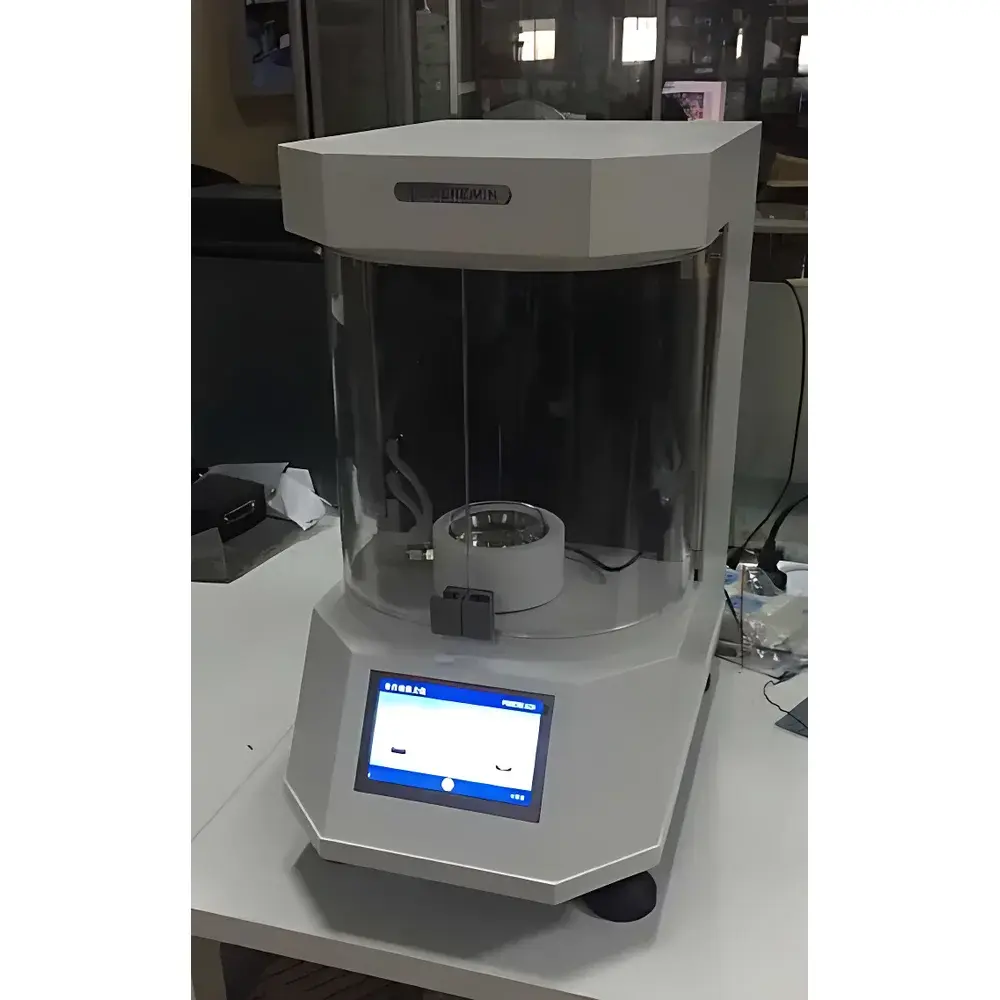
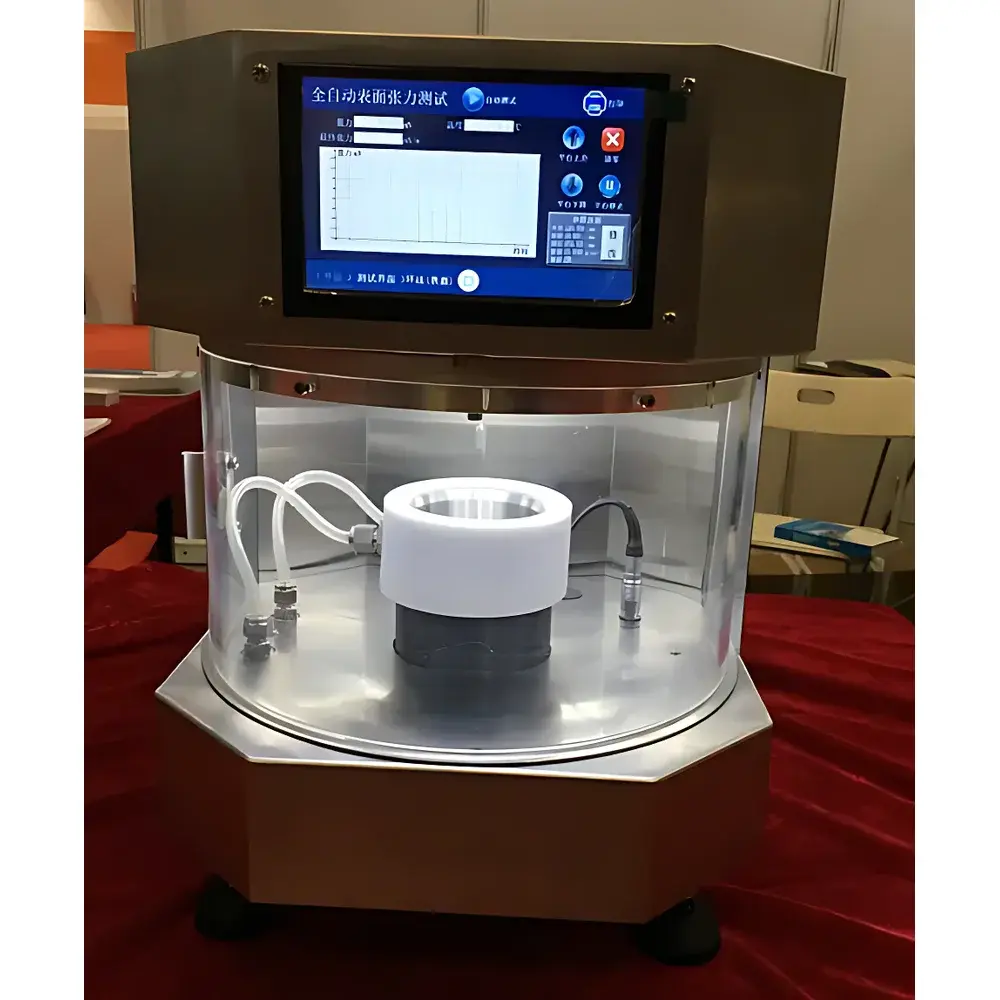
ZYKX JK15A Fully Automated Surface Tensiometer
| Brand | ZYKX |
|---|---|
| Origin | Beijing, China |
| Manufacturer Type | Authorized Distributor |
| Country of Origin | China |
| Model | JK15A |
| Price Range | USD 7,000 – 14,000 |
| Surface Tension Range | 0–999.99 mN/m |
| Resolution | <0.05 mN/m |
| Measurement Methods | Du Noüy Ring Method & Wilhelmy Plate Method |
| Sampling Time | 1–5 s (plate), 20–150 s (ring) |
| Interfacial Tension Capability | Yes |
| Mass Measurement Range | 0–120 g (0.1 mg resolution) |
| Power Supply | AC 220 V, 50 Hz, <150 W |
| Operating Humidity | 30–85% RH |
Overview
The ZYKX JK15A Fully Automated Surface Tensiometer is a precision instrument engineered for the quantitative determination of surface tension (liquid–air interface) and interfacial tension (liquid–liquid interface) based on classical force-balance principles. It operates using two standardized physical methods: the Wilhelmy plate method—ideal for viscous or volatile liquids with rapid equilibration—and the Du Noüy ring method—suitable for routine quality control where historical comparability with legacy data is required. Both methods comply with internationally recognized test protocols, including SY/T 5370–1999 (Petroleum Industry Standard of the People’s Republic of China) and are traceable to ASTM D971 and ISO 6295 methodologies. The instrument employs high-stability stepper motor-driven vertical translation, coupled with a temperature-compensated load cell sensor (±0.05 mN/m resolution), ensuring reproducible force measurement under controlled environmental conditions (30–85% RH). Its all-metal housing and vibration-damped mechanical architecture minimize thermal drift and external interference—critical for long-duration kinetic measurements in industrial QC labs or field-deployed monitoring scenarios.
Key Features
- Fully automated dual-method operation: seamless switching between Wilhelmy plate and Du Noüy ring configurations via software-selectable hardware modules
- Integrated 7-inch LCD touchscreen interface with built-in thermal printer—enables standalone field deployment without PC dependency
- Real-time force acquisition at 100 Hz sampling rate; dynamic curve logging supports surface relaxation kinetics and critical micelle concentration (CMC) analysis
- High-precision mass measurement module (0–120 g, 0.1 mg resolution) for concurrent density or buoyancy-corrected interfacial calculations
- Modular expansion support: optional Peltier-controlled thermostatic stage (±0.1 °C stability), fiber contact angle attachment, and custom sample holders for non-standard geometries
- Windows-based native software with GLP-compliant audit trail, user-level access control, and timestamped data export in CSV/Excel formats
Sample Compatibility & Compliance
The JK15A accommodates a broad range of liquid systems—including hydrocarbon-based oils, aqueous surfactant solutions, polymer melts, biofluids, and ionic liquids—without requiring chemical reagents or consumables beyond standard platinum probes. Its measurement range (0–999.99 mN/m) covers low-tension formulations (e.g., fluorosurfactants at ~10 mN/m) through high-tension molten salts (>800 mN/m). All hardware and firmware conform to electromagnetic compatibility (EMC) standards IEC 61326-1 and safety standard IEC 61010-1. Data integrity meets FDA 21 CFR Part 11 requirements when used with validated software configuration, including electronic signatures, immutable audit logs, and role-based permissions. Routine calibration verification follows ISO/IEC 17025 guidelines using certified reference liquids (e.g., ultra-pure water at 20 °C: 72.75 mN/m ± 0.1 mN/m).
Software & Data Management
The proprietary Windows-native application provides intuitive workflow navigation, multi-language UI (English, Chinese, Spanish), and synchronized hardware control. It enables real-time visualization of force vs. time curves, automatic peak detection for ring detachment events, and dynamic baseline correction for plate immersion artifacts. Raw data files include metadata (operator ID, ambient temperature/humidity, probe serial number, method parameters), supporting full traceability per ISO 17025 clause 7.7. Export functions generate publication-ready graphs (PNG/SVG) and structured datasets compatible with MATLAB, OriginLab, or statistical process control (SPC) platforms. Optional network licensing allows centralized instrument fleet management across distributed lab sites, with encrypted cloud backup and version-controlled method templates.
Applications
- EOR (Enhanced Oil Recovery): Quantitative evaluation of surfactant flooding efficiency via dynamic interfacial tension (IFT) reduction below 10−2 mN/m in brine–crude oil systems
- Formulation Science: CMC determination, HLB optimization, and stability screening of emulsions, foams, and microemulsions
- Materials Coating: Surface energy assessment of substrates prior to inkjet printing, paint adhesion, or anti-fouling film deposition
- Pharmaceutical Development: Wetting behavior analysis of excipient blends, tablet disintegration kinetics, and liposomal membrane fluidity correlation
- Environmental Monitoring: Field-deployable assessment of surfactant contamination in groundwater or wastewater effluents per EPA Method 1604
FAQ
What standards does the JK15A comply with for surface tension measurement?
It adheres to SY/T 5370–1999, ASTM D971, ISO 6295, and GB/T 6541–2016, with method validation documentation available upon request.
Can the instrument measure interfacial tension between two immiscible liquids?
Yes—equipped with calibrated density input and dual-phase sample holders, it calculates interfacial tension using the same force-balance algorithms as surface tension.
Is temperature control integrated or optional?
A Peltier-based thermostatic platform is an optional accessory; ambient temperature compensation is standard in all firmware versions.
How is data security ensured during regulatory audits?
With Part 11-compliant software mode enabled, all actions generate tamper-evident audit trails, electronic signatures, and immutable raw data archives.
What maintenance is required for platinum probes?
Platinum rings and plates require periodic cleaning in chromic acid or piranha solution followed by flame annealing; full recalibration is recommended after 500 cycles or annually.



