
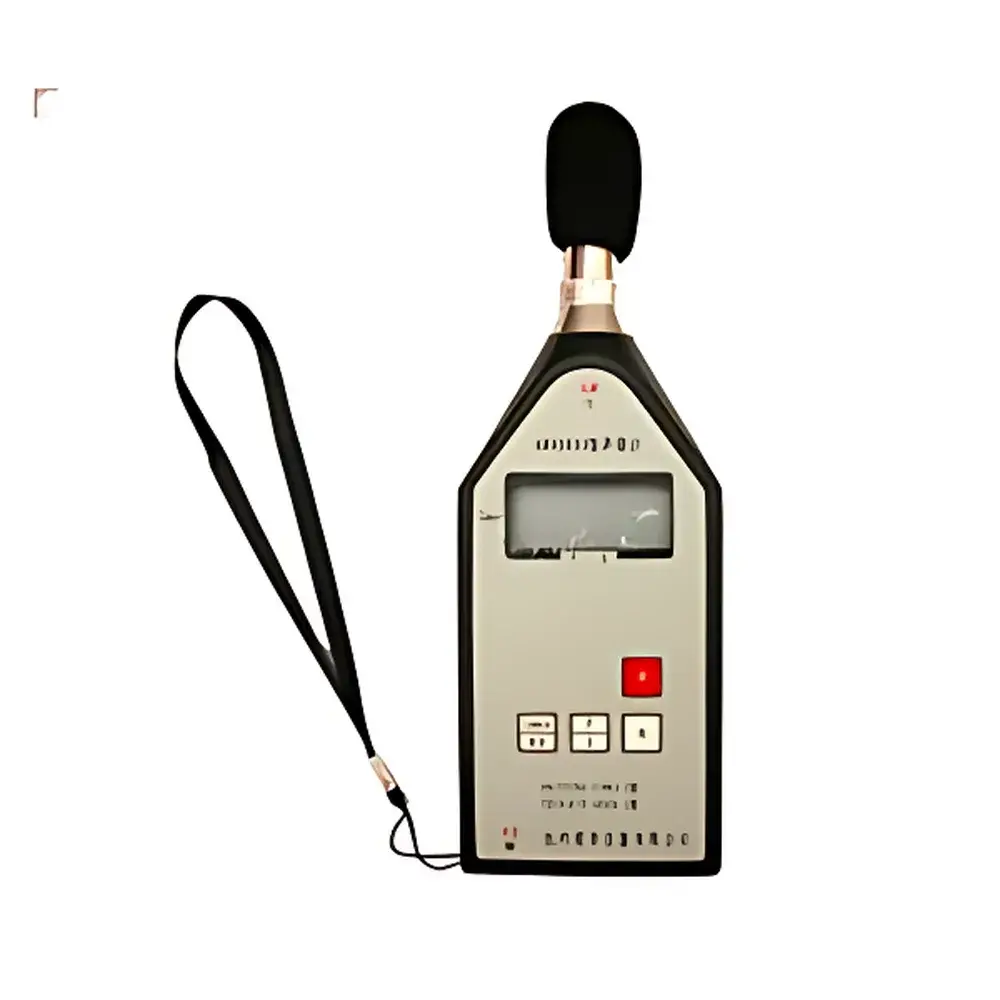
AWA 5633 Digital Sound Level Meter
| Origin | Beijing, China |
|---|---|
| Manufacturer Type | Authorized Distributor |
| Origin Category | Domestic (PRC) |
| Model | AWA 5633 |
| Pricing | Available Upon Request |
| Measurement Range | 35–130 dB(A) |
| Microphone | Φ12.7 mm Pre-polarized Condenser Microphone |
| Frequency Range | 31.5–8000 Hz |
| Frequency Weighting | A-weighting Only |
| Detection | Digital Detection with >90 dB Dynamic Range |
| Time Weighting | Fast (F) and Slow (S) |
| Range Control | Automatic |
| Display | 4-digit LCD, updated once per second |
| Output | AC Output |
| Calibration | Compatible with AWA6221B Acoustic Calibrator |
| Power Supply | 4×AA Alkaline Batteries, ~20 h Continuous Operation |
| Operating Environment | 0–40 °C, <90 % RH |
| Dimensions (L×W×H) | 210×75×32 mm |
| Weight | 0.3 kg (including batteries) |
Overview
The AWA 5633 Digital Sound Level Meter is a compact, handheld instrument engineered for reliable field-based noise assessment in compliance with international metrological standards. It operates on the fundamental principle of airborne sound pressure measurement using a pre-polarized condenser microphone, followed by analog-to-digital signal conditioning, frequency weighting (A), time-weighted RMS detection (Fast/Slow), and real-time digital display. Designed to meet the performance requirements of Class 2 instruments as specified in IEC 61672-1:2002 and GB/T 3785—both globally recognized standards for electroacoustics—the AWA 5633 delivers traceable, repeatable acoustic measurements across industrial, environmental, and occupational settings. Its robust mechanical design, low-power architecture, and wide dynamic range (>90 dB) enable stable operation under variable ambient conditions without manual gain adjustment.
Key Features
- Compact ergonomic form factor (210 × 75 × 32 mm; 0.3 kg with batteries) optimized for one-handed operation and extended field deployment
- Automatic range switching ensures seamless coverage across the full 35–130 dB(A) measurement span without user intervention
- Digital RMS detection circuitry provides high linearity and minimal distortion, supporting accurate peak-hold and max-value retention functions
- A-weighted frequency response (31.5–8000 Hz) conforms to human hearing sensitivity curves per ISO 226:2003, enabling physiologically relevant noise evaluation
- Backlit 4-digit LCD display updates at 1 Hz—sufficient temporal resolution for steady-state and moderately fluctuating noise sources
- AC output interface allows connection to external data loggers, oscilloscopes, or spectrum analyzers for waveform capture and post-processing
- Powered by four standard AA alkaline cells, delivering up to 20 hours of continuous use—ideal for multi-site surveys and unattended monitoring sessions
Sample Compatibility & Compliance
The AWA 5633 is validated for use with standardized acoustic calibrators, specifically the AWA6221B (94 dB / 114 dB @ 1 kHz), ensuring traceable calibration against national metrology institutes. It supports routine verification in accordance with ISO 9001 internal audit protocols and fulfills technical prerequisites for environmental noise monitoring programs governed by local regulatory frameworks (e.g., China’s HJ 640–2012, EU Directive 2002/49/EC). While not certified for Class 1 applications or octave-band analysis, its Class 2 designation permits legally defensible use in workplace noise assessments (per GBZ/T 189.8), traffic noise mapping, construction site monitoring, and basic building acoustics screening—provided measurement procedures follow ISO 1996-1 and ISO 1996-2.
Software & Data Management
The AWA 5633 operates as a standalone meter without embedded memory or USB connectivity. However, its AC output enables integration into third-party acquisition systems compliant with IEEE 1057 or IEC 61000-4-30 for synchronized time-series logging. When paired with calibrated recording hardware and post-processing software (e.g., MATLAB Signal Processing Toolbox, Brüel & Kjær PULSE, or open-source tools like Audacity with calibration correction), users can generate annotated spectrograms, statistical sound level distributions (L10, L50, L90), and time-history plots. Though the device itself does not support FDA 21 CFR Part 11-compliant electronic signatures or audit trails, its output may be incorporated into GLP/GMP-aligned workflows when documented within validated laboratory information management systems (LIMS).
Applications
- Occupational health and safety: Routine assessment of worker exposure to noise in manufacturing, logistics, and maintenance environments
- Environmental compliance: Monitoring community noise near highways, railways, airports, and industrial zones per municipal ordinances
- Building commissioning: Preliminary evaluation of HVAC system noise, façade transmission loss, and room reverberation characteristics
- Product development: Quick verification of noise emissions from consumer appliances, power tools, and small machinery during prototyping
- Educational laboratories: Teaching core concepts of sound pressure level, frequency weighting, time constants, and instrument calibration methodology
FAQ
Does the AWA 5633 support C-weighting or Z-weighting?
No. The instrument implements only A-frequency weighting, as required for general-purpose environmental and occupational noise evaluation per IEC 61672-1.
Can it measure impulse or peak sound pressure levels (Lpeak)?
No. The AWA 5633 does not comply with the peak-sensing requirements of IEC 61672-1 Annex C and therefore cannot report LCpeak or LZpeak.
Is firmware upgrade capability available?
No. The device features fixed-function digital signal processing logic with no field-upgradable firmware or configuration options.
What is the recommended recalibration interval?
Annual calibration against an accredited acoustic standard is advised; more frequent checks (e.g., before and after each measurement campaign) using the AWA6221B calibrator are mandatory for data integrity.
Does it meet ANSI S1.4 requirements?
While functionally equivalent to ANSI S1.4 Type 2 meters, formal ANSI accreditation is not claimed; compliance is asserted solely against IEC 61672-1:2002 and GB/T 3785.







