
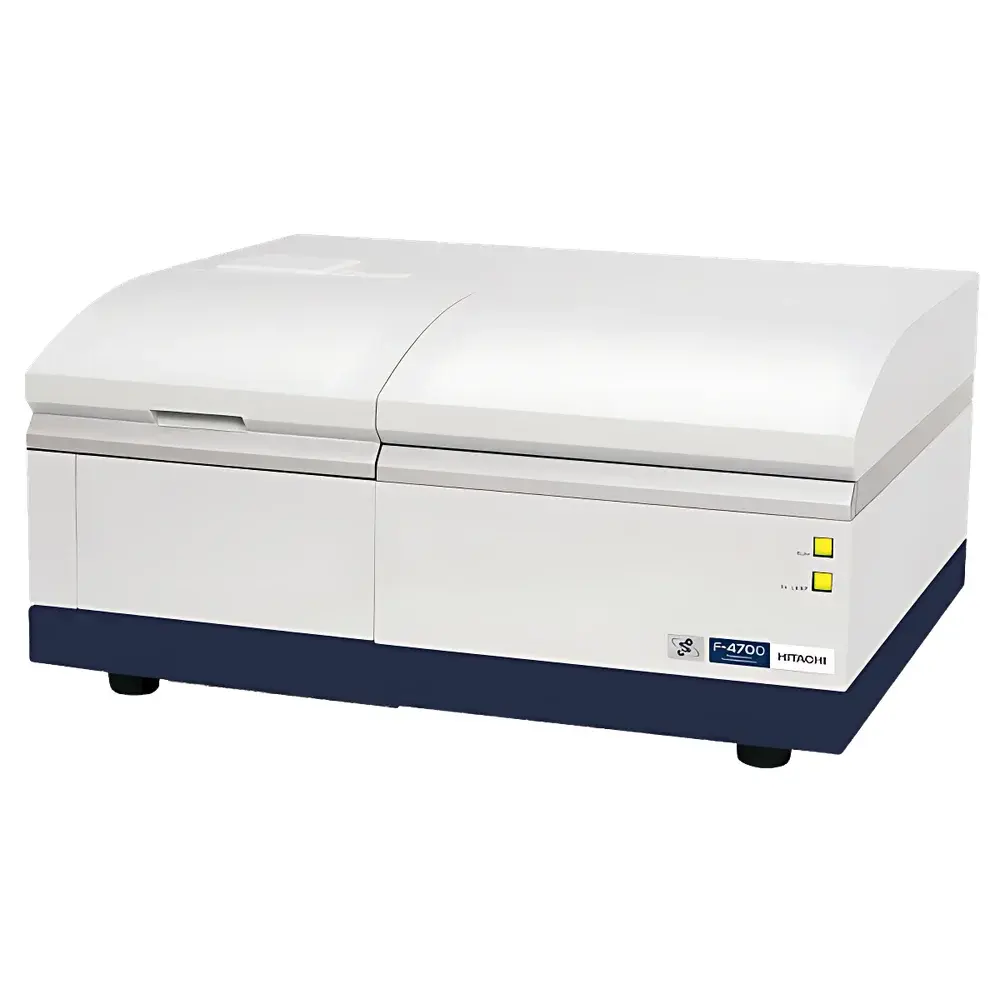
Hitachi F-4700 Molecular Fluorescence Spectrometer
| Brand | Hitachi |
|---|---|
| Origin | Japan |
| Manufacturer Type | Original Equipment Manufacturer (OEM) |
| Instrument Type | Steady-State Fluorescence Spectrometer |
| Excitation Source | Xenon Arc Lamp |
| Monochromator Type | Dual Grating |
| Slit Width Range | 1–20 nm |
| Typical S/N Ratio (Water Raman, 350 nm ex/397 nm em) | ≥450:1 |
| Detection Limit (Fluorescein in Aqueous Solution) | ≤1 × 10⁻¹² mol/L |
| Lamp Lifetime | ≥2,000 hours |
| Scan Speed | Up to 60,000 nm/min |
Overview
The Hitachi F-4700 Molecular Fluorescence Spectrometer is a high-performance steady-state fluorometer engineered for quantitative and qualitative analysis of fluorescent compounds across research, pharmaceutical, environmental, and materials science laboratories. Based on the well-established dual-monochromator optical architecture—comprising independent excitation and emission grating monochromators—the F-4700 employs a high-intensity, long-life xenon arc lamp as its excitation source and a red-sensitive photomultiplier tube (PMT) detector optimized for low-noise signal acquisition. Its design adheres to fundamental principles of molecular fluorescence spectroscopy: selective excitation of electronic transitions followed by detection of emitted photons at longer wavelengths. The instrument delivers exceptional signal-to-noise (S/N) performance—validated against the water Raman peak at 397 nm (excited at 350 nm)—with a typical S/N ratio exceeding 450:1, enabling reliable detection of sub-picomolar analyte concentrations under standard conditions.
Key Features
- Enhanced optical throughput via improved excitation optics and higher quantum-efficiency PMT detection, resulting in approximately 2× greater sensitivity compared to the predecessor F-4600 model.
- Dual-grating monochromator system with continuously adjustable slit widths (1–20 nm) for precise control of spectral bandwidth and resolution—critical for resolving overlapping emission bands or minimizing stray light in complex matrices.
- Long-life xenon lamp (≥2,000 h operational lifetime) coupled with stabilized lamp power supply, reducing maintenance frequency and consumable cost while maintaining consistent irradiance output over extended measurement campaigns.
- Integrated fluorescence fingerprinting capability: automated multi-wavelength excitation/emission scanning for rapid generation of 3D fluorescence contour plots (EEMs), supporting compound identification and mixture deconvolution without external software.
- Automatic diurnal variation correction function: real-time compensation for ambient temperature and humidity-induced drift in baseline stability, ensuring reproducibility across multi-day experiments or unattended overnight acquisitions.
- Modular sample compartment accommodating standard 10-mm quartz cuvettes, microvolume cells (down to 50 µL), solid-sample holders, and optional accessories including polarizers, temperature-controlled cells (−10 to +80 °C), and fiber-optic probes.
Sample Compatibility & Compliance
The F-4700 supports aqueous and organic solvent-based liquid samples, thin films, powders, and gels—provided they are compatible with UV-Vis transparent optical path materials. It meets essential regulatory design considerations for GLP-compliant environments, including audit-trail-ready operation logs (when used with FL Solutions software v4.10 or later), user-access-level controls, and timestamped data export in ASCII, CSV, and native .F47 formats. While not pre-certified for FDA 21 CFR Part 11, the system architecture supports implementation of electronic signature workflows and data integrity protocols required for regulated QC/QA applications under ISO/IEC 17025, USP , and ASTM E2500-15 guidelines.
Software & Data Management
Controlled exclusively via Hitachi’s FL Solutions software (Windows OS), the F-4700 enables method-driven acquisition, real-time spectral visualization, kinetic time-scan monitoring, and advanced post-processing—including background subtraction, peak integration, spectral deconvolution, and multivariate analysis (PCA). All raw and processed datasets retain full metadata (instrument parameters, date/time stamps, operator ID, calibration history), facilitating traceability and compliance with laboratory information management system (LIMS) integration standards. Export options include TIFF, PNG, and vector-based PDF for publication-quality figures; batch processing supports automated report generation per SOP-defined templates.
Applications
- Quantitative assay development for biomarkers (e.g., NADH, tryptophan, chlorophyll) in cell lysates and serum.
- Excitation-emission matrix (EEM) fingerprinting of dissolved organic matter (DOM) in environmental water quality monitoring.
- Stability-indicating analysis of photolabile APIs under ICH Q1B forced degradation conditions.
- Characterization of quantum dots, conjugated polymers, and lanthanide-doped nanomaterials via lifetime-independent intensity mapping.
- High-throughput screening of enzyme activity using fluorogenic substrates (e.g., β-galactosidase, caspase-3).
- Quality control of fluorescent dyes, pigments, and optical brighteners in textile and polymer manufacturing.
FAQ
What is the typical detection limit for fluorescein using the F-4700 under standard conditions?
Under optimized settings (1-nm slits, 1-s integration time, room temperature), the instrument achieves a practical detection limit of ≤1 × 10⁻¹² mol/L for fluorescein in aqueous buffer, referenced against ultrapure water blank.
Can the F-4700 perform time-resolved fluorescence measurements?
No—the F-4700 is a steady-state fluorometer and does not support pulsed excitation or lifetime decay analysis. For time-resolved applications, Hitachi recommends the F-7000 or FLUOROLOG series equipped with TCSPC modules.
Is the xenon lamp user-replaceable, and what tools are required?
Yes—the lamp module is field-replaceable using only a hex key and alignment jig provided with the instrument; no optical recalibration is necessary post-installation due to precision-machined mechanical registration.
Does the F-4700 support compliance with pharmacopeial methods such as USP <185>?
It satisfies instrumental requirements for fluorescence intensity measurement per USP <185>, though method validation—including system suitability testing and reference standard traceability—remains the responsibility of the end-user laboratory.
How is wavelength accuracy verified and maintained?
Wavelength calibration is performed using built-in holmium oxide and didymium glass filters; routine verification follows ASTM E275-22 procedures, with factory calibration traceable to NIST SRM 2034.




