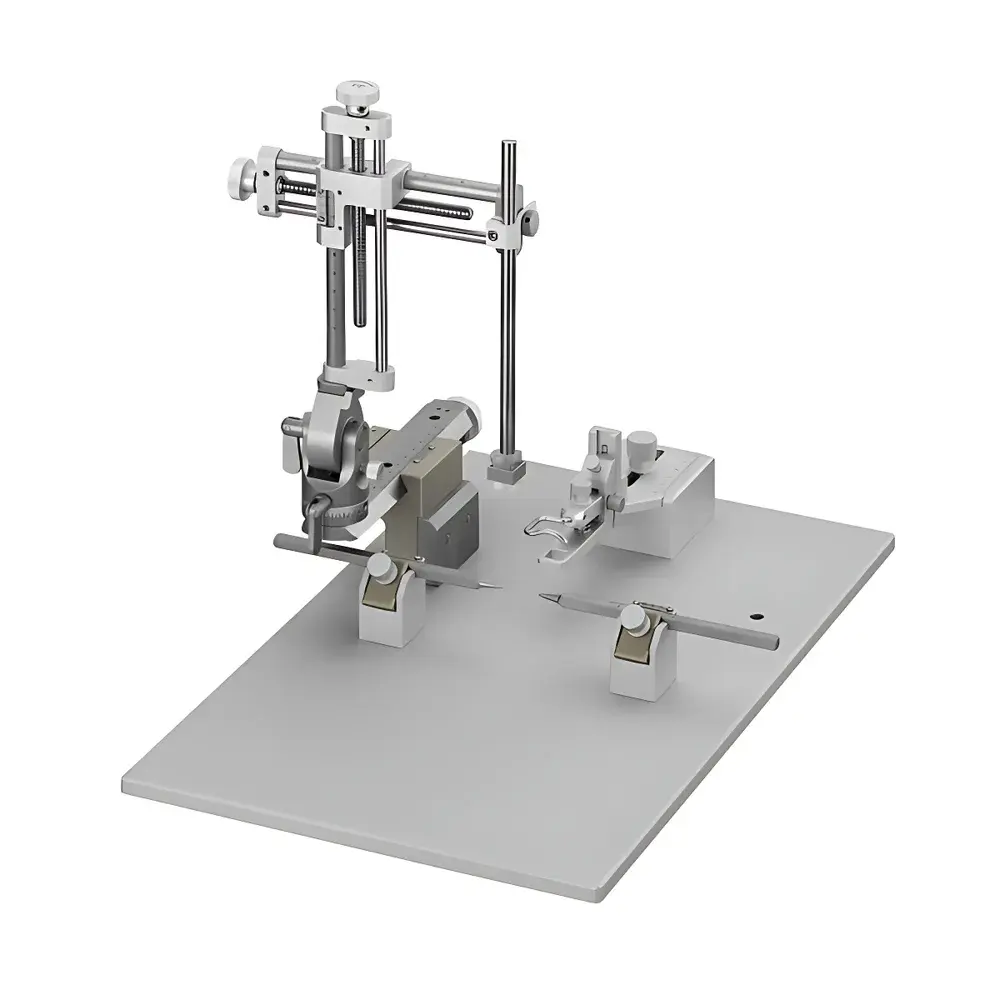
NeuroStar Lite Rat Stereotaxic Instrument
| Origin | Guangdong, China |
|---|---|
| Manufacturer Type | Authorized Distributor |
| Origin Category | Domestic (PRC) |
| Model | Lite Series |
| Quotation | Available Upon Request |
| Base Plate Dimensions | 400 mm × 255 mm |
| Inter-aural Rod Height Above Base | 35.5 mm |
| Ear Bar Groove Scale Resolution | 0.1 mm |
| Ear Bar Graduation Range | 35 mm (1 mm graduation) |
| Adapter Anterior–Posterior Travel | 43.5 mm |
| Adapter Vertical Adjustment Range | 30 mm (−20 mm to +10 mm), 0.1 mm resolution |
Overview
The NeuroStar Lite Rat Stereotaxic Instrument is an engineered mechanical platform designed for high-precision intracranial targeting in rodent neurosurgical and neuroscience research applications. Based on the principles of stereotaxic coordinate geometry—where anatomical landmarks (bregma, lambda, and interaural line) define a three-dimensional Cartesian reference frame—the instrument enables reproducible placement of electrodes, cannulae, microinjection needles, or optical fibers within predefined brain regions of rats (typically 200–500 g). Its lightweight yet rigid aluminum alloy construction balances portability with operational stability during acute or chronic surgical procedures. Unlike modular or motorized systems, the Lite series emphasizes manual dexterity, tactile feedback, and minimal setup complexity—making it especially suitable for teaching laboratories, pilot studies, and resource-constrained facilities where reliability and ease of sterilization are prioritized over automation.
Key Features
- Extended base plate (400 mm × 255 mm) provides enhanced stability and accommodates auxiliary equipment such as heating pads, anesthesia manifolds, or imaging mounts without compromising workspace clearance.
- Inter-aural rod height fixed at 35.5 mm ensures consistent skull leveling across standard rat strains, minimizing angular deviation during bregma–lambda alignment.
- Ear bar grooves incorporate a precision-machined scale with 0.1 mm resolution, enabling rapid visual verification of lateral symmetry prior to skull fixation—critical for reducing inter-subject variability in bilateral targeting.
- Ear bar graduation range of 35 mm (1 mm marked intervals) supports adjustment across diverse skull widths, including Sprague-Dawley, Wistar, and Long-Evans rats.
- Adapter assembly offers 43.5 mm anterior–posterior travel along a hardened stainless steel rail, facilitating accurate positioning relative to bregma using standard atlas-derived coordinates.
- Vertical adjustment mechanism delivers ±20 mm downward and +10 mm upward displacement (30 mm total range) with micrometer-style fine-tuning knobs calibrated to 0.1 mm increments—enabling precise depth control for cortical, subcortical, or ventricular targeting.
Sample Compatibility & Compliance
The NeuroStar Lite is validated for use with adult rats (200–500 g body weight) under standard surgical protocols compliant with the NIH Guide for the Care and Use of Laboratory Animals and AAALAC International accreditation standards. All contact surfaces—including ear bars, incisor hook, and adapter clamps—are autoclavable (121°C, 20 min) or compatible with ethanol/isopropanol disinfection. The instrument does not integrate electronic components or software; therefore, it falls outside scope for FDA 21 CFR Part 11 or IEC 62304 regulatory requirements. However, its mechanical repeatability supports GLP-aligned documentation workflows when paired with standardized SOPs for coordinate recording, surgical log entries, and post-hoc histological verification.
Software & Data Management
As a purely mechanical stereotaxic platform, the NeuroStar Lite requires no embedded firmware, drivers, or proprietary software. Coordinate acquisition relies on external tools: researchers typically cross-reference measurements with digital atlases (e.g., Paxinos & Watson, 8th Edition), spreadsheet-based calculation templates, or open-source planning utilities such as BrainRAT or StereoAtlas. Raw positional data (AP, ML, DV) are manually logged into laboratory notebooks or LIMS-compatible spreadsheets. For institutions requiring audit trails, integration with ELN platforms (e.g., LabArchives, Benchling) is achieved via structured text entry and timestamped annotations—fully compatible with ISO/IEC 17025 documentation practices.
Applications
- Intracerebral microinjection of viral vectors, pharmacological agents, or cell suspensions into hippocampal CA1, striatum, or prefrontal cortex.
- Chronic implantation of bilateral EEG or LFP electrodes for seizure modeling or sleep architecture analysis.
- Stereotactic lesioning using thermocoagulation probes or excitotoxins (e.g., ibotenic acid).
- Optogenetic fiber optic cannula placement for pathway-specific neuromodulation experiments.
- Training modules in undergraduate and graduate neuroscience curricula focusing on surgical technique, anatomical orientation, and coordinate transformation fundamentals.
FAQ
Is the NeuroStar Lite compatible with mouse stereotaxic procedures?
No—it is specifically engineered for rat-scale anatomy. Mouse applications require reduced base dimensions, finer vertical resolution (<0.05 mm), and lower-force ear bar actuation; we recommend the NeuroStar Mini series for murine models.
Can the instrument be used with stereotactic frames from other manufacturers?
Mechanical interchangeability is limited due to proprietary rail geometry and clamp interface specifications. Adapters for third-party accessories (e.g., Kopf manipulators) are available upon request but require dimensional validation prior to shipment.
Does the Lite series support digital readout or motorized positioning?
No. The Lite series is manually operated. For digital position tracking or programmable movement, consider the NeuroStar Pro or NeuroStar Connect lines, which integrate optical encoders and RS-232/USB interfaces.
What maintenance is required to ensure long-term accuracy?
Monthly inspection of rail lubrication, knob torque consistency, and scale calibration against NIST-traceable gauge blocks is recommended. Avoid exposure to saline solutions or acidic cleaning agents that may corrode aluminum components.