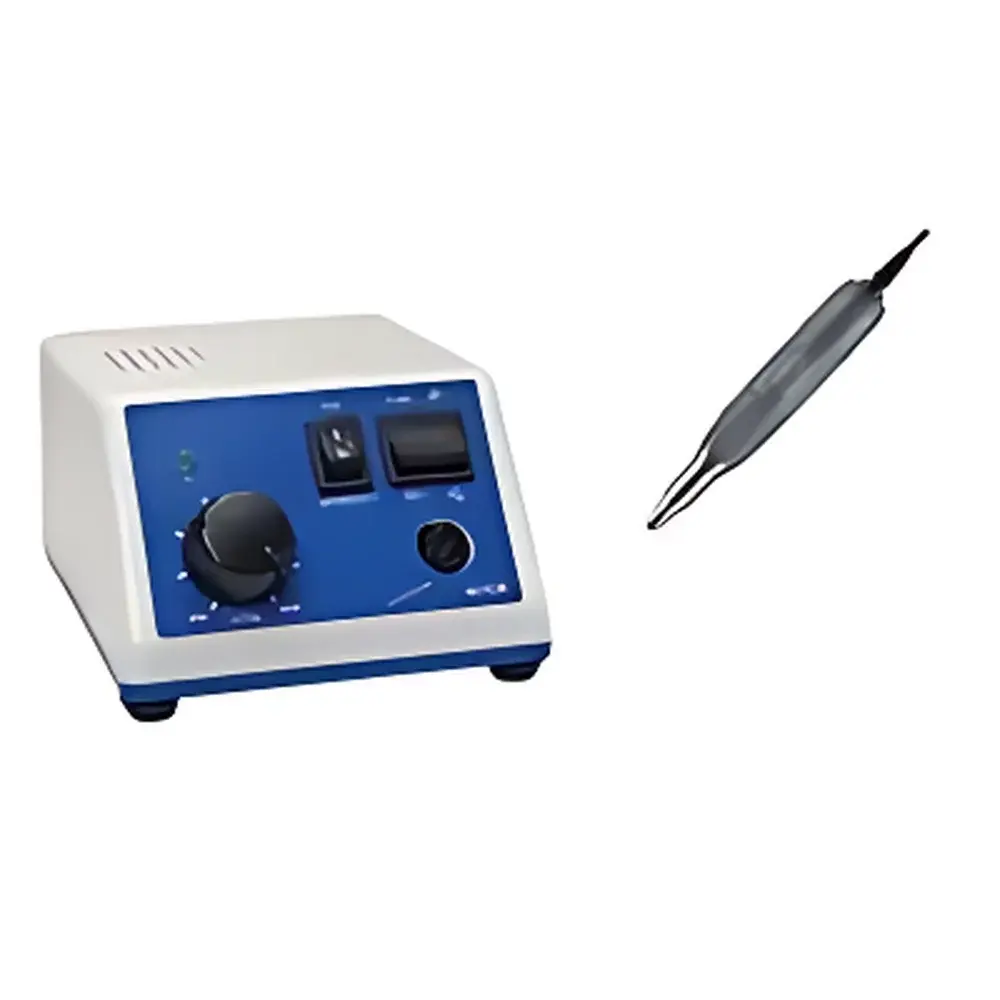
MicroHandheld Cranial Drill Model 78001
| Origin | Guangdong, China |
|---|---|
| Manufacturer Type | Authorized Distributor |
| Origin Category | Domestic (China) |
| Model | 78001 |
| Pricing | Available Upon Request |
| Max. Speed | 38,000 rpm |
| Control Modes | Manual Trigger & Foot Pedal |
| Mounting Compatibility | Stereotaxic Arm Adapter Interface |
| Drill Bit Options | 0.5–2.3 mm diameter, Round-Tip & Flat-Tip Configurations (HM-series) |
Overview
The MicroHandheld Cranial Drill Model 78001 is an ergonomically engineered precision surgical instrument designed for controlled, low-trauma craniotomy procedures in rodent and small-mammal neurosurgical research. Operating on a high-efficiency brushless DC motor platform, it delivers stable rotational speeds up to 38,000 rpm with minimal vibration and thermal generation—critical parameters for preserving underlying dura mater integrity and minimizing periosteal tissue damage during skull exposure. Unlike bulkier benchtop drills, its compact handheld form factor enables direct tactile feedback and fine spatial control under stereotaxic guidance, supporting both freehand and arm-mounted configurations. The device is purpose-built for integration into standard rodent stereotaxic workstations (e.g., Stoelting, David Kopf, or RWD systems), allowing vertical actuation via manipulator arm translation while maintaining consistent drill axis alignment.
Key Features
- Brushless DC motor with electronic speed regulation ensures consistent torque delivery across the full 0–38,000 rpm range, eliminating speed drop under load during cortical bone penetration.
- Dual activation modes: fingertip trigger for momentary engagement and foot pedal interface for hands-free, sustained operation—ideal for prolonged drilling sequences requiring bilateral hand positioning.
- Quick-release collet system (0.5–2.3 mm shank compatibility) supports rapid interchange of HM-series carbide-tipped drill bits without tools.
- Integrated mounting flange with standardized M4 threaded interface enables rigid attachment to stereotaxic manipulator arms, ensuring coaxial alignment with the anterior–posterior and dorsal–ventral coordinate axes.
- IP54-rated housing provides resistance to liquid splashes and particulate ingress during routine disinfection cycles using 70% ethanol or approved enzymatic cleaners.
- Low-noise operation (<62 dB at 30 cm) reduces auditory stress in behavioral recovery protocols post-surgery.
Sample Compatibility & Compliance
The Model 78001 is validated for use in adult mice (C57BL/6, BALB/c), rats (Sprague-Dawley, Wistar), and juvenile ferrets—species with calvarial thickness ranging from 0.18 mm (mouse parietal) to 0.45 mm (rat frontal). Drill bit selection follows anatomical constraints: round-tip bits (HM10xx series) are recommended for precise circular osteotomy; flat-tip bits (HM31xx series) facilitate controlled skull thinning prior to cranial window implantation or dural exposure. All HM-series bits are manufactured from micrograin tungsten carbide with ISO 5832-4 compliant biocompatible coating. The instrument complies with IEC 61000-6-3 (EMC emissions) and IEC 60601-1 general safety requirements for laboratory medical devices. It supports GLP-compliant documentation workflows when paired with audit-trail-enabled stereotaxic software platforms.
Software & Data Management
While the Model 78001 operates as a standalone electromechanical tool, its foot pedal interface includes TTL-compatible output signaling for synchronization with third-party acquisition systems (e.g., Spike2, MATLAB Data Acquisition Toolbox, or OpenEphys). This enables time-stamped logging of drill activation events relative to electrophysiological recordings, optogenetic stimulation pulses, or behavioral video frames. Optional firmware upgrade kits support USB-C connectivity for configuration parameter logging (e.g., cumulative runtime, bit usage count) and calibration certificate traceability—features aligned with FDA 21 CFR Part 11 data integrity expectations for preclinical study archives.
Applications
- Craniotomy for chronic electrode or optical fiber implantation in electrophysiology and fiber photometry studies.
- Skull thinning and cranial window preparation for two-photon microscopy and intrinsic signal imaging.
- Lesion induction via controlled cortical impact or targeted ablation in stroke and TBI models.
- Transcranial drug delivery cannula placement in behavioral pharmacology assays.
- Calvarial defect modeling for bone regeneration and biomaterial evaluation.
FAQ
Is the Model 78001 compatible with non-RWD stereotaxic frames?
Yes—the M4 mounting interface conforms to ISO 2768-mK general tolerance standards and interfaces mechanically with Stoelting 51600, Kopf 1900, and Leica Angle Two systems using optional adapter plates.
What sterilization methods are validated for the handpiece?
Autoclaving is not recommended. Validated reprocessing includes immersion in 70% v/v ethanol for 10 minutes followed by air drying; or use of hydrogen peroxide plasma (Sterrad®) cycles with no more than 200 cycles over device lifetime.
Do HM-series drill bits require recalibration after replacement?
No—each HM bit is individually laser-trimmed to nominal diameter tolerance ±0.005 mm and does not require system-level recalibration. Bit wear monitoring is advised after ≥50 animal procedures per bit.
Can the foot pedal be used with existing lab power strips?
The pedal uses a Class II double-insulated 24 V DC input and must be powered exclusively via the included UL/CE-certified switching power supply; daisy-chaining to shared outlets is prohibited per IEC 60601-1 Clause 8.5.2.
Is technical support available for protocol optimization?
Yes—application engineers provide peer-reviewed drilling parameter guidelines (e.g., feed rate vs. bone density, optimal RPM for frontal vs. parietal bone) based on published murine and rat histomorphometric datasets.