
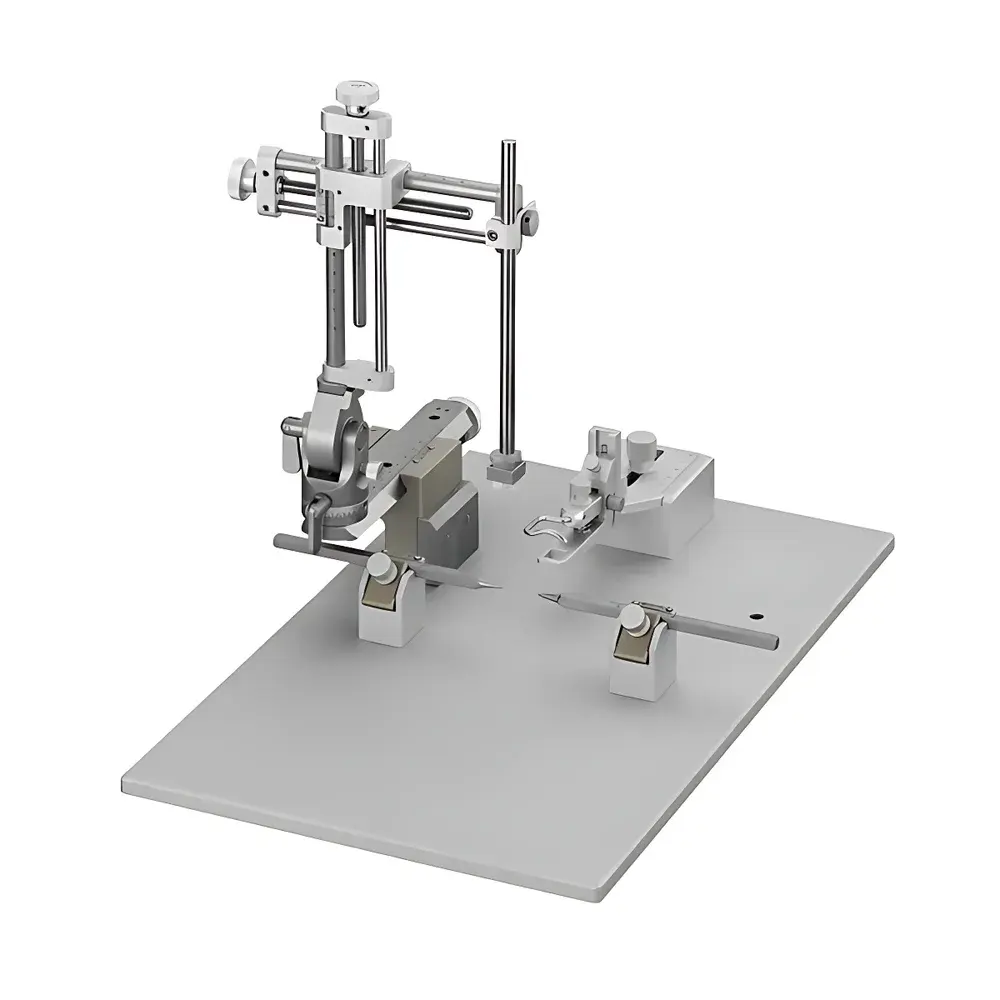
RWD Light-Duty Rat Stereotaxic Instrument
| Brand | RWD |
|---|---|
| Origin | Shenzhen, China |
| Manufacturer Type | Direct Manufacturer |
| Regional Classification | Domestic (China) |
| Model | Light-Duty |
| Price Range | USD 1,400 – 7,000 |
| Animal Compatibility | Rat (standard), Mouse, Bird, Cat, Gecko, Guinea Pig |
| Motion Range (X/Y/Z) | ±80 mm |
| Ear Bar Height from Base Plate | 35.5 mm |
| Ear Bar Scale Resolution | 0.1 mm |
| Ear Bar Graduation Range | 35 mm (±1 mm accuracy) |
| Adapter Anterior–Posterior Travel | 43.5 mm |
| Adapter Vertical Adjustment | −20 mm to +10 mm (30 mm total, 0.1 mm resolution) |
| Vertical Rotation | 0–180° with continuous locking |
| Horizontal Rotation | 0–360° with continuous locking |
| Integrated Accessories Support | Microinjection Pump, Stereo Microscope Camera, Cranial Drill |
| Structural Innovation | Adapter Block (replaces conventional U-frame) |
| Drive Mechanism | Dual-lead Screw for Smooth & Precise Arm Translation |
| Thermal Stability | Maintains dimensional accuracy across typical lab temperature ranges (15–30°C) |
| Surface Finish | Chemically resistant, autoclavable-grade anodized aluminum and stainless steel |
| Zero-Point Function | Digital display allows arbitrary coordinate reset at any position |
| Bregma-Based Direct Targeting | Enables atlas-guided coordinate entry without secondary calculation |
| Linear Readout Resolution | 10 µm |
| Base Plate Dimensions | 400 mm × 255 mm |
| Vertical Orientation Indicator | Dedicated visual marker to prevent axis misalignment |
| Independent Vertical Lock & Positioning Knob | Eliminates coupling error during angular adjustment |
| Lateral Rotation Clearance | 28 mm between knob and U-mount |
| Scale Ergonomics | Laser-etched, high-contrast graduations to reduce ocular fatigue |
| Headholder Geometry | Contoured cradle design for enhanced cranial immobilization |
| Ear Bar Clamping | Dual-point pressure plate mechanism for rapid, repeatable fixation |
Overview
The RWD Light-Duty Rat Stereotaxic Instrument is a precision-engineered neurosurgical platform designed for consistent, reproducible intracranial targeting in rodent models—primarily rats, with modular adaptability for mice, guinea pigs, birds, cats, and geckos. Built upon stereotaxic principles rooted in the Paxinos & Watson rat brain atlas, the system employs orthogonal Cartesian coordinate geometry (anteroposterior, mediolateral, dorsoventral) referenced to anatomical landmarks—most commonly the bregma suture. Unlike legacy U-frame designs, this instrument replaces rigid structural constraints with a low-profile adapter block architecture, significantly expanding unobstructed access above and around the animal’s head. This facilitates simultaneous integration of microinjection systems, high-magnification imaging optics, and cranial drilling tools without mechanical interference. Its dual-lead screw translation mechanism ensures backlash-free motion control with 10 µm resolution across all three axes, while thermally stable materials maintain positional fidelity under standard laboratory ambient conditions (15–30°C). The instrument is not intended for human use and complies with ISO 13485-aligned manufacturing practices for research-grade life science equipment.
Key Features
- Adapter block architecture replaces traditional U-frame, delivering unimpeded overhead and lateral access during surgical procedures
- Three-axis micrometer-driven motion (X/Y/Z) with ±80 mm travel range and 10 µm digital readout resolution
- Dual independent rotation systems: 0–180° vertical tilt with discrete locking detents and 0–360° horizontal swivel with friction-adjustable retention
- Modular animal adapters—including rat-specific contoured headholders—engineered for secure, low-pressure cranial immobilization
- Ergonomic scale design: laser-etched, high-contrast graduations on ear bars and vertical adjustment sleeves reduce visual fatigue during prolonged sessions
- Pressure-plate ear bar clamping mechanism enables rapid, repeatable fixation without torque-sensitive knobs
- Large base plate (400 mm × 255 mm) supports multi-instrument setups and accommodates extended surgical workflows
- Dedicated vertical orientation indicator prevents accidental axis inversion during coordinate entry or repositioning
- Independent vertical lock and positioning knobs eliminate mechanical coupling errors when adjusting angle and depth simultaneously
- Chemically inert, anodized aluminum and stainless-steel construction resists ethanol, isopropanol, and enzymatic decontaminants; compatible with routine surface sterilization protocols
Sample Compatibility & Compliance
The instrument is validated for use with adult Sprague-Dawley and Wistar rats (250–500 g), C57BL/6 and BALB/c mice (18–35 g), guinea pigs (200–400 g), domestic pigeons (~300 g), domestic cats (2–4 kg), and leopard geckos (40–80 g). Adapter interchangeability follows standardized mounting interfaces per IEC 61000-6-3 EMC guidelines for lab instrumentation. While not certified under FDA 21 CFR Part 11 or ISO 13485 for clinical application, the device conforms to GLP-relevant design controls for preclinical neuroscience research, including traceable calibration documentation, mechanical repeatability testing (≤ ±5 µm deviation over 100 cycles), and material biocompatibility per ISO 10993-5 (cytotoxicity screening). All metallic components meet RoHS 2011/65/EU restrictions on hazardous substances.
Software & Data Management
This is a fully manual, non-electronic stereotaxic platform—no embedded firmware, wireless connectivity, or proprietary software is included or required. Coordinate entry, zero-point assignment, and depth tracking rely entirely on mechanical micrometers and calibrated scales. However, the instrument integrates seamlessly with third-party digital ecosystems: digital calipers (e.g., Mitutoyo IP67 series) can be paired via USB or Bluetooth for external data logging; microscope-mounted cameras (Olympus SZX7, Zeiss Stemi 305) mount directly to the optional accessory rail; and syringe pump controllers (World Precision Instruments Micro4, Harvard Apparatus PHD Ultra) interface mechanically via standard Luer-lock or threaded collar mounts. For labs operating under 21 CFR Part 11–compliant workflows, all positional records must be manually transcribed into validated electronic lab notebooks (e.g., LabArchives, Benchling) with user authentication and audit trail enabled.
Applications
- Stereotactic intracerebral injection of viral vectors (AAV, lentivirus), tracers (Fluoro-Gold, CTB), or pharmacological agents
- Electrophysiological electrode implantation for chronic in vivo recording (tetrodes, silicon probes, optrodes)
- Focal cranial window preparation for two-photon microscopy or intrinsic signal imaging
- Targeted electrolytic or radiofrequency lesioning in behavioral neuroscience paradigms
- Implantation of osmotic minipumps for sustained CNS drug delivery
- Combined optogenetic fiber optic cannula placement with electrophysiology or fMRI-compatible setups
- Developmental neuroanatomy studies requiring precise targeting across postnatal age groups
FAQ
Is this instrument compatible with MRI or PET-compatible animal holders?
Yes—its non-ferromagnetic construction (6061-T6 aluminum, 304 stainless steel) permits safe use within 5 Gauss lines of 3T and 7T MRI scanners when paired with approved non-magnetic headposts and bite bars.
Can the digital readout version (Model 68511/68514) be calibrated in-house?
Yes—the integrated digital encoder is field-calibratable using NIST-traceable gauge blocks and a certified optical comparator; full calibration procedure is documented in the Technical Manual v3.2.
What is the maximum recommended animal weight for the rat adapter?
The standard rat headholder is rated for animals up to 600 g; for heavier subjects (>500 g), we recommend using the reinforced base plate (Part #68864D) with additional lateral stabilization brackets.
Does RWD provide atlas integration support for non-rat species?
RWD supplies downloadable coordinate conversion tables for mouse (Franklin & Paxinos), guinea pig (Schweitzer), and pigeon (Karten & Hodos), aligned to common stereotaxic reference points (e.g., interaural line, lambda, bregma equivalents).
Are replacement ear bars and adapters available as spare parts?
Yes—all mechanical components—including species-specific adapters, ear bars, vertical sleeves, and dual-lead screws—are stocked globally and available through authorized RWD distributors with lead times under 5 business days.



