
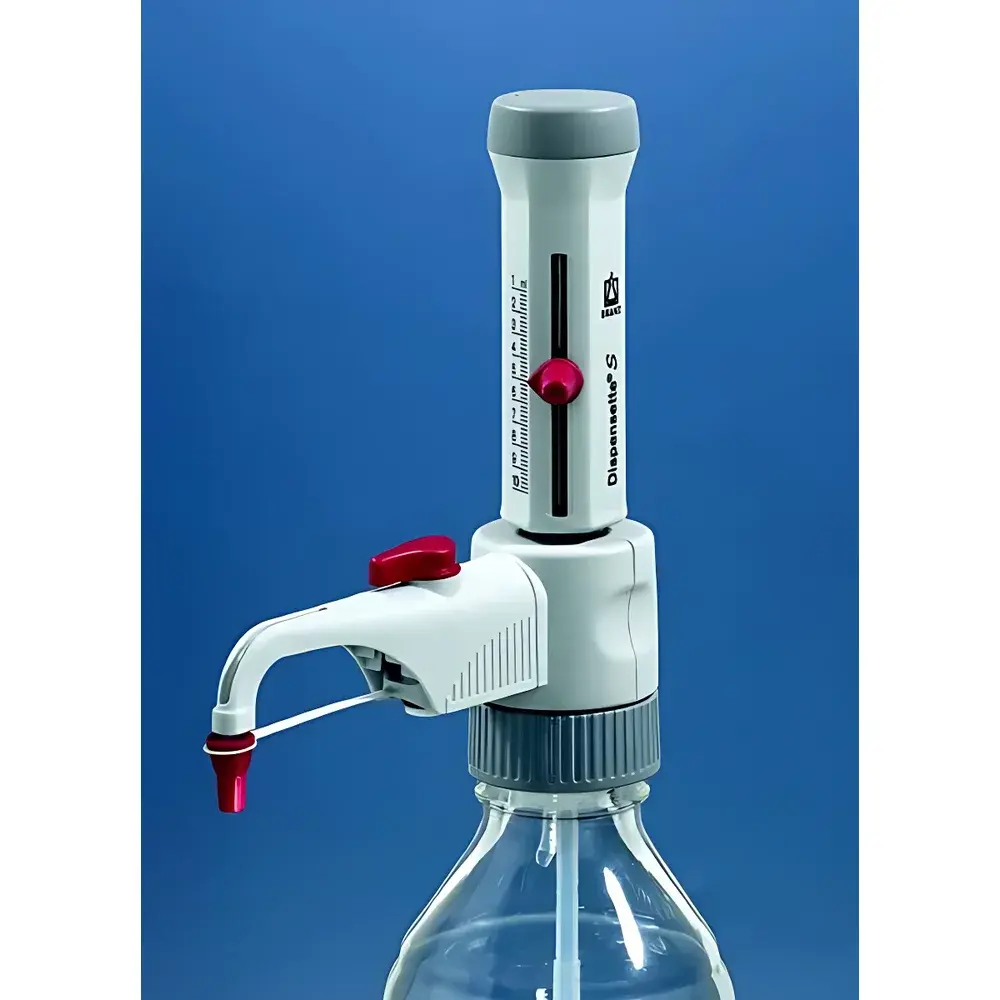
Dispensette® S Basic Bottle Top Dispenser
| Brand | BRAND (Brandt GmbH / BRAND) |
|---|---|
| Origin | Germany |
| Distributor Type | Authorized Distributor |
| Import Status | Imported |
| Model | Vernier-Adjustable Type |
| Instrument Type | Manual Bottle Top Dispenser |
| Price Range | USD 650 – 1,300 (FOB Hamburg) |
| Operating Limits | Max. vapor pressure 500 mbar |
| Wetted Materials | Borosilicate glass, ceramic, platinum-iridium alloy, ETFE, FEP, PFA, PP (safety cap) |
Overview
The Dispensette® S Basic is a manually operated, vernier-adjustable bottle top dispenser engineered for precision, safety, and chemical compatibility in routine laboratory liquid handling. Designed and manufactured in Germany under strict ISO 9001-certified production protocols, it operates on positive displacement piston principle—ensuring consistent volumetric delivery independent of operator technique or liquid properties such as surface tension or volatility. Unlike air-displacement pipettes, the Dispensette® S eliminates aerosol generation and cross-contamination risk by maintaining a sealed fluid path from reagent bottle to dispense tip. Its core application domain spans analytical chemistry, quality control laboratories, pharmaceutical QC/QA workflows, and academic teaching labs where reproducible, traceable, and chemically inert dispensing of aggressive liquids is required.
Key Features
- Vernier scale volume adjustment with integrated toothed guide rail—enables repeatable setting accuracy within ±0.5% of nominal volume across the full range (1–100 mL), verified per ISO 8655-3 calibration standards.
- Chemically resistant wetted materials: borosilicate glass barrel, ceramic piston seal, platinum-iridium alloy valve seat, and fluoropolymer-lined flow path (ETFE/FEP/PFA) ensure long-term stability with concentrated acids (e.g., H₃PO₄, H₂SO₄), alkaline solutions (e.g., 50% NaOH), saline media, and common organic solvents (e.g., acetone, ethanol, chloroform).
- Optimized fluid dynamics architecture reduces aspiration force by up to 30% compared to legacy models—critical for high-volume dispensing (≥25 mL) and extended user ergonomics during repetitive tasks.
- New-generation discharge tube assembly available with or without integrated anti-drip safety reflux valve—prevents unintended drips post-dispense and supports GLP-compliant documentation when used with audit-trail-capable dispensing logs.
- Maximum operational envelope: compatible with liquids up to 2.2 g/cm³ density, 500 mm²/s kinematic viscosity, 500 mbar vapor pressure, and 40 °C ambient temperature—covering >95% of standard laboratory reagents per IUPAC solvent classification guidelines.
Sample Compatibility & Compliance
The Dispensette® S Basic meets material compatibility requirements defined in ASTM D471 (rubber property testing) and ISO 15223-1 (labeling of medical devices), though classified as general-purpose lab equipment rather than medical device. All wetted components are certified non-leaching per USP and pass extractables testing per EP 3.2.1. The device conforms to CE marking directives (2014/30/EU EMC and 2014/35/EU LVD) and carries German TÜV certification for mechanical safety. While not intrinsically rated for explosion-proof environments, its spark-free construction (no electronic components, all-metal/ceramic/glass actuation) permits use in Class I, Division 2 hazardous locations when installed per NFPA 497 guidelines.
Software & Data Management
As a manual, non-electronic instrument, the Dispensette® S Basic does not incorporate embedded firmware or digital interfaces. However, it supports integration into regulated environments through complementary documentation practices: volume settings are recorded manually in bound lab notebooks or electronic lab notebooks (ELNs) compliant with 21 CFR Part 11. Optional calibration certificates (traceable to PTB, Germany) include uncertainty budgets per ISO/IEC 17025 and may be archived alongside instrument logbooks for GMP/GLP audits. For automated traceability, users may pair the dispenser with barcode-labeled reagent bottles and integrate usage records into LIMS via manual entry or spreadsheet-based tracking templates aligned with ISO/IEC 17025 clause 7.7.
Applications
- Precise dispensing of corrosive reagents in titration standardization (e.g., 0.1 M H₂SO₄, 0.5 M NaOH) per ISO 9001-controlled QC procedures.
- Preparation of calibration standards and reference solutions in environmental testing labs (EPA Method 300.0, ISO 11885).
- Reagent addition in wet-chemistry sample digestion workflows (e.g., aqua regia, HF-HNO₃ mixtures—note: HF requires optional PFA discharge tube).
- High-reproducibility solvent transfer in HPLC mobile phase preparation, minimizing batch-to-batch variation.
- Teaching applications in undergraduate chemistry labs requiring demonstrable metrological traceability and hands-on understanding of volumetric accuracy concepts.
FAQ
Is the Dispensette® S Basic suitable for hydrofluoric acid (HF)?
HF compatibility requires the optional PFA discharge tube and ceramic/platinum-iridium valve configuration; standard configurations are not recommended for HF handling.
Can this dispenser be calibrated in-house?
Yes—gravimetric calibration per ISO 8655-3 is fully supported using Class A volumetric flasks and certified analytical balances; calibration intervals should follow internal SOPs or regulatory requirements (e.g., daily pre-use checks in GMP environments).
What maintenance is required?
Routine cleaning with compatible solvents and periodic inspection of piston seal integrity; no lubrication is required—the ceramic/polymer interface is self-lubricating and chemically inert.
Does it comply with FDA 21 CFR Part 11?
The device itself is not electronic and therefore not subject to Part 11; however, associated calibration records and usage logs generated in compliant ELN/LIMS systems may satisfy Part 11 requirements for record retention and audit trails.
How does the vernier scale improve accuracy versus dial-type dispensers?
The toothed vernier mechanism minimizes parallax error and mechanical backlash, delivering superior repeatability (CV < 0.3%) especially at low volumes (1–5 mL), as validated in interlaboratory studies published in Accreditation and Quality Assurance (2021, Vol. 26, pp. 417–425).



