
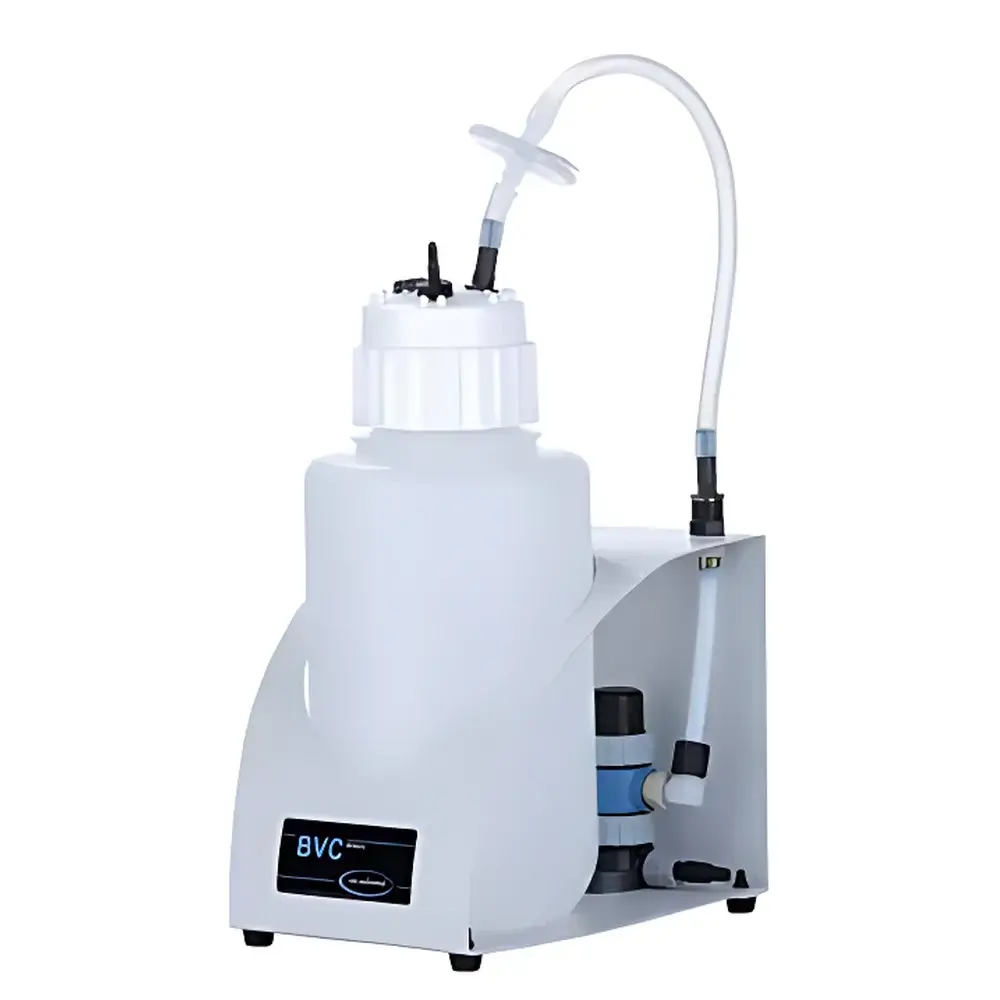
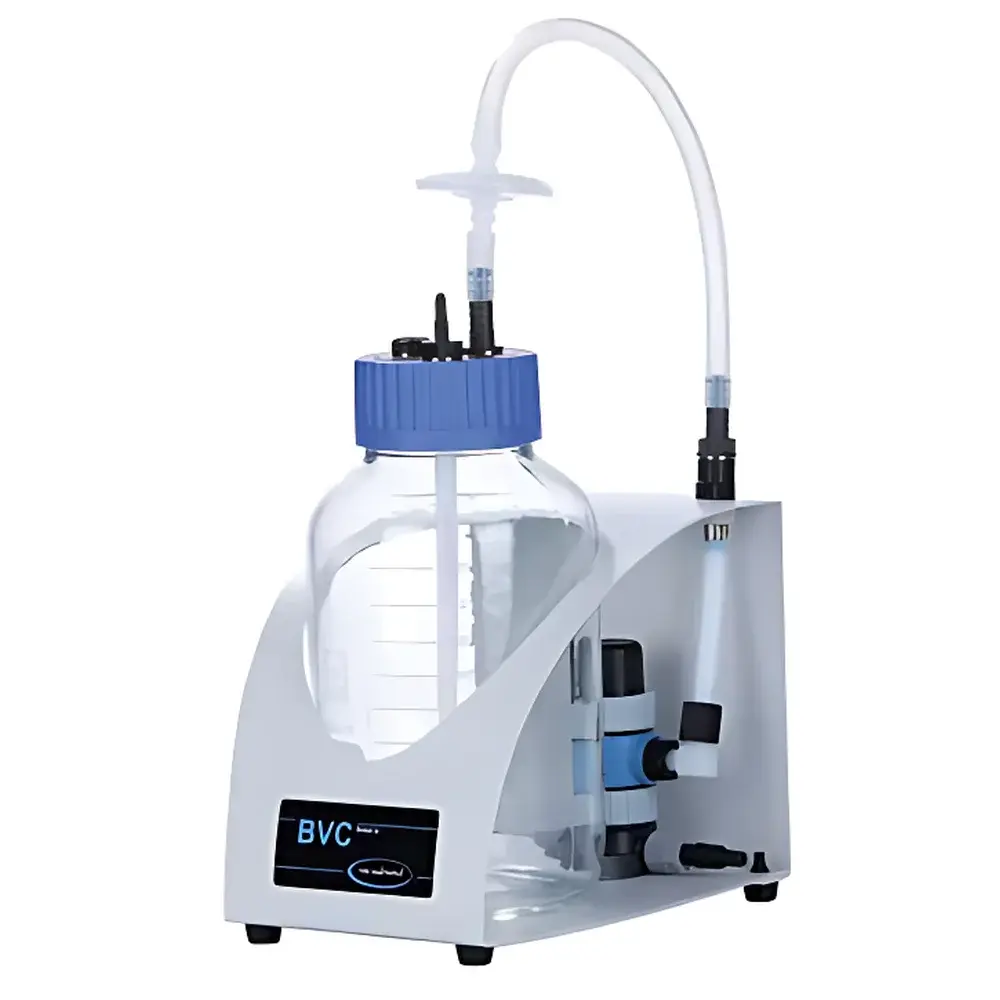
VACUUBRAND BVC basic Vacuum Liquid Handling System
| Brand | VACUUBRAND® |
|---|---|
| Origin | Germany |
| Model | BVC basic |
| Power Requirement | None (pneumatically operated) |
| Bottle Options | 4 L polypropylene (BVC basic) or 2 L borosilicate glass with anti-burst film (BVC basic G) |
| Sterilization | Fully autoclavable (121 °C, 20 min, saturated steam) |
| Filtration | Integrated hydrophobic 0.2 µm sterilizing filter |
| Vacuum Control | Mechanical vacuum regulator |
| Compliance | Designed for GLP-compliant liquid aspiration in ISO 13485 and FDA 21 CFR Part 11–aligned workflows |
Overview
The VACUUBRAND BVC basic Vacuum Liquid Handling System is a non-powered, pneumatically driven aspiration platform engineered for precise, contamination-controlled removal of biological, chemical, and aqueous liquids in research laboratories, clinical diagnostics, and quality control environments. Unlike electrically powered vacuum manifolds, the BVC basic operates exclusively via an external vacuum source—such as a VACUUBRAND diaphragm pump or centralized VACUU·LAN® vacuum network—eliminating electrical hazards, heat generation, and energy dependency. Its core architecture leverages passive mechanical vacuum regulation to maintain stable, application-optimized suction pressure across variable flow conditions. This principle ensures reproducible aspiration rates while minimizing vapor load on the vacuum supply—a critical factor in extending pump service life and maintaining consistent network performance. The system’s design prioritizes biosafety and chemical resilience: all wetted components—including bottle, cap, tubing interface, and filter housing—are fully autoclavable at 121 °C for 20 minutes under saturated steam, supporting routine decontamination in GLP and GMP-regulated settings.
Key Features
- Mechanical vacuum regulator: Dynamically adjusts vacuum level at the aspiration port only when required, reducing overall gas throughput and preventing unnecessary strain on central vacuum infrastructure.
- Autoclavable construction: Entire assembly—including 4 L PP bottle (BVC basic) or 2 L borosilicate glass bottle with anti-burst polymer film (BVC basic G)—is validated for repeated steam sterilization without degradation of dimensional stability or seal integrity.
- Aerosol-suppressing inlet geometry: Integrated air-inlet pathway within the cap directs incoming atmospheric air tangentially along the inner wall of the collection vessel, disrupting foam formation and limiting aerosol dispersion during aspiration.
- VacuuHandControl (VHC) handpiece: Ergonomic, one-handed aspirator with through-tube design; liquid path remains physically isolated from operator contact surfaces, eliminating cross-contamination risk between samples or users.
- Hydrophobic 0.2 µm sterilizing filter: Positioned upstream of the vacuum line, this membrane filter prevents liquid ingress into the vacuum source while retaining microbial contaminants—validated per ASTM F838-22 for bacterial retention efficiency.
- No power requirement: Eliminates need for electrical outlets near biosafety cabinets or fume hoods, enhancing spatial flexibility and compliance with IEC 61010-1 safety standards for laboratory equipment.
Sample Compatibility & Compliance
The BVC basic accommodates a broad spectrum of liquid types—including cell culture supernatants, enzymatic reaction mixtures, buffered saline solutions, acidic/basic reagents (e.g., sodium hypochlorite up to 5 %), and organic solvents compatible with polypropylene or borosilicate glass. The BVC basic G variant—with its coated borosilicate bottle—is specifically qualified for aggressive oxidizers and halogenated compounds where PP compatibility is insufficient. All configurations comply with ISO 13485:2016 requirements for medical device manufacturing support equipment and meet material biocompatibility criteria per USP and . Filter integrity testing protocols align with ISO 13408-2 for aseptic processing, and full-system autoclaving supports audit readiness for FDA 21 CFR Part 11 electronic record controls when paired with validated documentation practices.
Software & Data Management
As a purely mechanical, non-electronic system, the BVC basic does not incorporate embedded firmware, touch interfaces, or data logging capabilities. This architecture intentionally avoids software validation burdens associated with regulated environments. However, its operational parameters—vacuum setpoint, aspiration duration, and sterilization cycle logs—are fully traceable via external lab notebooks, LIMS entries, or electronic batch records when used in conjunction with VACUUBRAND’s optional VACUU·LAN® network monitoring modules (e.g., VACUU·VIEW software). For 21 CFR Part 11 compliance, manual entry of aspiration events—including operator ID, date/time stamp, and bottle lot number—is recommended and supported by the system’s standardized labeling and barcode-ready bottle caps.
Applications
- Cell culture maintenance: Safe aspiration of spent media and trypsinized monolayers without aerosol generation or thermal stress to adjacent incubators.
- Clinical specimen processing: High-throughput handling of urine, serum, and CSF samples under CLIA- and CAP-accredited workflows.
- QC/QA laboratories: Reproducible decanting of titration reagents, HPLC mobile phase waste, and dissolution test effluents.
- Biosafety Level 2 (BSL-2) containment: Integration with Class II A2 cabinets via dedicated vacuum ports, maintaining negative pressure integrity during aspiration.
- Chemistry teaching labs: Robust, low-maintenance alternative to water aspirators—no risk of backflow, freezing, or municipal water contamination.
FAQ
Does the BVC basic require electricity to operate?
No. It functions solely via connection to an external vacuum source and contains no electrical components.
Can the entire system be sterilized in an autoclave?
Yes. Both BVC basic and BVC basic G configurations—including bottle, cap, filter housing, and VHC handpiece—are validated for full-cycle autoclaving at 121 °C, 20 minutes, 100 kPa gauge pressure.
What vacuum pressure range does the mechanical regulator maintain?
The regulator is calibrated to deliver stable aspiration pressure between –0.6 and –0.9 bar (gauge), adjustable via knurled knob to match viscosity and container geometry.
Is the 0.2 µm filter replaceable, and how is integrity verified?
Yes—the filter cartridge is user-replaceable. Integrity is confirmed via bubble point testing per ASTM F838-22 prior to first use and after each sterilization cycle.
How does the BVC basic G differ chemically from the standard BVC basic?
The BVC basic G uses borosilicate glass (DIN ISO 3585) with a conformal polymer film that resists shattering and provides enhanced resistance to chlorine-based disinfectants, strong acids, and alkaline solutions incompatible with polypropylene.



