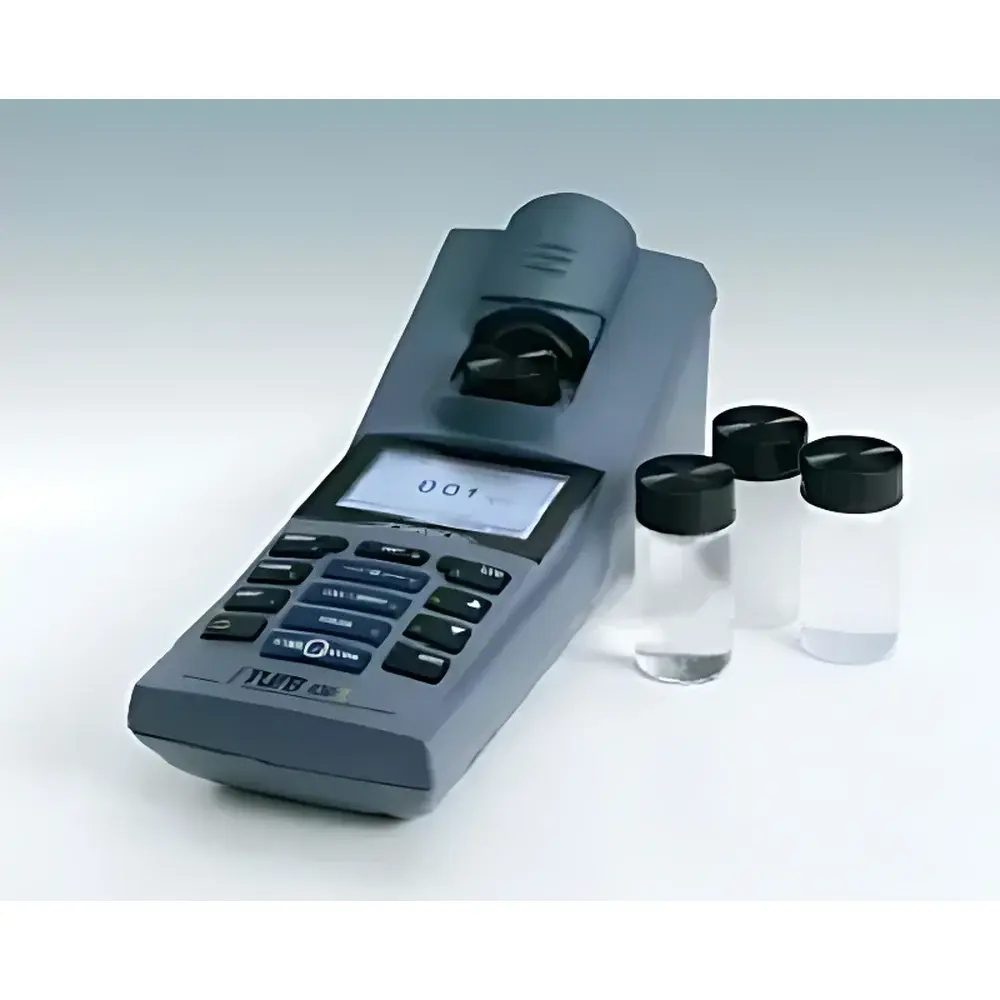
WTW pHotoFlex Portable Photometer with COD Measurement Capability
| Brand | WTW |
|---|---|
| Origin | Germany |
| Model | pHotoFlex |
| Optical Wavelengths | 436, 517, 557, 594, 610, 690 nm (±2 nm) |
| Photometric Range | Absorbance –0.200 to +2.000 |
| Repeatability | ±0.005 ABS |
| Resolution | 0.001 ABS |
| Measurement Time | 2 s |
| pH Range | –2.00 to +16.00 pH (±0.01 pH) |
| mV Range | –1000 to +1000 mV (±1 mV) |
| Temperature | –5.0 to +100.0 °C (±0.3 °C) |
| Turbidity Mode (pHotoFlex Turb) | IR LED @ 860 nm per DIN EN ISO 7027 |
| Data Storage | 1000 measurement records |
| Interface | RS-232 (AK540/B cable for PC |
| Dimensions | 236 × 86 × 117 mm |
| Weight | 0.6 kg |
| Ingress Protection | IP67 |
| Operating Temp. | 0–50 °C |
| Storage Temp. | –25 to +65 °C |
| Power | 4 × AA 1.5 V alkaline (≈5000 measurements) |
| Optional Accessories | LabStation portable lab platform (251301), LSdata software, SenTix 41 pH electrode, 28 mm and 16 mm cuvettes |
Overview
The WTW pHotoFlex is a rugged, field-deployable photometer engineered for precision multi-parameter water quality analysis in compliance with international standard methods. Designed around solid-state LED optics with six fixed-wavelength channels (436, 517, 557, 594, 610, and 690 nm, each ±2 nm), the instrument implements spectrophotometric quantification based on Beer–Lambert law principles. Its dual-mode architecture supports both colorimetric determination—covering over 150 pre-programmed analytes including COD, nitrate, phosphate, ammonia, chlorine species, and heavy metals—and integrated electrochemical pH/mV/temperature measurement via standardized BNC-compatible pH electrodes. When equipped with the optional pHotoFlex Turb module, the system extends functionality to turbidity assessment at 860 nm in strict accordance with DIN EN ISO 7027, enabling simultaneous optical and electrochemical characterization of aqueous samples across environmental monitoring, wastewater treatment, food & beverage production, and industrial process control applications.
Key Features
- Six precisely calibrated LED light sources with narrow-band interference filters ensure high spectral fidelity and long-term photometric stability without lamp replacement.
- Pre-loaded method library includes >150 validated protocols aligned with APHA, ISO, ASTM, and DIN standards—enabling rapid, operator-independent quantification of key water quality parameters.
- User-definable method storage supports up to 100 custom calibration curves and measurement configurations, facilitating adaptation to site-specific or research-driven assay requirements.
- Modular cuvette adapter accommodates both 16 mm round and 28 mm square cells, ensuring compatibility with WTW’s full range of reagent vials and standard-compliant sample vessels.
- Integrated pH/mV/temperature module accepts any standard BNC pH electrode (e.g., SenTix 41), enabling concurrent optical and potentiometric analysis without external instrumentation.
- IP67-rated enclosure guarantees dust-tight operation and temporary submersion resistance—critical for field use in rain, mud, or humid laboratory environments.
- RS-232 interface enables bidirectional communication with PCs, thermal printers, or barcode scanners (e.g., for automatic reagent ID recognition), supporting GLP-compliant data traceability.
Sample Compatibility & Compliance
The pHotoFlex is validated for use with liquid samples across drinking water, surface water, wastewater effluents, industrial process streams, and food-grade matrices. Its optical path design minimizes stray light interference and accommodates colored, turbid, or suspended particulate-laden samples—particularly when paired with the 860 nm turbidity channel compliant with DIN EN ISO 7027. All pre-programmed methods adhere to recognized regulatory frameworks: COD determinations follow ISO 15705 or EPA 410.4 equivalents; pH measurements comply with ISO 10523 and USP ; turbidity results satisfy ISO 7027 and ASTM D6508 requirements. The device supports audit-ready documentation through timestamped data logging and optional LSdata software, meeting foundational expectations for GLP and GMP-aligned laboratories under FDA 21 CFR Part 11 when configured with appropriate access controls and electronic signature capability.
Software & Data Management
Data acquisition and post-processing are supported via WTW’s LSdata software suite (optional accessory 251301), which provides secure import of up to 1000 measurement records from the instrument’s internal memory. LSdata enables batch export to CSV or Excel formats, statistical evaluation (mean, SD, CV%), trend visualization, report generation with customizable templates, and direct integration into LIMS environments. The RS-232 interface operates at standard baud rates (e.g., 9600 bps) with ASCII-based command protocols, permitting third-party software integration via documented API structures. For field deployments requiring extended autonomy, the LabStation portable workstation (251301) offers integrated power management, USB-to-RS232 conversion, and offline method configuration—eliminating dependency on mains-powered computing infrastructure.
Applications
- Environmental field surveys: Rapid on-site screening of nutrient loads (NO₃⁻, PO₄³⁻), organic pollution indicators (COD, TOC surrogates), and disinfectant residuals (free/total chlorine).
- Municipal and industrial wastewater plants: Real-time process monitoring of nitrification/denitrification efficiency, coagulant dosing control, and final effluent compliance verification.
- Food & beverage QA/QC: Sugar content estimation (via anthrone method), sulfite quantification in wine, phosphoric acid titration in soft drinks, and microbial growth indicator assays.
- Pharmaceutical water systems: Conductivity-corrected pH verification, TOC correlation studies, and purified water turbidity surveillance per USP .
- Educational laboratories: Pedagogical demonstration of spectrophotometric principles, calibration curve development, and multi-analyte interference analysis.
FAQ
Does the pHotoFlex require annual recalibration by an authorized service center?
No—routine user calibration using certified reference standards (e.g., 0.02/10/1000 NTU kits or pH 4.01/7.00/10.01 buffers) satisfies ISO/IEC 17025 metrological requirements. Full factory recalibration is recommended every 24 months or after physical impact.
Can the instrument store calibration curves generated outside the pre-programmed method set?
Yes—up to 100 user-defined methods may be stored, each containing slope/intercept coefficients, wavelength selection, unit definition, and upper/lower measurement limits.
Is the RS-232 interface compatible with modern Windows/macOS systems lacking legacy serial ports?
Yes—when used with a certified USB-to-RS232 adapter (e.g., FTDI chipset-based), the instrument communicates reliably with current OS versions via virtual COM port drivers.
What is the typical lifetime of the LED light sources under normal usage conditions?
LEDs are rated for ≥100,000 hours of operational life—effectively eliminating source degradation concerns over the instrument’s service lifetime.
Does the pHotoFlex Turb module meet regulatory requirements for drinking water turbidity reporting?
Yes—the 860 nm infrared detection system complies with DIN EN ISO 7027, which is referenced in EU Directive 98/83/EC and U.S. EPA Method 180.1 for regulatory reporting.
Related Products