
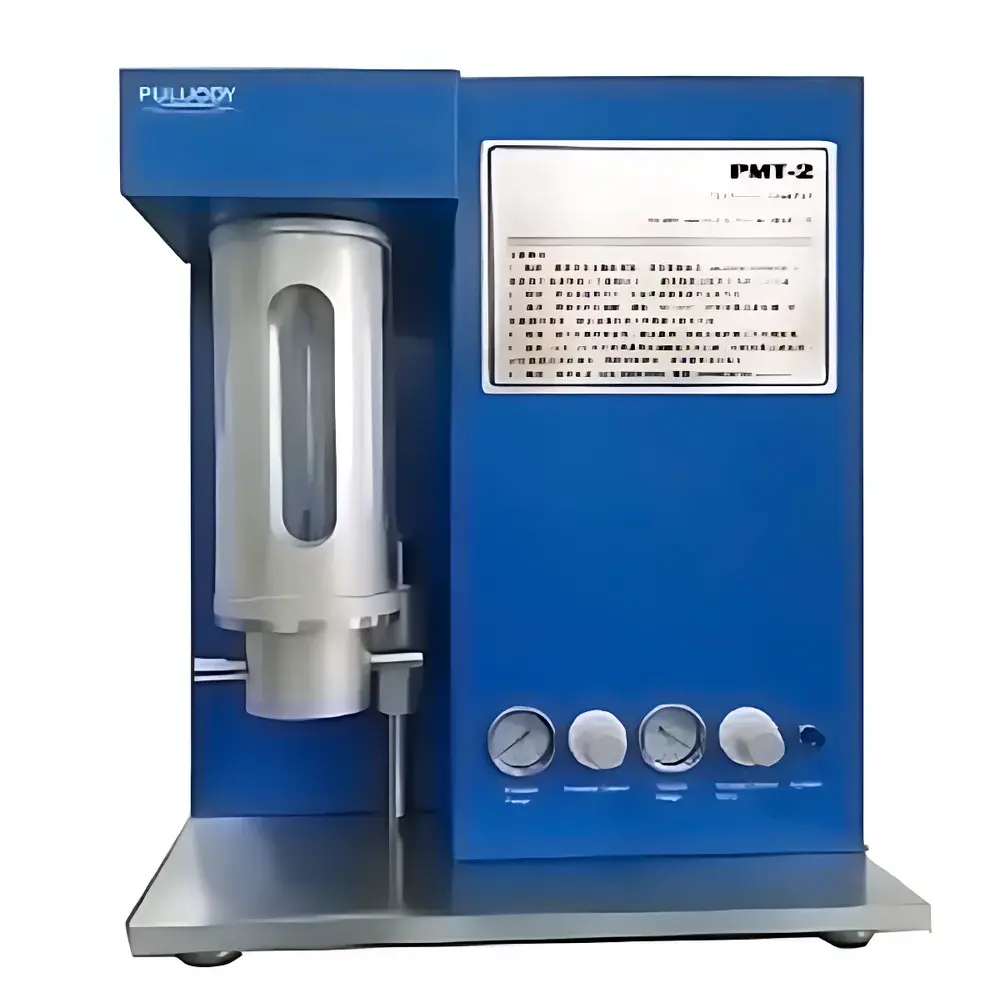
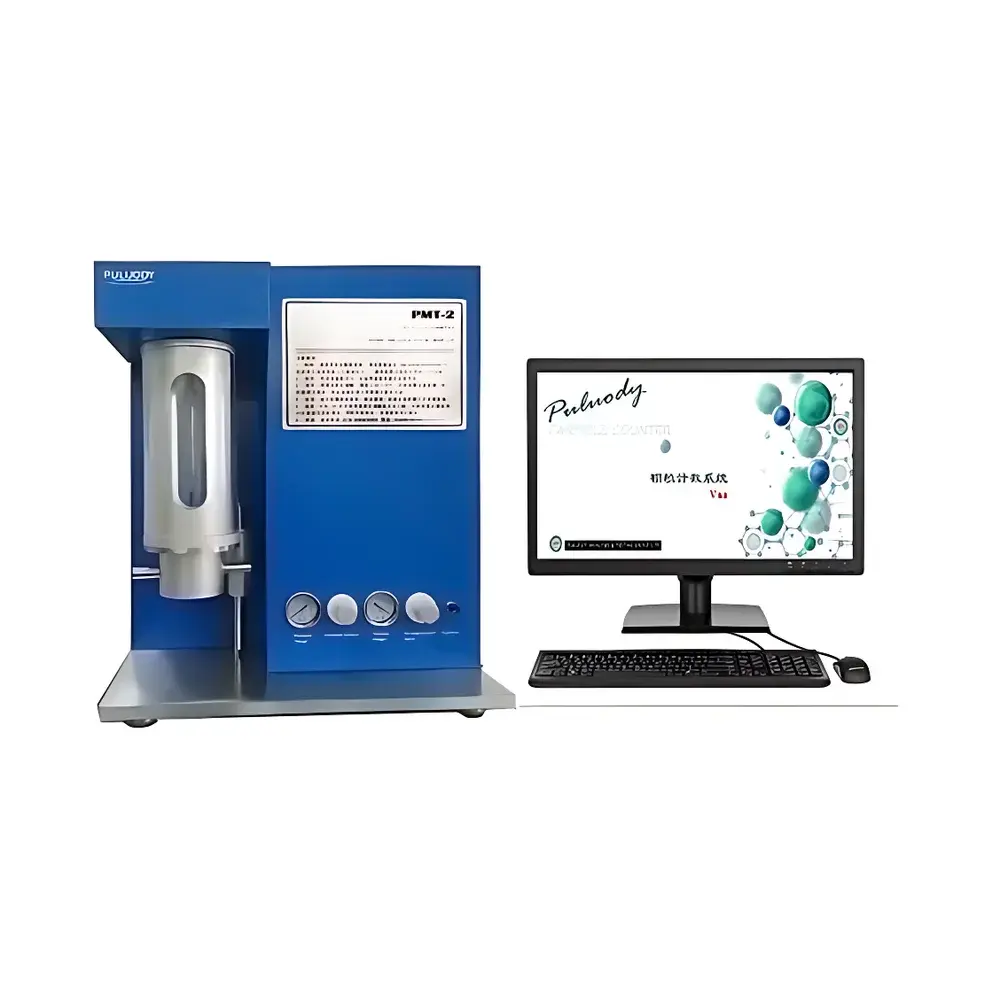
PULUODY PMT-2-J Optical Liquid Particle Counter for Photoresist
| Brand | PULUODY |
|---|---|
| Model | PMT-2-J |
| Type | Optical Particle Counter |
| Detection Principle | Dual-Laser Narrow-Beam Light Scattering |
| Detection Range | 0.065–0.2 µm & 0.1–0.5 µm (customizable to 1–100 µm or 4–70 µm(c)) |
| Accuracy | ±3% typical |
| Sampling Precision | <±1% |
| Coincidence Limit | 10,000 particles/mL (2.5% coincidence error) |
| Calibration Standards | ISO 21501-2, JJG 1061, Latex Spheres |
| Compliance | Chinese Pharmacopoeia 2015/2020, USP <788>, EP, BP, GB 8368 |
| Output Interface | 4–20 mA analog output with configurable alarm trigger |
| Power Input | 100–265 VAC, 50–60 Hz |
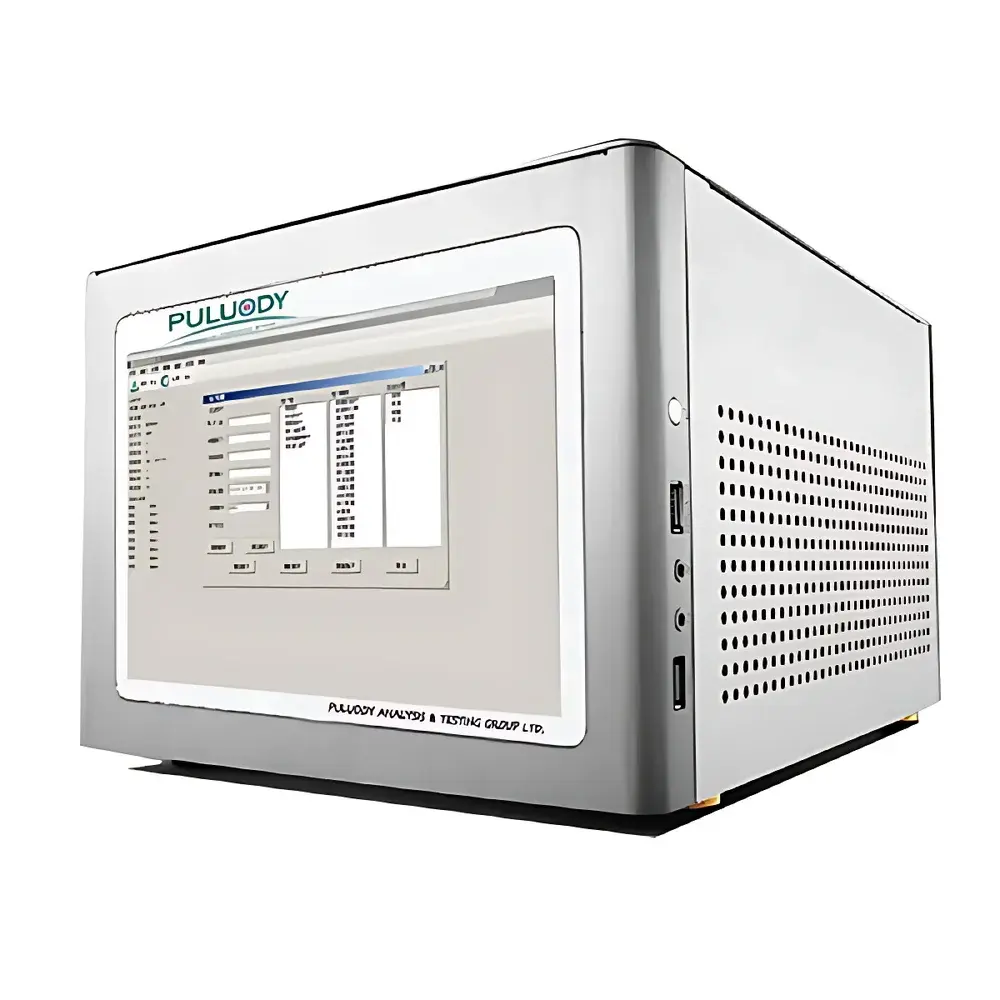
| Software | PULUODY V8.3 Integrated Analysis & Calibration Software (PC + touchscreen GUI) |
| Operation | 7-inch color LCD touchscreen + optional wireless keyboard/mouse |
Overview
The PULUODY PMT-2-J Optical Liquid Particle Counter is a high-sensitivity, dual-laser narrow-beam particle detection system engineered for quantitative analysis of insoluble particulate contamination in ultra-pure and process-critical liquids—particularly photoresists, semiconductor cleaning agents, ultrapure water (UPW), electronic-grade solvents, and polymer solutions. Operating on the principle of light obscuration combined with advanced dual-wavelength laser scattering, the instrument achieves sub-100 nm resolution with minimized optical noise and enhanced signal-to-noise ratio. Its core sensor represents the eighth-generation evolution of PULUODY’s proprietary narrow-beam optical architecture, optimized for low-volume, high-viscosity, and optically challenging media common in photolithography and microelectronics manufacturing. Unlike conventional single-laser counters, the PMT-2-J employs two spatially separated laser sources operating at distinct wavelengths, enabling simultaneous differential scattering response and improved discrimination between refractive index artifacts and true solid particulates.
Key Features
- Dual-laser narrow-beam optical sensor with independent wavelength channels for enhanced particle classification fidelity in complex organic matrices
- Precision metering piston pump coupled with electromagnetic flow control for volumetric accuracy <±1% and repeatable sample delivery under variable backpressure conditions
- Configurable detection thresholds: standard ranges of 0.065–0.2 µm and 0.1–0.5 µm; extended custom modes support user-defined bins from 1–100 µm or 4–70 µm(c)
- Integrated real-time alarm logic with programmable threshold triggers and 4–20 mA analog output for PLC/SCADA integration in cleanroom or fab-line environments
- Modular design supporting both online continuous monitoring (via dedicated flow cell and bypass loop) and offline batch analysis (portable sampling with syringe or bottle interface)
- Full compliance with pharmacopeial and industrial standards including USP , EP 2.9.19, ChP 2020 General Chapter 0903, ISO 21501-2, and GB/T 8368–2018
Sample Compatibility & Compliance
The PMT-2-J is validated for use with non-aqueous, low-conductivity, and high-refractive-index liquids commonly encountered in semiconductor front-end processes—including positive/negative tone photoresists (e.g., DNQ-Novolac, chemically amplified resists), developer solutions, spin-coating solvents (PGMEA, EL, cyclohexanone), and post-etch rinse fluids. Its optical path design mitigates bubble interference and minimizes adsorption-related losses on hydrophobic surfaces. All calibration and verification procedures adhere to GLP-aligned documentation protocols. Instrument qualification includes IQ/OQ documentation packages, and software functionality supports audit trails, electronic signatures, and data integrity controls compliant with FDA 21 CFR Part 11 when deployed in regulated pharmaceutical or medical device manufacturing settings.
Software & Data Management
PULUODY V8.3 software provides fully segregated modules for measurement acquisition and metrological calibration—eliminating cross-contamination of operational parameters during routine testing. The interface supports multi-user role-based access control, customizable report templates (PDF/CSV/XLSX), automatic generation of ISO 4406 and NAS 1638 contamination codes, and trend analysis over time-series datasets. Raw pulse-height histograms are exportable for third-party statistical evaluation. Firmware updates are delivered via secure HTTPS channel with SHA-256 signature verification. Data storage complies with ICH M7 and Annex 11 expectations for traceability and retention.
Applications
The PMT-2-J serves as a critical quality assurance tool across multiple high-precision domains: monitoring particulate load in photoresist dispense lines prior to wafer coating; verifying filter integrity in UPW distribution systems; quantifying residual catalysts or agglomerates in polymer precursor solutions; validating cleanliness of glass substrates used in display fabrication; and assessing microfiltration efficiency in nano-scale purification trains. It is routinely deployed in Class 1–10 cleanrooms for in-process verification of particle shedding from wet benches, track-and-trace of contamination events, and root-cause analysis of yield-limiting defects in 28 nm and below node lithography processes.
FAQ
What liquid types are compatible with the PMT-2-J for photoresist analysis?
The system is validated for organic solvents, resist formulations, developers, and strippers with viscosity up to 50 cP and refractive index between 1.33–1.62.
Does the instrument support automated calibration verification per pharmacopeial requirements?
Yes—V8.3 software includes guided calibration workflows aligned with USP System Suitability Tests and ISO 21501-2 reference material protocols.
Can the PMT-2-J be integrated into a factory automation network?
It features native Modbus TCP and 4–20 mA analog outputs, with optional OPC UA gateway support for MES/ERP connectivity.
Is remote diagnostics and firmware update capability available?
Remote maintenance is supported via encrypted SSH tunnel with session logging; firmware updates require signed package authentication.
How is data integrity ensured during long-term unattended operation?
All measurements are timestamped, digitally signed, and stored with immutable audit trails—including operator ID, environmental logs, and calibration history—per 21 CFR Part 11 Annex 11 guidelines.
Related Products



