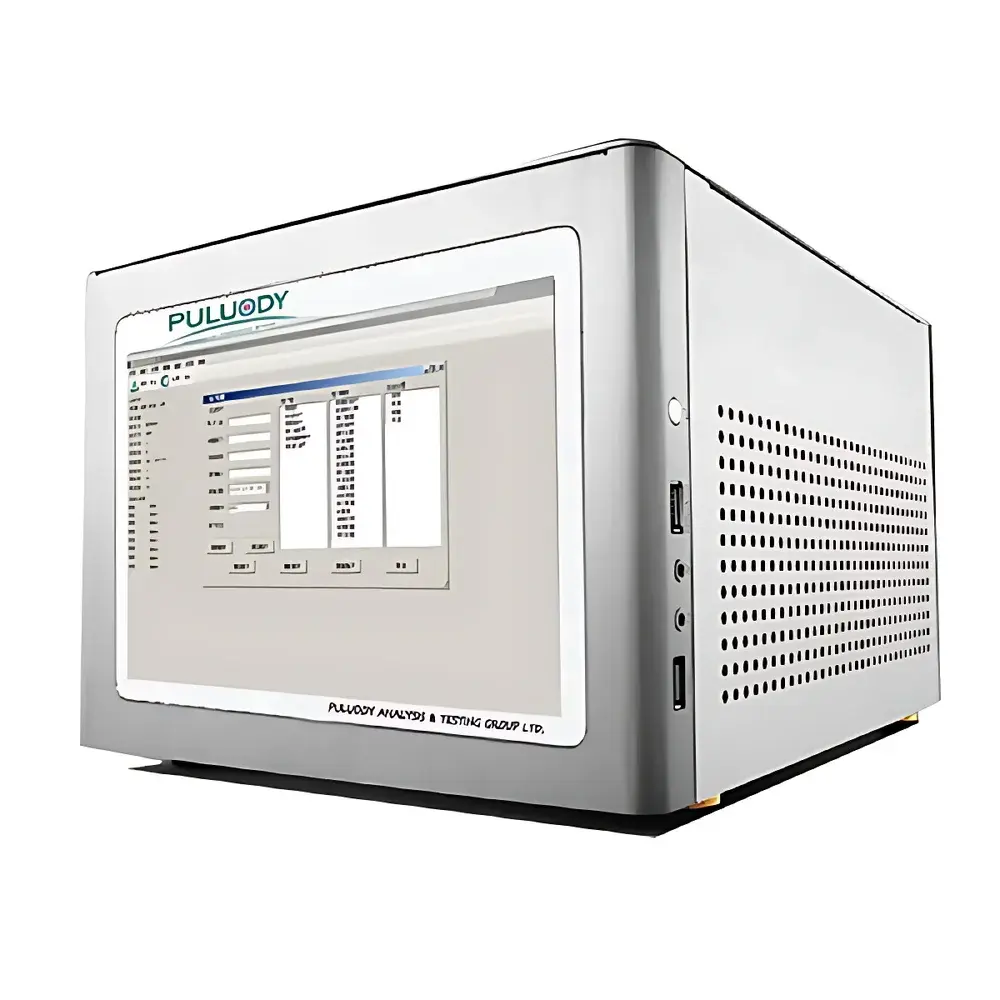
PULUODY PMT-2CCS Ultra-Pure Water Liquid Particle Counter (100 nm Detection Threshold)
| Brand | PULUODY |
|---|---|
| Model | PMT-2CCS |
| Detection Threshold | 100 nm |
| Sensor Technology | 8th-Generation Dual-Laser Narrow-Beam Optical Sensor |
| Measurement Range | 0.1–0.5 µm (with customizable ranges: 1–100 µm or 4–70 µm(c), down to 0.1 µm(c)) |
| Sampling Accuracy | < ±1% |
| Counting Accuracy | < ±3% (typical) |
| Coincidence Limit | 1000 particles/mL (2.5% coincidence error) |
| Flow Control | Precision Piston Pump + Electromagnetic Flow Regulation |
| Calibration Standards | JJG 1061, ISO 21501, Polystyrene Latex (PSL) Spheres |
| Output Interface | 4–20 mA Analog Signal |
| Alarm Function | Configurable Particle Exceedance Alert |
| Power Input | 100–265 VAC, 50–60 Hz |
| Compliance | Designed for ISO 14644-1/2, SEMI F57, ASTM D6978, USP <788> & <789>, and GLP/GMP-aligned data integrity workflows |
Overview
The PULUODY PMT-2CCS Ultra-Pure Water Liquid Particle Counter is an engineered solution for real-time, high-sensitivity particulate contamination monitoring in ultra-pure water (UPW) and process liquids used across semiconductor front-end fabrication, flat-panel display (FPD) manufacturing, and advanced electronics assembly. Operating on the principle of dual-laser light scattering with narrow-beam optical detection, the instrument achieves a verified lower detection limit of 100 nm—enabling quantification of sub-100 nm colloidal silica, metallic wear debris, and polymer agglomerates critical to wafer yield control. Its architecture integrates fluidic precision, optical stability, and regulatory-grade data handling to meet the stringent requirements of Class 1–10 cleanroom environments and continuous UPW loop monitoring per SEMI C35 and ITRS roadmap specifications.
Key Features
- 8th-generation dual-laser narrow-beam optical sensor with optimized signal-to-noise ratio for low-concentration nanoscale particle detection in transparent, low-viscosity liquids.
- Dual-mode flow control system: high-stability precision piston pump (volumetric metering) combined with electromagnetic flow regulation ensures repeatable sample aspiration at rates from 1–50 mL/min, minimizing shear-induced artifact generation.
- Configurable detection thresholds: standard 0.1–0.5 µm range; optional firmware-enabled customization for 1–100 µm or 4–70 µm(c) distributions—including user-defined 0.1 µm(c) counting capability for nucleation-sensitive processes.
- Touchscreen HMI with embedded V8.3 analysis software—separating real-time acquisition logic from calibration and reporting modules to eliminate software-induced measurement interference.
- 4–20 mA analog output with programmable alarm thresholds, supporting integration into SCADA, MES, and PLC-based factory automation systems without middleware dependency.
- Modular design supports both inline installation (NPT 1/4″ or 3/8″ wetted path) and offline benchtop operation via portable sampling manifold, enabling cross-platform validation between UPW loops, CMP slurries, and photoresist delivery lines.
Sample Compatibility & Compliance
The PMT-2CCS is validated for use with ultrapure water (resistivity ≥18.2 MΩ·cm), deionized solvents (e.g., IPA, PGMEA), aqueous cleaning chemistries (SC1, SC2), dilute HF-based etchants, and low-conductivity polymer solutions. All wetted materials comply with SEMI F57 requirements for extractables and leachables. Instrument firmware and data handling protocols support audit-ready operation under FDA 21 CFR Part 11 (electronic signatures, audit trail, role-based access), ISO/IEC 17025 calibration traceability, and GLP/GMP documentation standards. Calibration verification follows ISO 21501-4 using NIST-traceable PSL reference standards; routine verification adheres to JJG 1061 national metrological verification procedures.
Software & Data Management
The V8.3 software suite operates in two isolated execution layers: acquisition firmware (real-time particle event capture and hydrodynamic sizing) and post-processing engine (statistical analysis, ISO 4406/ISO 11171 coding, trend charting). Raw pulse data is stored in vendor-neutral .csv and .tdms formats with embedded timestamps, operator ID, and environmental metadata (temperature, pressure, flow rate). The system logs all user actions—including parameter changes, calibration events, and report exports—in an immutable audit trail compliant with 21 CFR Part 11 Annex 11. iPad-compatible remote monitoring enables secure Wi-Fi or cellular-based access to live histograms, cumulative counts, and alarm status without compromising network segmentation policies.
Applications
- Continuous UPW loop monitoring at point-of-use (POU) and point-of-entry (POE) in 300 mm wafer fabs—detecting transient spikes from filter breakthrough or ion exchange resin degradation.
- In-line verification of nano-filtration membrane integrity during recirculation of CMP slurry reclaim systems.
- Offline qualification of photoresist and developer purity prior to spin-coating—quantifying gelatinous microgels undetectable by single-laser systems.
- Validation of cleaning efficacy on silicon wafers, glass substrates, and MEMS components using particle count delta (ΔPC) metrics per SEMI F32.
- Monitoring organic contaminant aggregation in ultrapure solvent delivery lines for EUV lithography tools.
FAQ
What is the minimum detectable particle size under standard operating conditions?
The instrument achieves a validated lower detection threshold of 100 nm in ultrapure water when configured with optimized laser alignment, background subtraction, and signal gating parameters.
Does the system support automated calibration verification?
Yes—V8.3 includes scheduled auto-verification routines using onboard PSL suspension injection; results are logged with pass/fail flags and deviation metrics against baseline calibration curves.
Can the PMT-2CCS be integrated into a Fab-wide SECS/GEM interface?
While native SECS-II is not embedded, the 4–20 mA output and Modbus TCP option enable seamless integration via third-party gateway devices compliant with SEMI E30/E37 standards.
Is the wetted path compatible with 5% HF solutions?
The standard flow cell uses sapphire windows and PFA/PCTFE seals rated for intermittent exposure to ≤5% HF at ambient temperature; extended exposure requires optional Hastelloy C-276 wetted components.
How is data integrity ensured during power interruption?
All active measurements are buffered in non-volatile memory; upon recovery, the system resumes logging from the last confirmed timestamp without data loss or counter reset.