
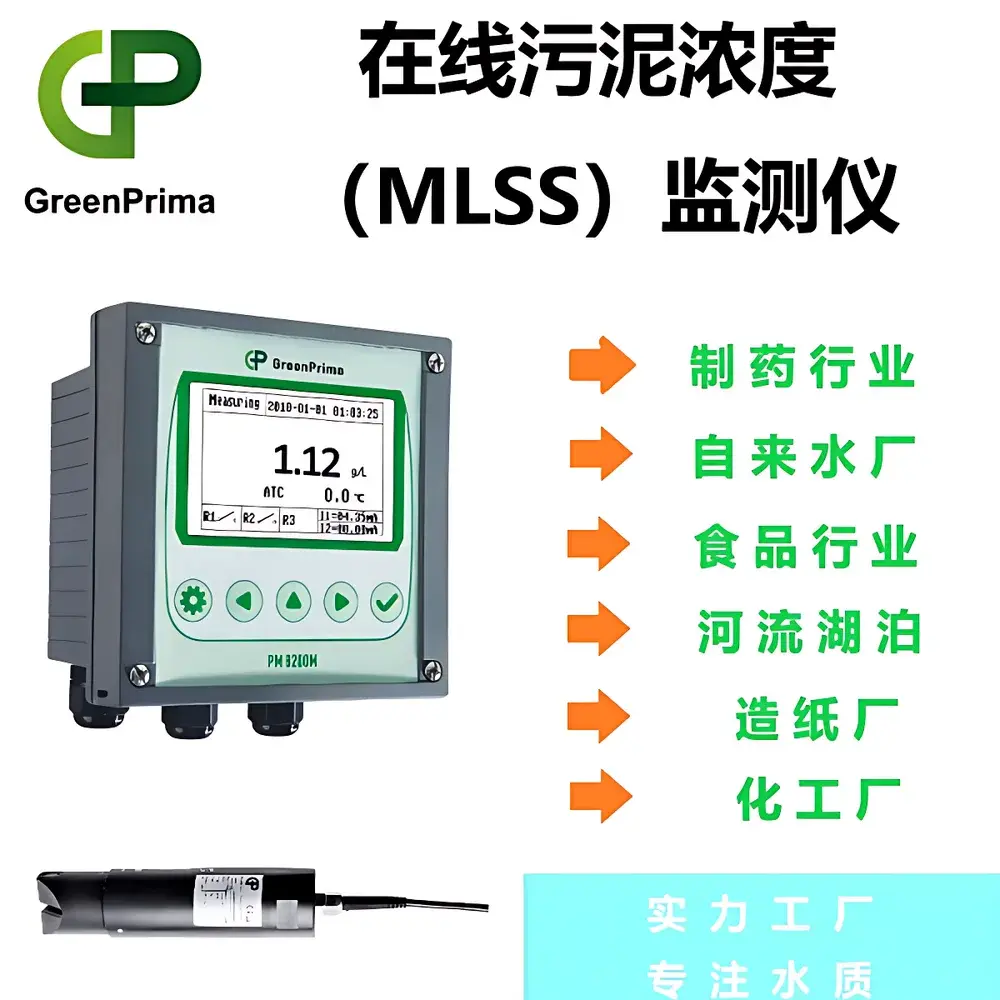
GreenPrima PM8200M Online Sludge Concentration (MLSS) Analyzer
| Brand | GreenPrima |
|---|---|
| Origin | Austria |
| Manufacturer | GreenPrima GmbH |
| Model | PM8200M |
| Type | Online Suspended Solids Analyzer |
| Measurement Principle | 90° Near-Infrared Light Scattering |
| Range | 0–50 g/L |
| Resolution | 0.01 g/L |
| Temperature Compensation | -10–130 °C (NTC10K/PT1000) |
| Display | Backlit Graphic LCD (Bilingual: EN/CH) |
| Outputs | Dual Isolated 4–20 mA (0.1% FS), RS485 Modbus RTU (HART optional) |
| Cleaning Output | Adjustable Interval (0.1–1000 h) & Duration (1–1000 s) |
| Alarm | 2 Independent Hi/Lo Relays (5 A / 250 VAC) |
| Enclosure Rating | IP65 (Controller), IP68 (Bsens550 Sensor) |
| Power | 90–260 VAC, 50/60 Hz or 24 VDC |
| Dimensions (W×H×D) | 144 × 144 × 106 mm |
| Weight | 0.86 kg |
| Sensor Material | Delrin® |
| Max Pressure | 5 bar |
| Response Time | <30 s |
| Cable Length | 7 m (standard) |
Overview
The GreenPrima PM8200M Online Sludge Concentration Analyzer is an industrial-grade, continuous-monitoring instrument engineered for precise and stable measurement of mixed liquor suspended solids (MLSS) and total suspended solids (TSS) in municipal wastewater treatment plants, industrial effluent streams, and activated sludge bioreactors. It operates on the principle of 90° near-infrared (NIR) light scattering — a robust optical method that minimizes interference from sample coloration, dye leaching, or dissolved organic matter commonly encountered in real-world wastewater matrices. Unlike turbidity-based systems calibrated in NTU, the PM8200M delivers direct mass-concentration output in grams per liter (g/L), traceable to gravimetric reference methods. Its integrated Bsens550 submersible sensor features a Delrin® optical housing rated IP68 and withstands pressures up to 5 bar, enabling reliable deployment in aeration tanks, secondary clarifiers, return sludge lines, and digester feed streams without drift or fouling-induced signal degradation.
Key Features
- True MLSS quantification via 90° NIR scattering — immune to chromatic interference and optimized for high-solids, variable-color wastewater
- Dual-channel isolated 4–20 mA analog outputs with full-scale accuracy of ±0.1% — configurable for simultaneous transmission of concentration and temperature values
- Bilingual (English/Chinese) menu-driven interface on backlit graphic LCD — supports intuitive local configuration without external software
- Programmable automatic cleaning output — interval (0.1–1000 hours) and duration (1–1000 seconds) fully adjustable to match site-specific fouling dynamics
- Temperature compensation using NTC10K or PT1000 sensors — auto- or manual-mode selection ensures stability across thermal gradients from -10 °C to 130 °C
- Robust IP65 wall-mount/pipeline-mount controller enclosure — designed for long-term operation in humid, chemically aggressive environments
- Compliant with IEC 61000-6-2 (EMC immunity) and IEC 61000-6-4 (EMC emission) standards — validated for industrial plant floor deployment
Sample Compatibility & Compliance
The PM8200M is validated for continuous monitoring of activated sludge, anaerobic digestate, primary clarifier effluent, and membrane bioreactor (MBR) mixed liquor. It maintains linearity and repeatability across heterogeneous suspensions containing organic flocs, inorganic grit, filamentous bacteria, and grease-laden particles — provided particle size distribution remains within the effective detection range of NIR scattering (typically >1 µm). The system meets requirements for routine process control under ISO 5667-16 (water quality — sampling — guidance on biomass sampling) and supports regulatory reporting aligned with EU Urban Wastewater Treatment Directive (91/271/EEC) and US EPA Method 160.1 (total suspended solids). While not certified for safety-critical SIL applications, its architecture supports integration into PLC-based SCADA systems compliant with IEC 62443-3-3 for industrial cybersecurity.
Software & Data Management
The PM8200M does not require proprietary PC software for basic operation; all calibration, alarm thresholds, and output scaling are performed locally via the front-panel interface. For centralized data acquisition, it supports standard Modbus RTU over RS485 — enabling seamless integration with DCS, PLC, or cloud-based IIoT platforms (e.g., Siemens Desigo, Rockwell FactoryTalk, or Azure IoT Edge). Optional HART communication allows for advanced diagnostics and remote parameter adjustment when deployed with compatible handheld communicators or asset management systems. Audit trails for calibration events and configuration changes are retained in non-volatile memory, supporting GLP-aligned recordkeeping. Data logging capability is available via external Modbus-enabled data loggers — no internal storage or timestamped event history is embedded in the controller.
Applications
- Real-time optimization of sludge retention time (SRT) and wasting rates in conventional activated sludge (CAS) and sequencing batch reactors (SBR)
- Feedback control of return activated sludge (RAS) pump speed based on MLSS concentration in secondary clarifier underflow
- Monitoring solids inventory in membrane bioreactors (MBR) to prevent irreversible membrane fouling
- Performance verification of dissolved air flotation (DAF) and lamella clarifiers in industrial pretreatment systems
- Process troubleshooting during shock loads, nitrification failures, or filamentous bulking events — supported by rapid <30 s response time
- Regulatory compliance reporting for discharge permits requiring TSS/MLSS trending over 24-hour rolling averages
FAQ
What is the difference between MLSS and TSS measurement with this analyzer?
The PM8200M reports total suspended solids concentration in g/L, which correlates directly with MLSS in biological treatment units. While it does not distinguish volatile vs. fixed solids, its NIR scattering response has been empirically calibrated against standard gravimetric MLSS procedures (APHA 2540D) for activated sludge samples.
Can the sensor be installed in pressurized pipelines?
Yes — the Bsens550 sensor is rated for continuous operation at up to 5 bar static pressure and may be mounted in-line with appropriate flanged or threaded adapters (DN50–DN100). Flow velocity should remain below 3 m/s to avoid cavitation-induced signal noise.
Is third-party calibration certification available?
GreenPrima provides factory calibration certificates traceable to national metrology institutes. On-site recalibration using NIST-traceable slurry standards (e.g., polystyrene latex suspensions or ground silica slurries) is supported via password-protected calibration mode (code: 1100).
Does the system comply with FDA 21 CFR Part 11?
No — the PM8200M is not designed for pharmaceutical manufacturing environments requiring electronic record/electronic signature (ER/ES) functionality. It lacks user role-based access control, audit trail export, and digital signature capabilities required under Part 11.
How often does the sensor require maintenance in high-fouling applications?
With enabled automatic cleaning (recommended interval: 2–8 hours depending on sludge viscosity), routine manual inspection is typically required only every 3–6 months. Optical surface integrity can be verified using the built-in diagnostic LED intensity check function.







