
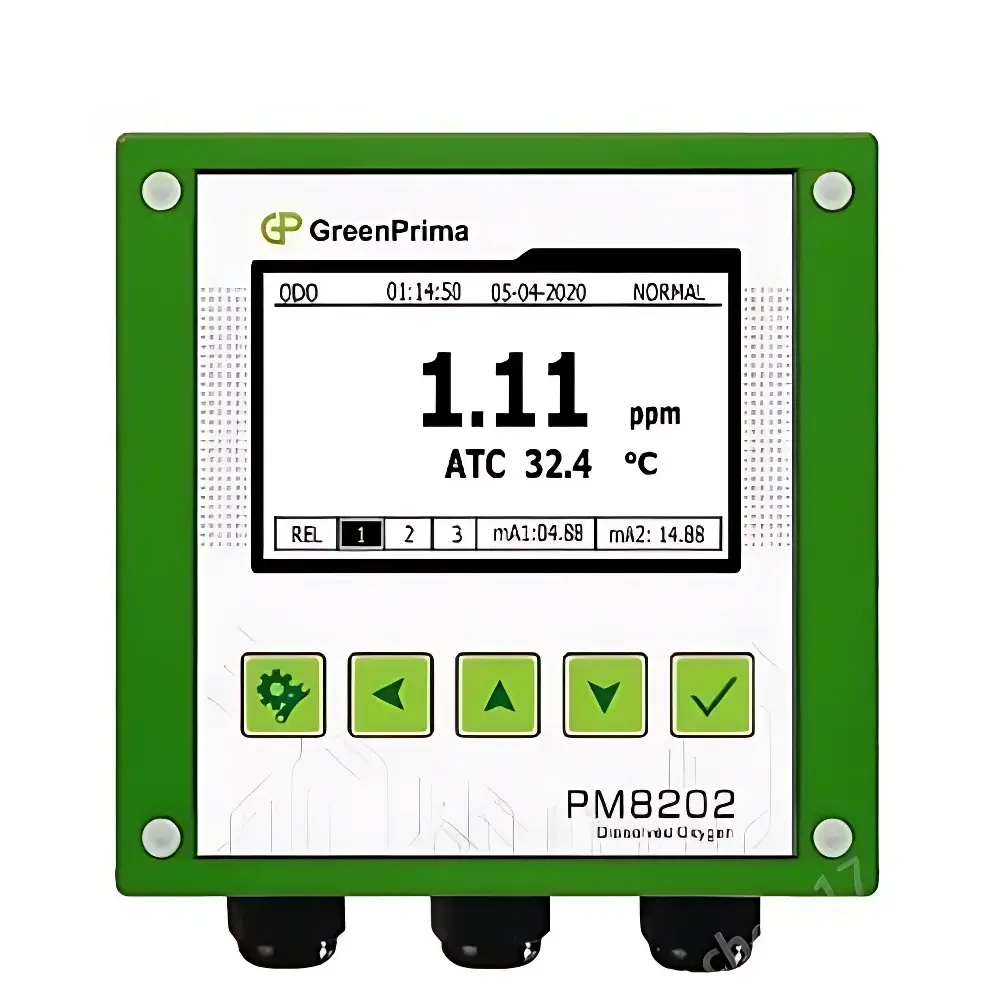
GreenPrima PM 8202D Polarographic Dissolved Oxygen Analyzer
| Brand | GreenPrima |
|---|---|
| Origin | United Kingdom |
| Manufacturer Type | Original Equipment Manufacturer (OEM) |
| Product Category | Imported Instrument |
| Model | PM 8202D |
| Instrument Type | Online Analyzer |
| Measurement Principle | Polarographic Electrochemical Sensor (Clark-type) |
| Measurement Range | 0.00–20.00 ppm / 0.00–200.00 ppb |
| Accuracy | ±0.02 ppm / ±0.02 ppb |
| Detection Limit | 0.001 ppm / 0.01 ppb |
| Resolution | 0.001 ppm / 0.01 ppb |
| Temperature Compensation | -10 to 130 °C (manual or automatic, NTC10K/PT1000 compatible) |
| Operating Temperature | -10 to 70.0 °C |
| Storage Temperature | -20 to 70.0 °C |
| Display | Backlit large-dot-matrix LCD (Chinese/English interface) |
| Data Storage | 600,000 records |
| Power Supply | 90–260 VAC, 50/60 Hz or optional 24 VDC |
| Analog Outputs | Two isolated 4–20 mA outputs (max. loop resistance 500 Ω, accuracy 0.1 % FS, configurable for DO or temperature) |
| Digital Communication | RS485 Modbus RTU |
| Cleaning Control Output | Adjustable interval (0.1–1000 h) and duration (1–1000 s) |
| Alarm Outputs | Two independent Hi/Lo relay alarms (5 A / 250 VAC / 30 VDC, with hysteresis setting) |
| Enclosure Rating | IP65 |
| Mounting Options | Wall-mount, panel-mount, pipe-mount |
| Dimensions (W×H×D) | 144 × 144 × 108 mm |
| Cutout Size | 138 × 138 mm |
| Weight | 0.87 kg |
Overview
The GreenPrima PM 8202D Polarographic Dissolved Oxygen Analyzer is an online process instrument engineered for continuous, high-stability measurement of dissolved oxygen (DO) in aqueous media using the classical Clark-type polarographic principle. It operates via a three-electrode electrochemical cell housed within a gas-permeable membrane—typically Teflon or polyethylene—which selectively allows molecular oxygen to diffuse into an electrolyte-filled chamber. An applied cathodic potential (-0.6 to -0.8 V vs. Ag/AgCl reference) reduces diffused O₂ at the gold or platinum working electrode, generating a current linearly proportional to the partial pressure of oxygen. This current is converted to concentration units (ppm or ppb) using temperature-compensated calibration algorithms. Designed for unattended operation in demanding industrial and environmental applications, the PM 8202D integrates robust signal conditioning, dual analog outputs, and Modbus-enabled data integration—making it suitable for real-time process control loops and regulatory-compliant monitoring systems.
Key Features
- IP65-rated sealed enclosure with corrosion-resistant housing, certified for deployment in humid, dusty, or splash-prone environments including wastewater treatment plants and pharmaceutical clean utility areas.
- Large backlit dot-matrix LCD display showing real-time DO concentration, temperature, system status, relay activation states, and timestamped operational events—supporting both English and Chinese language interfaces.
- Modular sensor compatibility: supports interchangeable polarographic electrodes (e.g., Bsens420, Bsens430, Bsens440), each optimized for specific flow regimes, fouling resistance, or sterilization requirements.
- Dual isolated 4–20 mA outputs configurable independently for DO value and temperature—traceable to NIST standards with full-scale accuracy of ±0.1 %, supporting integration into DCS, SCADA, or PLC architectures.
- Configurable cleaning cycle management via dedicated output—enabling automated periodic membrane surface maintenance to mitigate biofilm accumulation and ensure long-term measurement stability.
- Password-protected configuration menu prevents unauthorized parameter modification, aligning with GLP/GMP documentation integrity requirements and facilitating audit-ready operational logs.
- Flexible mounting options—including wall, panel, and pipe flange configurations—accommodate diverse installation constraints across municipal water infrastructure, bioreactor skids, and cooling tower networks.
Sample Compatibility & Compliance
The PM 8202D is validated for use in low-conductivity and high-turbidity aqueous streams, including raw sewage influent, potable water distribution networks, aquaculture recirculation systems, and purified water (PW) and water-for-injection (WFI) loops per USP . Its polarographic design exhibits minimal interference from common ions (e.g., Cl⁻, NO₃⁻, SO₄²⁻) and is insensitive to redox-active species such as Fe²⁺/Fe³⁺ when operated under standard polarization voltage. The analyzer complies with IEC 61000-6-2 (immunity) and IEC 61000-6-4 (emissions), and its analog outputs meet EN 61326-1 for industrial electromagnetic compatibility. While not intrinsically safe, optional hazardous-area certifications (e.g., ATEX/IECEx) are available upon request for classified zones.
Software & Data Management
Internal non-volatile memory stores up to 600,000 timestamped measurement records (DO, temperature, alarm flags, calibration events), retained through power loss. Data export is supported via Modbus RTU over RS485, enabling direct ingestion into historian platforms (e.g., Siemens Desigo CC, Honeywell Experion PKS) or custom SQL-based dashboards. Firmware updates are performed via USB or serial interface using GreenPrima’s proprietary configuration utility, which enforces version-controlled parameter templates and maintains full audit trails—including user ID, timestamp, and pre-/post-change values—for FDA 21 CFR Part 11 compliance where electronic records are subject to regulatory review.
Applications
- Municipal and industrial wastewater treatment: monitoring aeration basin DO setpoints to optimize energy consumption and nitrification efficiency.
- Drinking water distribution: detecting hypoxic conditions in storage reservoirs and booster stations to prevent microbial regrowth.
- Pharmaceutical manufacturing: continuous verification of DO levels in bioreactors, clean steam condensate return lines, and purified water storage tanks.
- Aquaculture and hydroponics: maintaining species-specific oxygen thresholds in recirculating aquaculture systems (RAS) and nutrient film technique (NFT) channels.
- Power generation: safeguarding condensate polishing systems against oxygen pitting corrosion in boiler feedwater circuits.
- Fermentation and fine chemical synthesis: ensuring stoichiometric oxygen supply during aerobic microbial cultivation and catalytic oxidation reactions.
FAQ
What maintenance intervals are recommended for the polarographic sensor?
Electrolyte replenishment and membrane replacement should be performed every 3–6 months depending on sample fouling propensity; more frequent servicing is advised for high-solids or biofouling-prone applications.
Does the PM 8202D support automatic temperature compensation?
Yes—it accepts input from either NTC10K or PT1000 temperature sensors and applies polynomial-based compensation across the full -10 to 130 °C range, ensuring accurate DO readings regardless of thermal drift.
Can the device be integrated into existing SCADA systems?
Absolutely—the RS485 Modbus RTU interface provides native interoperability with major industrial automation platforms, including Rockwell Automation, Schneider Electric EcoStruxure, and Siemens SIMATIC S7 series controllers.
Is calibration traceable to national standards?
Field calibration uses zero-oxygen (sodium sulfite) and saturated-air standards; GreenPrima provides optional factory calibration certificates traceable to UKAS-accredited reference methods per ISO 5814 and ASTM D888.
How does the cleaning output function interface with external solenoid valves or air jets?
The dry-contact cleaning output delivers programmable TTL-level pulses (1–1000 s duration, repeatable every 0.1–1000 h), directly compatible with 24 VDC solenoid actuators or pneumatic control modules used in automated sensor maintenance systems.
Related Products







