
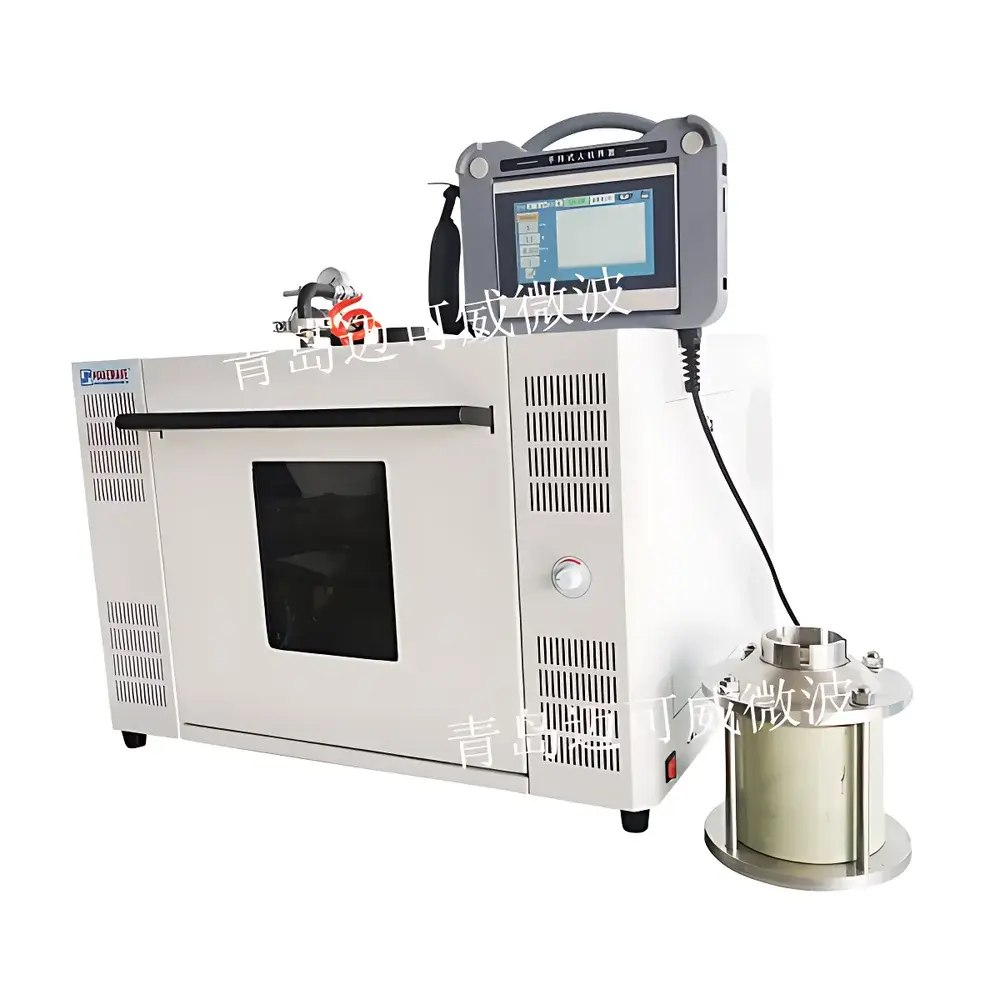
MAKEWAVE MKX-X1G1A-1L High-Capacity Microwave Digestion System for Radionuclide Sample Preparation
| Brand | MAKEWAVE |
|---|---|
| Model | MKX-X1G1A-1L |
| Chamber Volume | 20 L |
| Digestion Vessel Capacity | 1 L |
| Microwave Power | 0–800 W (PID-controlled, continuous non-pulsed) |
| Frequency | 2450 MHz |
| Temperature Range | 0–260 °C (fiber-optic sensing) |
| Pressure Range | 0–3 MPa (capillary pressure transducer) |
| Vessel Material | Inner TFM |
| Safety Features | Dual-metal flange + screw-lock sealing, burst-disk pressure relief, <5 mW/cm² microwave leakage |
| Compliance | Meets GB 4706.21 & GB 10436 national safety standards for microwave equipment |
| Control System | PLC-based touchscreen interface with real-time T/P/Pwr/time curve logging and USB data export |
Overview
The MAKEWAVE MKX-X1G1A-1L is a high-capacity, purpose-engineered microwave digestion system designed specifically for radiochemical laboratories requiring robust, reproducible, and compliant sample preparation of large-mass inorganic matrices. Unlike conventional benchtop microwave digesters limited to ≤100 mL vessels, this system integrates a 1 L pressurized digestion cavity within a 20 L industrial-grade stainless-steel chamber—enabling full-volume dissolution of heterogeneous environmental samples such as soils, sediments, geological cores, and biological tissues without pre-aliquoting or dilution. Its operational principle relies on controlled dielectric heating via 2450 MHz continuous-wave microwaves, coupled with closed-vessel pressurization to elevate solvent boiling points and accelerate oxidative decomposition of refractory silicates, metal oxides, and organic-bound radionuclides (e.g., 238U, 232Th, 137Cs, 90Sr). The system adheres to the fundamental requirements of ISO 17294-2 (water quality — determination of elements by ICP-MS), ASTM D5688 (microwave-assisted acid digestion of soils), and EPA Method 3052 for trace metal analysis—making it suitable for accredited environmental testing labs operating under ISO/IEC 17025 quality management systems.
Key Features
- Industrial-grade 20 L cavity constructed from fully welded 304 stainless steel with multi-layer PFA (perfluoroalkoxy) coating—resistant to HNO3, HF, HCl, and aqua regia up to 260 °C
- 1 L high-pressure digestion vessel featuring dual-wall architecture: inner TFM (modified PTFE) liner for chemical inertness and outer PEEK+GF (polyether ether ketone + glass fiber) jacket for mechanical integrity at ≥3 MPa
- Non-contact magnetic stirring integrated at vessel base—ensuring homogeneous thermal distribution and preventing localized hot spots during extended digestion cycles
- Fiber-optic temperature monitoring (0–260 °C) and capillary-based pressure transduction (0–3 MPa) provide independent, drift-free feedback for closed-loop PID control
- Continuous, non-pulsed microwave output (0–800 W) with automatic frequency tuning—minimizing standing wave effects and enabling precise energy delivery across variable load conditions
- Dual-safety locking mechanism: precision-machined dual-metal flange with torque-calibrated screw drive, plus redundant burst-disk pressure relief calibrated to 3.2 MPa
- Real-time graphical display of temperature, pressure, power, and time profiles via 7-inch color touchscreen; all parameters logged with timestamp and exportable via USB in CSV format
Sample Compatibility & Compliance
The MKX-X1G1A-1L accommodates solid-to-liquid ratios up to 1:50 (e.g., 100 g soil + 500 mL HNO3/HF/H2O2), supporting complete mineralization of silica-rich matrices and organic-rich biomass without charring or volatile loss. It complies with GLP documentation requirements through audit-trail-enabled data logging—including operator ID, method name, start/stop timestamps, and deviation alerts. Microwave radiation emission remains below 5 mW/cm² at 5 cm distance (per GB 10436 and IEC 61000-3-2), and electrical safety conforms to GB 4706.21 (microwave oven safety standard). Optional integration with fume extraction ducting satisfies OSHA 1910.1200 (Hazard Communication) and local laboratory ventilation codes.
Software & Data Management
The embedded PLC controller supports up to 20 programmable digestion methods, each configurable with up to 5 ramp-hold segments. All operational parameters—including setpoints, actual readings, alarms, and system status—are stored with millisecond resolution. Data export is compatible with LIMS environments via standardized CSV files containing column headers aligned with ASTM E1447 metadata conventions. No proprietary software installation is required; exported logs are directly importable into Excel, OriginLab, or laboratory informatics platforms. Audit trails include electronic signatures (where enabled via external authentication), session lockout after 5 minutes of inactivity, and write-protected storage preventing post-run modification.
Applications
- Environmental monitoring: Total digestion of >50 g sediment cores for ICP-MS quantification of U, Th, Ra isotopes and heavy metals (As, Cd, Pb, Hg)
- Nuclear forensics: Reproducible leaching of uranium-bearing minerals (e.g., uraninite, pitchblende) under simulated geological conditions
- Geochemical research: High-yield recovery of rare earth elements (REEs) from granitic rock powders using mixed-acid protocols
- Bioaccumulation studies: Complete solubilization of whole fish tissue or plant biomass (1–10 g) for radiocesium (137Cs) and strontium-90 (90Sr) analysis
- Regulatory compliance testing: EPA SW-846 Method 3052 validation for TCLP-extractable metals in hazardous waste characterization
FAQ
What sample types are validated for use with the 1 L vessel?
Soils, sediments, sludges, geological samples (rocks, ores), and biological tissues—provided total solid mass does not exceed 100 g and acid volume remains within ASME B31.3-compliant fill limits (≤75% vessel capacity).
Is HF digestion supported?
Yes—the TFM liner and PEEK+GF outer vessel are chemically resistant to hydrofluoric acid concentrations up to 40% v/v at temperatures ≤220 °C.
How is method transfer ensured between instruments?
By maintaining identical power ramp profiles, pressure thresholds, and hold times—and verifying performance using NIST SRM 2710a (Montana Soil) reference material digested in triplicate.
Can the system be integrated into an automated sample prep line?
Not natively; it operates as a standalone workstation. However, digital I/O ports support external PLC handshake signals for start/stop coordination in semi-automated workflows.
What maintenance intervals are recommended?
Fiber-optic probe calibration annually; PFA chamber coating inspection every 500 cycles; burst-disk replacement after any pressure event exceeding 2.8 MPa or per 2-year shelf life.



